
Traditional IRA or Roth IRA – Which one should you contribute to?
Everyone has an opinion but nobody has a definitive answer.
Until now.
This article shows that there is a clear winner for people who plan to retire early.
And if you choose the right option, you could accumulate an extra $100,000 over the course of your lifetime!
Types of Retirement Accounts
Before I get into the specifics, let me first recap the two major types of retirement accounts.
Tax-Free-Contribution Accounts
Tax-Free-Contribution accounts are the most-common type and have the following characteristics:
- Funded with pre-tax (i.e. untaxed) dollars
- Grow tax free
- Taxed at withdrawal
Here’s a simple illustration showing when your money gets taxed:

Traditional IRAs, 401(k)s, and 403(b)s are all examples of this type of retirement account.
Tax-Free-Withdrawal Accounts
Tax-Free-Withdrawal accounts, on the other hand, are:
- Funded with after-tax dollars
- Grow tax free
- Allow tax-free withdrawals

Roth IRAs and Roth 401(k)s are examples of this type of retirement account.
Taxable Accounts
Both options are good because they provide some tax benefits that allow your investments to grow faster than they would if simply invested in a normal taxable account.
Here’s what a taxable account looks like:

Not only is your money taxed before it enters the taxable account, your investment growth is also taxed along the way.
Choosing Between a Roth IRA and a Traditional IRA
When choosing between a Traditional IRA and a Roth IRA, you are effectively choosing when you want to pay tax on your money.
If you decide to go with a Traditional IRA, you pay tax when you withdraw the money and if you go with a Roth IRA, you pay the tax up front.
Roth IRA Conversion Ladder
Today, I’m going to show you how to get the best of both worlds – tax-free contributions, tax-free growth, AND tax-free withdrawals!

Here’s the strategy:
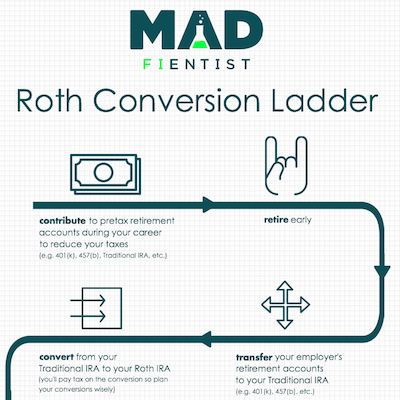
Step 1: Contribute to a Traditional IRA During Your Working Years
While you are working, your tax rate will likely be higher than it will be after FI so shield as much of your income from the taxman as possible by contributing to a Traditional IRA.
Step 2: Slowly Convert Traditional IRA to Roth IRA
Once you begin your early retirement, you’ll have less taxable income than you did when you were working, so use this period to convert your Traditional IRA to a Roth IRA.
You didn’t pay tax on the money when you contributed to your Traditional IRA so you have to pay tax when you convert to a Roth. Your income will be lower after you retire though so you’ll likely pay very little tax on the conversion. In fact, if you convert an amount equal to your deductions, exemptions, and credits every year (and assuming you have no other ordinary income), you could execute these conversions without paying any tax at all!
Step 3: Enjoy Your Completely Tax Free Retirement Money
After converting your entire Traditional IRA to a Roth IRA during your early retirement, you can withdraw that money from the Roth tax free!
Note: To avoid paying a 10% early-withdrawal penalty, you have to wait five years after the conversion (or until you turn 59.5, if that’s sooner) to withdraw the converted funds from the Roth.
How is This Possible?
This strategy is referred to as a Roth IRA Conversion Ladder and you may be wondering why everyone doesn’t do this.
Well, there are a few reasons this strategy only makes sense for early retirees…
Low Income and Living Costs
Most early retirees live on a modest amount of income from tax-efficient sources like long-term capital gains and dividends (which are taxed at 0% when you’re in the 15% tax bracket or below). This means they can use their tax-free space (i.e. deductions and exemptions) for things like Roth conversions.
Long Conversion Timeframe
Conversions from a Traditional IRA to a Roth IRA are taxed as ordinary income so it’s beneficial to spread the conversion over a large timeframe. That way, you don’t increase your taxable income too much in any given year.
Since most people work full time until they reach retirement age, they never have periods of lower income to do these conversions cheaply. Any amount converted while working would increase the amount of tax they have to pay at their marginal tax rate and wouldn’t be worthwhile.
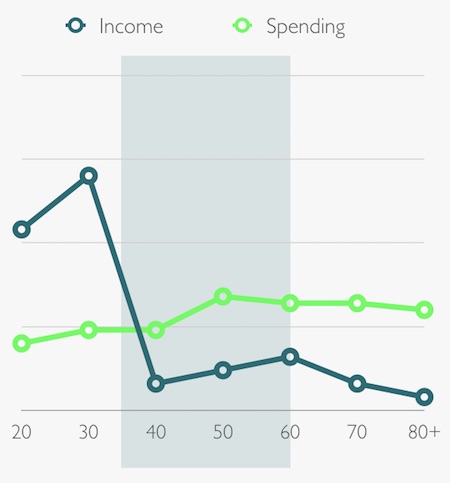
Here’s a typical income/spending graph for someone on the standard retirement track:
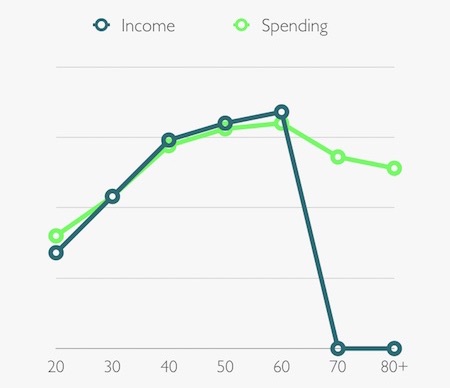
As you can see, income is high (and growing) from age 20 to age 60 so there aren’t any good opportunities to do the conversion.
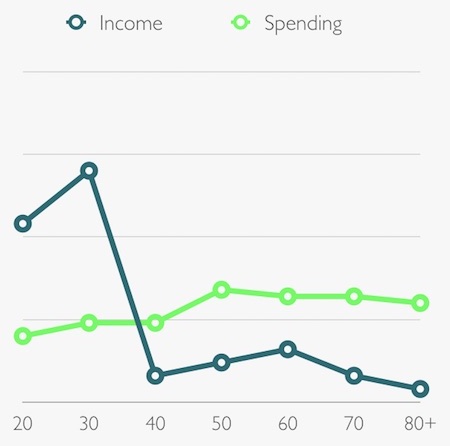
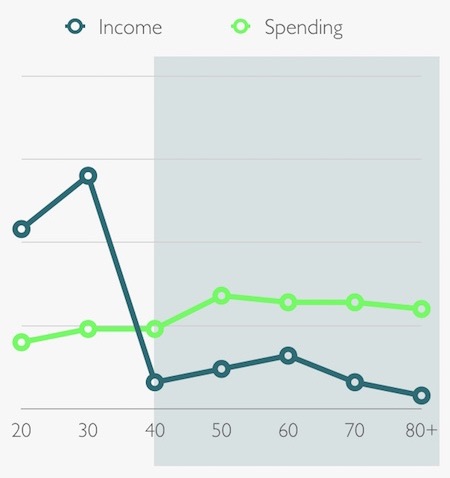
Early retirees, however, can use their low-income years during early retirement to gradually perform the conversion, tax free.
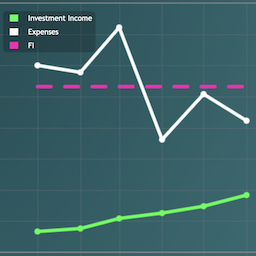
Here’s a typical income/spending graph for an early retiree:
Let’s see how this entire strategy could play out…
To save on taxes during your working career (i.e. when your income is high), you contribute to a Traditional IRA:
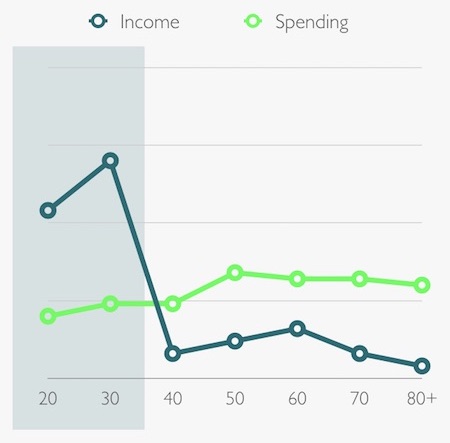
When your income drops during early retirement, you start rolling over that money to a Roth IRA:
Five years after you begin the conversions, you begin withdrawing money from your Roth, penalty free:
The Power of this Strategy
A simple example will highlight how much money this strategy could save you over the long run.
Imagine two 30-year-olds who hope to retire by the age of 40.
To make things simple, assume they each start with nothing, make $60,000 a year, and can happily live off of $18,000 per year.
Investor A decides to max out his Roth IRA between now and when he retires at 40.
Investor B instead decides to max out his Traditional IRA and then slowly convert it to a Roth IRA after he turns 40.
Both invest all leftover money into taxable accounts.
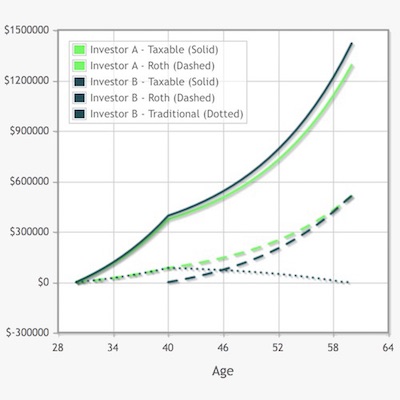
The following graph shows the value of the accounts of these two investors:
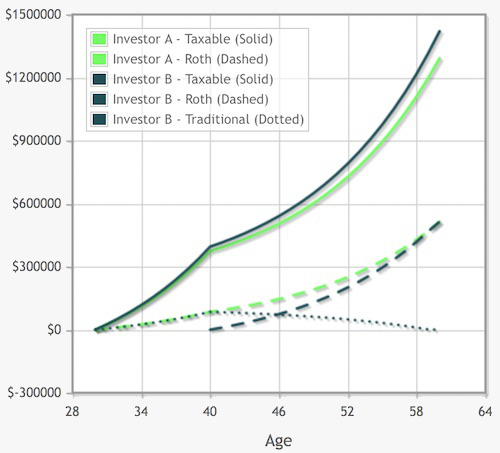
Investor A is represented by the light green lines and Investor B is represented by the dark green lines.
The solid lines are the investors’ normal taxable accounts, the dashed lines are the investors’ Roth IRA accounts, and the dotted line is Investor B’s Traditional IRA account.
At age 40, both investors stop contributing to their accounts and begin withdrawing $18,000 per year from the taxable accounts. Investor B also begins converting his Traditional IRA into a Roth IRA at this time.
Since Investor B converts less than his standard deductions and exemptions each year, he avoids paying taxes on the conversion and ends up having exactly the same amount of money in his Roth IRA as Investor A does when they reach standard retirement age.
What you’ll notice though is that Investor B actually has quite a bit more in his taxable account. Contributing to a Traditional IRA reduced his taxes when he was working so he had more money to invest in the taxable account during his 30s. As a result, he ends up with over $100,000 more than Investor A when he reaches retirement age!
It’s pretty incredible that a simple choice between two good options can result in a six-figure difference in retirement savings!
Why Stop There?
In this article, I’ve shown how a Traditional IRA can become a completely tax-free retirement vehicle when combined with a Roth IRA.
In the Ultimate Retirement Account article, I described how an HSA can also be used as a completely tax-free retirement account.
What about the other major retirement accounts like the 401(k) and 403(b)?
Yes, they too can potentially become completely tax free!
Tax-Free 401(k)
Since you can easily convert your 401(k)/403(b) to a Traditional IRA after you separate from your employer, it is just one extra step to get your 401(k)/403(b) money into a Roth IRA using the tax-free method described above.
What if You Earn Too Little or Too Much?
The upfront tax deductions provided by traditional retirement accounts are the reason this strategy is so beneficial.
If your income is low enough that you don’t have to pay taxes anyway, additional tax deductions aren’t going to help you so you should just put your money into a Roth. That way, you can withdraw it later, tax free (when you could be in a higher tax bracket).
Conversely, if you earn too much to get the Traditional IRA tax deductions, you’d also be better off contributing to a Roth, a Mega Backdoor Roth, or simply a taxable account.
Here are the 2018 income limits for obtaining Traditional IRA tax deductions:
- IRA deductions for people covered by a retirement plan at work (e.g. 401(k), 403(b), etc.)
- IRA deductions for people NOT covered by a workplace retirement plan
Accessing Retirement Accounts Early
Many future early retirees worry about putting too much money into retirement accounts because they don’t want their money locked up until standard retirement age.
As this article has shown, the Roth IRA Conversion Ladder is a great way to access that money early but here are even more ways to access retirement account funds before standard retirement age.
Traditional vs Roth IRA
So there you have it.
Finally a definitive answer to the Roth IRA vs Traditional IRA debate.
For future early retirees, the clear winner is the Traditional IRA.
What do you think? Will this strategy work for you? Do you expect your income after FI to be low enough to allow for completely tax free conversions?
This post was originally published on February 12, 2013 but was updated on March 21, 2017
Great article, MF…
Clear, concise and a cool strategy. I liked it so well, I linked to it on my own post on the subject.
OH, and neat picture of the fighting foxes.
Thanks, Jim! The post that you referenced (http://jlcollinsnh.wordpress.com/2012/05/30/stocks-part-viii-the-401k-403b-ira-roth-buckets/) is actually one of my favorites of yours because it not only describes the various types of retirement accounts but it also discusses which investments should go into each type (or “bucket”, as you say) to maximize tax efficiency.
Ha, I’m glad you like the foxes image. It’s hard to find an image to represent a battle between two types of retirement accounts!
Hi MF, I have a 401(k) at a previous employer. I am now at a new employer that also offers a 401(k). Is it better to move the old 401(k) into the new one, or as you mentioned above, to convert it into a Traditional IRA? And if the latter is the better choice, how would I go about doing that? Thank you !
I’m not MF but the most prudent thing to do in this situation is to simply just rollover your old 401k into a Traditional IRA with either Vanguard or Fidelity. The reason is that most likely your new employer 401k will not offer options as great as the Vanguard or Fidelity Traditional IRA. Employer 401ks usually have higher expense ratios (ER) that really eat into your investments over the years that you’re employed. To rollover your money, simply google “401k rollover.” The first result is from Vanguard. You really can’t go wrong with Vanguard. Follow the instructions and profit.
This can prevent you from doing a backdoor Roth IRA, depending on how much you make.
Just be sure to do your homework and talk to a professional or two… Before you take action!!
Great Analysis FI!
I would also add:
1) Keep in mind that there is a 5-year holding period (lockout) when you convert a Traditional IRA to a Roth IRA. That is, the investor must wait 5 years before withrawing the originally converted amount.
2) In some cases it may make sense to make the original contributions to a Traditional IRA/401k, then withdraw desired amounts from the IRA/401k before age 59 1/2 (yes, PAYING THE EARLY WITHDRAWAL PENALTIES) if the IRA/401k contributions during working years are in a high tax bracket, and the withdrawals in retirement/early retirement are in a low tax bracket.
Thanks, GubMints! You make two great points. Your second point highlights why I take a “get all the tax breaks I can now, worry about getting my money out later” approach. I’ve already exceeded the amount of post-standard-retirement-age savings I need to accumulate but I still keep maxing out my tax-advantaged accounts because to me, the tax breaks are worth the added hassle of getting my money later (if I decide I need some of it before I turn 59 1/2). As you said, the worst-case scenario is I’d have to pay early withdrawal penalties but since my tax bracket will most likely be much lower after I reach FI, I could still end up being better off even after the penalty.
Hello,
I’m trying to implement this strategy for myself. I am starting to contribute more to my 401k and less to my taxable accounts. One thing alway makes me curious! To cover that five year waiting period for the first batch converted to be available, should you invest into a Roth IRA 5 years early so that you withdraw the principal and live on that? Or should you simply save 5 years of expenses into a taxable account?
I hope I stated my concern clearly.
Thank you!
Damien
Hi Damien,
You should have a non-retirement account with sufficient funds available to cover you for at least those first five years until you are able to access your rolled funds.
Also, you’re only able to rollover $10,000 tax-free each year (as of 2015 laws) as long as you don’t have any other ordinary income, so if you plan to need more than $10,000 per year to pay for expenses you will need to account for those funds in a non-taxable account, transfer more than $10,000 and pay taxes (albeit at a presumably much lower rate), or be willing to take early withdrawal fees on your Roth.
Regards,
Drew
Thanks Drew for the answer. We need to set up a few step by step rules such as how much/percentage you should have in an emergency fund, how much/percentage in taxable accounts and how much/percentage to throw in tax advantaged accounts.
Another strategy that would result in tax, but still be much less than what you would pay if you were working in a job. You can retire early and take money out of your Trad IRA up to your standard deduction and all other deductions $23,000-ish. You would only need to pay the 10% penalty. If you live overseas or live in a state w/o income tax then that should be all you need to pay. Am I missing something? I think this would work if you were retiring in your 50’s or needed the money sooner than 5 years out…
Jason could you do a SEPP instead of paying the 10% penalty?
This is the post I’ve been scouring the internet for!!! I always wondered to myself if this could work and now with your confirmation, it just makes me feel so much more reassured! But I still have a doubt/ question… I’m planning on retiring early with rental properties (which I believe you own as well). So my question is, do you think it will still be possible to offset profits from the rentals with other rental expenses (depreciation, etc) enough so, so that I will be below the 15% tax bracket? I’m assuming it will be as long as I possibly purchase more properties during those years and do a cost-depreciation study..? Penny for your thoughts pleaseeee.
Whenever I stumble upon such discussions of roth vs. traditional IRA, the considerations always seem to be whether one’s income would be lower or not at retirement (hence a lower or not tax bracket) or whether the tax rates will increase in the future (a very popular belief in Canada).
I think that these are minor factors and for most people hard to predict. For most people without (or with small) pension plans traditional IRA’s are better for the simple reason that the tax savings during contributions are at marginal rates, while the withdrawals are at average rates. This is of course why the conversion strategy proposed in this post works.
There’s an added advantage for people living in high tax states – they can change their residency after retirement.
So my conclusion is that for people without significant defined benefit pension plans or with huge savings, saving in a traditional IRA’s is the faster way to secure comfortable retirement income.
For me, my first priority is to make sure that I’ll not be on the street or a burden to my children. After that, if I’ve managed to save a ton of money, who cares if I pay a bit more in taxes. Security first, then getting rich!
That’s a great point, Pat. Trading a marginal tax rate for an average tax rate makes sense no matter what you think tax rates or your personal income will be in the future.
That’s also a good point about being able to move to a state with lower taxes after retirement. This is actually something I plan on writing about in the future. Because I’ll be living abroad for a good part of my life after FI, I’ll need to investigate which state would be best to establish residency in prior to leaving America. The last thing I’ll want to do is pay a bunch of state taxes when I’m not even living in a state.
Good idea about living abroad! I’m doing that right now to reach FI next year, full retirement 2 years after (got to get a boat :-). I get a whooping 92K deduction for living full time overseas. It helps because of the company perks pushes my salary above 95% percentile (US average income).
If I live overseas after retirement, than I can convert the full amount, IRA to Roth IRA every year, and withdrawal more than 30K/yr (dividends) and still pay $0 tax.
I used to pay California state tax (9%+), working in Silicon Valley. I relocated to Texas prior to working overseas. I changed my physical address, get a TX license, and filed Texas as my “home domicile” (IRS term). Now I do not pay that CA tax anymore! There are 7 states with no state income tax: NV, FL, TX, SD, WA, WY, AK. Alaska is special because it has no sales tax (double tax protection). If AK is too cold, live in southern WA, and drive across to Oregon (no sales tax) for shopping. Or live west South Dakota (no income tax) and shop at Montana (no sales tax). The no sales tax states are AK, MT, OR, NH, DE.
I love your website! Maybe because I’m an engineer :-)
Nice! Where are you living now?
Great call on ditching the California state tax. My parents are actually planning on moving to Florida soon so I’ll definitely be spending a bit of time down there to establish my legal residency before heading abroad!
Glad you’re enjoying the site! It’s amazing how many engineers and software developers are on the path to early financial independence. I think it’s our obsession with efficiency and our tendency to try to optimize everything that leads so many of us to this way of life. What kind of engineering do you do exactly, if you don’t mind me asking?
What do you need to do to establish legal residency for taxes? Can you just rent a place for say 6 months, change your drivers license, utilities, etc.? What do you do when you leave the US? Do you have your mail forwarded overseas? The last state you lived in stays as your tax address?
I imagine it’s different for each state so you’d probably want to do some research after you decide on a state.
I sadly wasn’t able to establish residency in Florida before moving abroad. I get my mail forwarded to my parent’s house in Florida but I’ll likely still need to file a Vermont tax return. I’ll probably write a post about it after I look into it more next year.
That’s some hardcore geographical arbitrage! I just printed out a map, color coded the states (no income tax and no sales tax) and pinned it to my wall. Yes, I’m an engineer too!
Haha, nice! Let me know where you end up deciding to go.
Don’t forget about TN! We do have a relatively high sales tax to make up for it, though the cost of living is substantially cheaper than some of the other non-income tax states.
Tennessee also has a Hall tax on dividends and interest of 6%.
I know this is an old article, but wanted to also point out that state sales taxes are also bracketed and tiered, just like federal taxes, and you get exemptions, too. If you have an income of just $18,000 in ER, as described above, then you’ll only pay $205 in state income taxes, which is only about 1.1%. If you’re married, filing jointly, you won’t pay any with exemptions. If you have one kid together, then you can make up to $36k without paying state income taxes. Depending on where in California you live, you can call that your weather tax, since I can’t imagine living in most of those states without breaking the bank in AC or Heating costs!
Hi, I’m confused on why withdrawals from a traditional IRA are not taxed at your marginal tax rate at time of withdrawal but instead at “average” instead:
“the tax savings during contributions are at marginal rates, while the withdrawals are at average rates.”
To ease the discussion, below are some of the tax brackets for 2014 for someone who is single.
0 to 9,075 10%
9,075 to 36,900 15%
If I have 10k of other income (to simplify, assume I have zero deductions and exemptions), and I withdraw 5k from my traditional IRA, I believe my marginal tax rate would be 15% on that withdrawal as my taxes on my full income of 15k would be calculated as:
10% * 9,075 + 15% * (15,000 – 9,075) = 1,796
The entire 5k I withdraw is taxed at the 15% rate (plus $925 of my other income). The average rate however is
1,796 / 15,000 = 12%
Which is of course lower than my marginal rate of 15%.(My average rate had I not taken the withdrawal would of been even lower.)
Now there is the corner case that your other income plus your traditional IRA withdrawal combined is below $9,075, in which case your average and marginal taxes rates would be equal at 10% since you are in a single bracket for all income. However, I don’t think that is the point this comment was trying make.
Also, I can change the parameters a little to get my rate paid on the withdrawal closer to my average rate. Suppose for example, I only have 6k of other income and still withdraw of 5k. In that case, the first $3,075 (9,075 – 6,000) of my withdrawal would be taxed at the lower (non-marginal) tax rate of 10% while the rest, $1,925 (5,000 – 3,075), would be taxed at the marginal rate of 15%. If it is this possible spitting of tax brackets that is the point of the comment, I think it is unfair to call the tax savings on contribution “marginal taxes” while the taxes paid on the withdrawal are called “average” since the symmetric case occurs on the contribution side: if your income is 10k and contribute 2k, you get the marginal 15% tax break on the first $925 ($10,000-$9,075) but only a 10% tax break on the remain $1,075. Hence the tax rates you are avoiding would be equally an “average” tax identical to the withdrawal case.
Am I missing something? (Sorry, for any grammar or arithmetic errors.)
Hey Matt, I definitely see what you’re saying but I think Pat’s point was that if you choose to contribute to a Roth instead of a Traditional, you are choosing to be taxed on that money at the marginal rate.
When it comes time to withdraw money from your retirement accounts, you withdraw how much you need to live on so you can think of all of the withdrawal being taxed at an average rate.
For example, If someone makes $20,000 and decides to contribute $5,000 to a Traditional IRA in 2014, they are saving at the marginal rate because that entire $5,000 would have been taxed at 15% if they had contributed to a Roth instead (using your example tax brackets).
Assume when they retire, they withdraw $20,000 every year from their IRA to live on. That $5,000 contribution they made in 2014 is just part of the amount they withdraw that year so it is being taxed at their average rate. Yes, you could argue that the $5,000 in question is the last $5,000 of the $20,000 total, so it is the part that is taxed at 15%, but I’d probably see it as just part of the average, since I’m withdrawing $20,000 per year no matter what.
I think it’s just a different way of looking at things.
FI, thank you for your reply.
I think the 5k from the traditional IRA fund really should be treated as the “last” 5k in the context of traditional vs Roth because if you had used a Roth you would only have 15k of taxable income rather than 20k with the other 5k coming from your Roth. It is the use of the traditional IRA that causes you to have that extra 5k of taxable income, all of which will be taxed at your marginal rate. (Unless that 5k crosses a tax bracket as discussed before, in which case only some part will be at your marginal.)
When I first read this comment, I thought I misunderstood the tax-ability of the traditional and one would literally calculate their average tax rate (without the traditional withdrawal) and apply that tax rate to the traditional withdrawal. I’m a bit sad to hear that’s not the case, but if it sounds too good to be true…
Please note that I am not arguing against traditional IRA over Roth, only that the “average” vs “marginal” argument here is a red herring.
Thank you again.
Good point Matt. The $5,000 should be considered the last $5,000 because of the choice to go Traditional instead of Roth. I guess it can’t really be thought of as trading a marginal rate for an average one so sorry for getting your hopes up!
Don’t worry about arguing or disagreeing with something, by the way. I am always up for a spirited debate here so if you don’t agree with something, I definitely want to hear why and chat more about it.
Thanks again for the comments and have a good weekend!
I realize this is an old post. But whether you are paying taxes now on a Roth, or later with a traditional, aren’t you paying the average / effective tax rate either way depending on your income level, tax bracket, deductions, etc? Is this really an advantage, marginal vs average tax rates as a differentiator between choosing Roth or Traditional? Asking because I don’t know. Thanks!
Yes, but you can have both. That is the point of the article.
With the same income, same tax rate, say 10 percent, one dollar from Roth is worth one dollar divided by .9 from deferred or $1.11.
So, when you retire early and have a lower income, especially until social security kicks in, you are in a lower tax bracket. Time to start converting to Roth for the explicit reason of saving on taxes.
I retired three years ago and am doing this before SS and RMDs both start at 70. At that point you have no chance, you have lost the opportunity.
FI – Thanks for this post; it leaves me with lots to think about. My strategy throughout my 20’s was to plow as much money into my Roth 401k and Roth IRA as possible due to the obvious benefits of no taxation in retirement; however, since the early retirement bug bit me in the past year when I found ERE and MMM (and now your blog today), I’m not so sure . . . .
Right now, my current investments are about evenly split between Roth and Traditional retirement accounts (Roth: IRA rollover from prior employer Roth 401k, current contributions to employer Roth 401k, and current contributions to Roth IRA; Traditional: 401k matching from current employer, 401k rollover from prior employer, plus the ever popular Ultimate Retirement Account (aka HSA)). The big drag on getting to FI are my wife’s student loans, so if I switch my current 401k contribution from Roth to Traditional, then I can plow the extra money from my paycheck into reducing her loans. Then, once we retire early, I can gradually convert my Traditional to Roth in a tax free manner as described above.
What are your thoughts on Roth 401k plans? (forgive me if you’ve covered this in prior posts – I searched but I couldn’t find any mention of them)
Looking forward to reading more great posts; you’re in my RSS reader! :)
Welcome, Tom! Your path through ERE and MMM to get here puts some serious pressure on me to deliver so I’ll try my best.
That’s a great idea to switch over your contributions from a Roth 401(k) to a Traditional 401(k) in order to help pay off your wife’s student loans faster. Paying off debt would be a great way to use the extra money you save from investing in a pre-tax retirement account, especially if the interest rate on the loan is high.
As far as Roth 401(k)s are concerned, I don’t think I’d ever utilize one personally but not because they’re bad. I just think the benefits of tax-free contributions far exceed the benefits of tax-free withdrawals so I’d always choose a Traditional 401(k), when given the choice. I want as much of my money working for me as long as possible so the less taxes I pay up front, the better. I have confidence that I will be able to optimize my withdrawal strategy to limit my tax burden later in life so that’s why I’m comfortable only funding tax-free contribution accounts during my working years.
Thanks a lot for stopping by and I look forward to hearing more about your journey to FI!
Hi Tom,
2c from me, if you don’t mind. As I wrote previously, I believe that traditional accounts provide a better opportunity for tax avoidance. Roth IRA’s have two main advantages (from my personal perspective); (1) their treatment when inherited, and (2) more investment choices compared to 401(k)’s (e.g. I do some futures trading).
Point (2) obviously does not apply to roth 401’s. As for (1), if I remember correctly rolled over roths are not treated the same way as “original” roths when inherited.
Having said that, I’m on the revenue increase side of the US fiscal debate and encourage people to pay more taxes. So, please, do go ahead with the Roth 401 contributions. My children need your taxes :)
Hi,
I love your website. I found you through J and MM. Question…. Can you roll over the IRA when you are still working to avoid taxes later or does this only work when in a lower tax bracket and not working as much?
Thanks
Hi Andria, good to hear from you again. I’m glad you’re enjoying the site!
You can roll over your traditional IRA into a Roth IRA while you are still working but you would have to pay tax on the amount that you roll over. Say you are in the 25% tax bracket, you’d pay at least 25% tax on the amount you convert because the conversion would be in addition to your ordinary income.
newcomer to your site. love it. I have two questions, that may be obvious to others but aren’t really to me as I’m still educating myself on all this.
1) Aren’t your contributions to a Traditional IRA limited to $5500/yr for individuals? I know employer sponsored 401ks are like $17K or so, so that’s not nearly as low, but my understanding is that as an individual you can’t increase your contribution to individual IRAs beyond %5500. I gotta be missing something right? Next question is part of the reason I’m asking.
2) My wife is an independent contractor. Initially, I had thought about using our Roth IRA to double as an tax-savings investment account should we owe taxes on her income next year (you can pull some or all of your principle contributions on the roth and, from what I read, replace it penalty free within 60 days w/o adding to your contribution limit). Your article here has me wondering if my wife contributing a major chunk of her IC earnings to our traditional IRA would mitigate her tax liability next year? Am I right about this, or missing something?
Again, fantastic article. I came to you through MMM and J as well, and for me you really hit a great balance between those two guys. You all compliment one another well in your approaches and styles. Esp loved your ‘get a university job’ article
Welcome, Ryan! I’m really glad to hear you’re enjoying the site.
To answer your questions:
1) You are absolutely correct. The IRA contribution limits are $5,500 for individuals in 2013 (subject to income). On the graph in the article, you’ll notice that the IRA balances only increase by $5,500 (plus investment earnings) per year for the first 10 years, at which point the two individuals stop contributing and leave the investments to grow until standard retirement age.
The max you can contribute to a 401(k) in 2013 is $17,500 so it allows you to shelter even more of your income from tax. I am still maxing out my 401(k), even though I have more than enough saved for post standard retirement age, because I plan on using the method described in this article to convert most of that 401(k) money into a Roth IRA, tax free.
2) Interesting idea using your wife’s Roth as a tax-savings investment account. I like that idea, as long as you have a backup plan if your investments tank! You also have to figure out if it is worth the added hassle of keeping track of everything for the IRS for a few months of tax-free growth. I personally don’t keep a lot of cash around (for an emergency fund, for example) because I know I could tap into my Roth IRA if I needed cash for something unexpectedly but I’m not sure I would put money into a Roth if I knew I was going to withdraw it again in three months for a quarterly tax payment. I just hate dealing with the IRS so anything that could potentially involve more paperwork, I tend to shy away from (unless the benefits outweigh the additional hassle).
Contributing to a Traditional IRA would lower your wife’s taxable income but I’m not sure how much she makes so I couldn’t say whether it would mitigate her tax liability completely. A lower tax burden is always a good thing though so if she is able to contribute to a Traditional IRA, that’s probably what I’d do!
Thanks for the thorough response! That all makes sense. I should have paid closer attn to your graph :)
Technically my wife’s income is considered self-employment so we don’t pay estimated taxes, just the self-employment tax come tax time. Also, she doesn’t bring in much, ~$12K for the year. I have a salaried job and contribute to our 401K tho I’m a ways from maxing it out. Our Roth IRA is all Vanguard stock/bond index mix, so I’m not too worried about it’s volatility. We also view it as an emergency fund (absolute last ditch, life-threatening, don’t ever plan on tapping it fund), and initially I had thought it might double as a better place than a savings acct to stash potential tax bill $. However, the traditional IRA seems better, and we already have one (also Vanguard target retirement index mix).
Thanks again!
Great article–it’s made me consider this as a strategy, and I’m doing the math and schedule for myself. I did the same detailed research about mortgage pay-off. The wisdom is that we should pay our mortgage off early to free up money, but after spending days running the numbers, I changed my strategy and am NOT paying off my mortgage early.
Thanks, GP FI. I too reached the same conclusion with my mortgage.
Let me know how the Traditional vs. Roth IRA numbers work out for your situation.
So I see, I am not the only one to have found your blog through MMM :-)
Nice post and I like the math. This is a subject I have wondered about for a while?
Do the conclusions change if one’s family income is above say $200k/yr and not $60k/yr as in the example above, since one can no longer get the benefits of tax deductions? Isn’t Traditional vs Roth IRA account irrelevant as you are investing post-tax money, or can one still take advantage of Traditional IRA account?
Thanks for the nice analysis and I will be adding your blog to my RSS feed.
No, you’re definitely not the first to get here via MMM. The standard path is usually from MMM to JLCollinsNH to here, which is why I feel Mad Fientist readers are some of the best around. Only the most intelligent and hardcore people make it all the way to this site :)
Yes, the conclusions definitely change at that income level because as you said, you would no longer benefit from any tax deductions. Depending on your Adjusted Gross Income, you may not even be able to contribute to an IRA at all (check out this article for IRA income limits).
Thanks for the response. I am glad that my assumptions were not incorrect as I do expect to have a lower tax bracket if I reach FI.
Our family AGI is above the limit set by IRS for deductions, but one can still contribute towards one’s Roth IRA as discussed in this Forbes article
http://www.forbes.com/sites/ashleaebeling/2012/01/20/the-serial-backdoor-roth-a-tax-free-retirement-kitty/
So for the last 2 years, I have been transferring $5000 or $5500 (starting 2013) from my post-tax income to the Traditional IRA account and then immediately converting it to Roth IRA. This is legal and allowed as the article above explains helps in growing your investments tax free.
Great article, Ron. Thanks a lot for the link.
I had heard about backdoor Roth contributions before but I never looked into the strategy because I’ve always been within the Roth income limits. That’s great you are able to do that though and it is definitely worth the extra effort to get the tax-free growth that Roth IRAs provide.
Ron,
I am in your same predicament. Since my income is high, I just max out my 401K, 17K/yr (pre-tax contribution) and get the full company match. Then went I retire, I convert the whole amount to IRA. I still get the deduction from the 401K every year. And its better than the 5K limit.
I don’t how this works if your 200K/yr income is from self-employment.
I had the exact same question as Ron, curious if my annual “backdoor” Roth Conversion was the right move given my joint income is above the deductible IRA threshold….
I had a hunch it would have been covered here in the comments, and voila’!!!
Big thanks Mad Fientist and the community here. Incredible how many people (myself included) have footed the intangible FI trail of MMM -> JCollinsNH -> Mad Fientist. The breadcrumbs left along the way were delicious.
Incomes over $200K are still be eligible for non-deductible traditional IRA thanks to a recent change in rules. You can do what is known as “back door IRA”. If you have no other deductible traditional IRA’s, then you convert the non-deductible traditional IRA to a Roth IRA with no additional tax since you never got the tax deduction in the first place on those funds due to your income. It does not help your tax bill go down like a 401k, but it helps nonetheless, as those funds can grow tax free.
Quick question on this. If you earn more than what’s allowable for a deduction on a traditional IRA, MAGI is higher than $62K in 2017, is there an advantage to funding a traditional IRA and then convert to a Roth or just contribute to a Roth?
I’m with AleN on needing a little more explanation.
If my wife and I are over the MAGI and decide to go this route of funding a non-deductible traditional IRA with the intention of immediately converting it over to a Roth IRA. If I’m understanding these previous comments that money would not be taxed at all when converting from traditional to Roth?
That seems like a really obvious way for someone who makes more than the Roth IRA “limit” to essentially make the same contribution they would have if they fell under the limit. Am I missing something?
There is no difference, you might as well contribute directly to a Roth. Rolling over from a traditional is just extra administrative work (and will require extra tax form filling I imagine). The only time it makes sense to do the roll-over is if you make over $200k so that you aren’t allowed a direct Roth contribution.
Thanks for the article, great stuff!
I have the wonderful problem of making “too much” money for the tIRA deductions, and I was just wondering if there was any way for me to get back down to where that would work, or if I should just stick to the Roth IRA for now.
I make $88,000 a year (filing single), and will shortly be maxing out contributions to my 401k.
Is there a convenient formula (or maybe you could build another calculator for your lab, wink-wink) that would show me all the possible ways I could lower my AGI for purposes of getting the deduction on the Traditional IRA?
I’ve looked at it briefly and concluded that I’ll be stuck paying taxes either way, so I may as well use Roth, but I’d love to be proven wrong!
Hey Justin, that is definitely a good problem to have!
Just going off of the numbers you gave me, if you max out your 401(k), that should take your Modified Adjusted Gross Income (MAGI) down to $70,500. If you are also able to contribute the max of $3,250 to a Health Savings Account, that should bring down your MAGI to $67,250.
A MAGI of $67,250 would allow you to make a tax-deductible contribution of around $880 to you traditional IRA and then you could contribute the other $4,620 to a Roth IRA.
If you have any stock or business losses that you could deduct, that could bring your MAGI down even further.
A Roth IRA is a great place to put your money though so don’t feel too bad if you exceed the Traditional IRA income limits. I’m no longer able to make tax-deductible Traditional IRA contributions so I happily just fully fund my Roth IRA every year instead.
Thanks for the rundown!
I don’t qualify for HSA (and my work doesn’t charge me anything for my current insurance, nor offer any stipend if I decline it), so I’ll just keep going with the Roth IRA.
The Roth IRA is an interesting vehicle, “traditional” retirees should find it appealing at the low end of the income scale (because they’ll be in a lower tax bracket there then they’re hoping to be in retirement) then there is a brief income window where a Traditional IRA might make sense, but then they can’t deduct it any more, so they might as well stick it in Roth again.
Hi Mad FI – LOVE your site. Just stumbled upon it yesterday from a reddit post and I’ve already read 10+ of your blog posts (and signed up for your newsletter).
I’m in a similar boat as Justin – I make “too much” for tIRA deduction, but also income level with married-filing jointly makes us ineligible for a Roth IRA. So plan is to max out 401k (no company match) and then put rest of money in taxable account – is my thinking correct?
I just read your HSA post and still need to review whether my employer supports HSA, but my thinking is:
1. HSA (if available)
2. 401k up to $17.5k ($18k for 2015)
3. Taxable account (currently contributing $4k/month).
Just want to make sure I’m not making a mistake by NOT funding a tIRA or rIRA in my current situation.
Thanks,
Ian
You can also contribute more than $17,500 to your 401k and anything over the max can go into a Roth 401k (if you have that option available to you). Similar to doing post tax investment except all dividends and cap gains are tax free.
Glad you’ve been enjoying the site, Ian!
As Dividend Harvester mentioned, you may be able to make after-tax contributions to your 401(k) and then rollover those contributions into a Roth IRA (see my latest post for more info on this strategy).
There is also a way for high earners to get around the income limits for Roth IRAs so take a look at this Bogleheads page for more on the Backdoor Roth IRA strategy.
Hope that helps!
Thanks for the comment, Justin–I’m in a very similar situation (income in the high 80s, don’t qualify for HSA)and have been trying to figure out if I was missing something obvious with respect to minimizing my tax exposure. I’m convinced that I’m doing all I can: max out my 403(b), max out my Roth IRA, and put the rest in taxable (haven’t gotten to this last step yet but am hoping to start this year).
I have a question. I have tried researching to find an answer but have had no results. When you are converting a IRA to a Roth IRA it is counted as additional income, and assuming you are retired and withraling say 30k per year, doesnt this increase your tax bill?
Thanks!
This is the specific section I am confused about
“Since normal people work full time until they reach retirement age, any amount converted will increase the amount of tax they have to pay. However, an early retiree can comfortably live off of $30,000 per year, for example, and gradually convert $9,000 to their Roth IRA per year without having to pay any tax on their income or conversion.”
Hey Brendan, using the example I gave, here’s how the tax would break down:
$9K Traditional to Roth IRA conversion (ordinary income)
$30K investment income (long-term capital gains and dividends)
So the total income would be 39K and after the standard deductions and exemptions, the taxable income would be 29K. This would put the lab rat in the 15% tax bracket. The great thing about being in the 15% tax bracket is that dividends and long-term capital gains get taxed at 0%. So the investment income would be taxed at 0% and the other 9K would be wiped out by the deductions and exemptions.
Let me know if it’s still not clear and I’ll point you to some documentation that may help clear things up.
This clears alot up for me regarding capital gains tax, thank you very much. However, if you didn’t withdrawal from the IRA the deductions would still lower your taxable income to 20k vs 29k, thus the IRA withdrawal increases your tax bill? I would appreciate the documentation to further my learning.
It doesn’t increase your tax bill because in the situation I described, the tax bill would be $0 whether you convert the $9K to a Roth IRA or not.
This TurboTax calculator is good for playing around with some numbers (Note: it uses 2012 IRS rules).
Check out this link to read more about qualified dividends and long-term capital gains. You will see that if you are in a lower tax bracket than the 25% bracket, your qualified dividends and long-term capital gains should be taxed at 0%.
Thank you again for the information. I begin full time work next summer and want to be thoroughly prepared before starting!
My pleasure, Brendan!
Sorry, digging this one back up!
Why do you not have to still pay tax on the $9k that was converted? Is it more accurate to say that the deductions and exemptions just OFFSET the tax that is paid? The tax bill for capital gains and dividends is 0, but the $9k is not capital gains or dividends. Why do you get off without paying taxes on that amount? Assuming you’re married and filing jointly, currently that federal tax rate is 10%. Wouldn’t you have to end up paying $900?
I was explaining this idea to a friend and decided to share your article as the chart and article explains it very well. Would you happen to still have the spreadsheet you used for the chart? No problem either way, just trying not to reinvent the wheel if possible. Thanks as always!
Nevermind, I put together a spreadsheet for him. He also saved over $100,000! Look forward to reading your new post. Keep up the great work!
Haha, I sent you an email containing the spreadsheet at the same time you left this second comment. Sorry I didn’t get the spreadsheet out to you before you created your own.
Was your friend surprised and excited by the $100K savings?
Definitely, he understood the idea, but didn’t realize the significance until running the numbers! Appreciate your help!
Hi,
I just found your blog, and it’s very interesting. But I’m not sure I agree with this article. It’s definitely a great trick if you want to maximize your savings at age 59.5, but it doesn’t really seem to help those of us who want to retire as early as possible, since you can’t touch the Roth IRA until then without paying a huge penalty.
Wouldn’t it be better (and also simpler) to just keep your money in a traditional IRA, and then withdraw from it with Substantially Equal Periodic Payments when you’re ready for early retirement?
Admittedly that does limit how much you can withdraw, but it lets you get your money out much earlier. And if your income is low enough for the tax-free Roth conversion strategy to work, it would also be low enough for SEPPs from a traditional to be tax-free.
Well, to start with, you can always withdraw your *contributions* to the Roth IRA at any time without penalty. You can’t touch your earnings until later without a fee, but you can always take out the money you put in.
Additionally, any money you roll into this account from another retirement account is available for penalty-free withdrawal after a 5 year period. This means you just need to have contributed enough to your Roth to last you those first 5 years of retirement, and then make sure you rollover enough from your other retirement accounts each year so that 5 years down the line when it becomes available, you live on the now-free-to-withdraw funds.
Hi Charlie, thanks for the comment.
As Justin described, you can access your Roth IRA contributions at any time and any retirement-account rollovers five years after the conversion, penalty free.
Therefore, you can potentially fund your early retirement with a Roth IRA conversion ladder, assuming you have enough to live off of for the first five years of early retirement (take a look at this article for more information on the Roth IRA conversion ladder strategy that Justin alluded to).
SEPPs could work too but there are limits to how much you can actually withdraw, as you mentioned, and I don’t really like the idea of being forced to continue the withdrawals when I may not actually need the money.
OK, I misunderstood the Roth IRA rules then. Thanks for setting me straight. I still have some doubts about the Roth conversion strategy though… I need to check my math but I will post a longer comment about that later.
No problem, Charlie. I look forward to hearing your conclusions after you’ve had the chance to run your own numbers.
I enjoy your excellent blog. I am concerned or perhaps just confused that the “pro rata” rule would prevent me from minimizing taxes on the conversion of traditional IRA to Roth IRA. Any thoughts? Thanks for your help.
Whoops, posted my comment to the wrong blog. Sorry for the non-relevant question. Wow, excellent article and strategy if you have enough in non-retirement qualified dividends to live off while converting to Roth IRA. If someone has zero earned income, should they then be able to convert at least 19,000 a year (standard exemption and deduction) tax free? Thanks for your outstanding blog.
Hey Keith, sorry for the delayed reply; I’ve been traveling so I haven’t been on my computer much the past few days.
Haha, when I first saw the email come in, notifying me of your comment, I wondered, “When did I mention pro-rata?” I’m intrigued now…which blog did you mean to post that comment on? From the comment, it sounds like it’d be something I’d be interested in reading.
To answer your question, if you’re single with no other income, you’d be able to convert $10,000 completely tax free in 2013 ($6,100 standard deduction and $3,900 exemptions).
This probably is a dumb question, but how do you deposit $5,500 into a traditional IRA pre-tax? I’ve never really understood how that works. Also, do you need to have itemized deductions greater than the standard deduction to take advantage of the traditional IRA?
You keep track of how much you deposit into the Traditional IRA. At tax time, you place the total deductible amount you deposited on the appropriate line of your return. That amount is then deducted from your income, regardless of your itemization status. Check out IRS Publication 590 for more info. (Certainly not a dumb question; many others probably had as well.)
Couldn’t have said it better myself, T! Thanks a lot for the response.
Hi MadFientist!
First, I want to thank you so much for all of your advice! It’s been an AMAZING help for this FI newbie!
So I’ve run into a conundrum and would like your sage advice! In Feb. 2013, I contributed 10,500 to my Roth IRA for 2012 and 2013. However, I currently live in Japan and that money was excluded from U.S. Taxes (foreign earned income exclusion). I didn’t know it at the time, but this is a very bad move. Now, if I continue to keep that money in the Roth, I will have to pay a 6% penalty tax for every year I keep that money in the Roth. I would like to move the money out of the Roth and into a taxable account but don’t want to pay the 10% penalty fee (that 10% will practically wipe out my gains). Is there a way to get around this penalty? Any help and advice you can offer would be VERY MUCH appreciated! Thank you!!
Absolutely James! One of the benefits to a Roth IRA over a Traditional IRA is that you can withdraw your contributions at any time without paying a penalty. The 10% early distribution fee would only apply to any earnings you’ve made. So if you deposited $10,500, and now it’s worth (say) $12,500, you can withdraw the $10,500 penalty free! If you want to withdraw the $2000 gains you’ve made, you’ll have to pay the 10% fee on that, but getting $12,300 out of $12,500 is sure nicer than only getting $10,000!
Hey James, glad to hear you’ve been getting a lot out of the articles!
I’ve been out of commission for a few days, so sorry for the delayed reply, but I’m glad to see Justin stepped in with an excellent response (thanks a lot, Justin!).
I have to ask, where in Japan do you live? I’ve always wanted to spend some time over there but still haven’t been yet.
“you should convert an amount equal to your deductions and exemptions (assuming you have no other ordinary income).” Hello mad fientist. What do you mean by deductions and exemptions? If I wanted to retire by age 65 (I’m 24 now) would converting to a Roth IRA from traditional even matter? Im considering not working past this time. I’m a little confused about converting slowly and how to do this.
Spending some time going back and re-reading your articles, all are fantastic. I’m just trying to confirm how you determine what can be converted from Traditional IRA to Roth IRA tax free? I see in the comments where you indicate $10,000 based on the deduction and personal exemption (single filer) so I’m intepreting that as follows: if I get $20K from capital gains and dividends I’ll pay $0 tax on that (under the income limits) so basically my $10K conversion would be ordinary income that would be reduced to $0 once you consider the deduction and personal exemption. Obviously would then be higher for married filing jointly. Am I interpreting this correctly? Thanks for all your good work!
Hey Dan, I’m really glad to hear you are enjoying all of the posts!
You are exactly right with your interpretation.
If you want to see how much tax you’d have to pay if you decide to convert more, TurboTax’s tax calculator is useful for playing around with the numbers.
This is exactly what I have been doing since I stopped working in 2007 at age 54. My income has been very low, so every year I have converted $25k or more from traditional IRA to Roth IRA, increasing my income to the point where I owe >= $0 in federal income tax. I have paid a little in state (NC) income tax. But now, a new consideration. Under the ACA I will be elgible for subsidies if my MAGI is below approximately $90k, and the subsidy decreases as income increases, so I will have to decide if and how much of an IRA to Roth conversion to do without costing too much in healthcare tax credits.
That’s great to hear it’s been working out so well for you, Mark.
You’re right that the Affordable Care Act adds another variable to the equation but hopefully you’ll still be able to get a lot of your Traditional IRA converted.
Mad Fientist you misunderstood Mark J’s problem here. He has been doing trad to Roth conversions of $25K every year with no problems. But he won’t be able to do such large conversions in the future with ACA because to do so the conversions are counted as income and more income means LESS subsidy. The way to get the largest subsidy is to have your MAGI be as low as possible. So this means a dilemma — do you continue to do Roth conversions or do you instead limit or stop doing them, so as to keep your MAGI low enough to get ACA related Advance Premium Tax Credits. At low income levels the tax credits are substantial — hundreds of dollars a month, or thousands over a year. Getting them would mean delaying the process of converting so much of one’s tIRA to Roth IRA.
Thanks a lot for the comment, xyzzy. I must have had the Earned Income Tax Credit on my mind or something.
I’ve corrected my comment, so that others don’t get confused, so thanks a lot for chiming in.
I think this point needs to be addressed further, as I think it is very important. Early retirees are going to most likely have a lower income levels and thus a lot of us will rely on the ACA to help subsidize our health care costs. I think we need to run some numbers to see how this effects our amount we can convert vs how much is lowers our discounts on health care.
I agree. One of the things has kept us from declearing FI is health care costs. Since I retired early from one job, the employer wants 50% of my pension for health care. The ACA even in California is much more expensive that people want to admit. A high deductible ACA plan can cost easily over $500 a month. We can always go with a catastrophic coverage for risk mitigation and pay $200. Notice that on the spreadsheet for FI, he had listed $140 a,month for health care and we had not found anything that cheap.
On the high side similar coverage as employed can cost upwards of $1000 a month with out ACA subsides that are scheduled to phase out.
Great stuff here. Just found your podcasts this week and they are very useful and interesting. I left my job almost 4 years ago when I was 33. I’ve been traveling and living cheap since then and my savings account hasn’t gone down much when you factor in the gains in the stock market. I didn’t have a specific plan for retiring permanently when I left, but don’t see going back into the career world either. I’m writing this from Buenos Aires and planning to stay here and teaching English this year. It will be my first time using my TEFL degree so should be interesting. Up to this point I haven’t worked, but traveled slowly and volunteered where I can which both saves money and provides interesting experiences. For instance in Oct/Nov I worked for 5 weeks in Bolivia walking, feeding and taking care of pumas (http://www.intiwarayassi.org/)
Anyway, I’m looking over your page here and GoCurryCrackers about never paying taxes again. I’m not worried about the capital gains exemptions as I need less than $12,000/year to keep going. I have 125k in my traditional IRA and have been converting that to a Roth since I left my job. Transferring at $9,500/year (10,150 exemption and standard deduction for 2014 minus some for non qualified dividends and bank interest) only requires a 7.5% return to hold steady from the 125,000. Have you run any numbers to see if would be advantageous to convert up to the top of the 10% tax rate? In my (single) case this is $9,075 (2014). Then I’d convert $18,500 and have to pay $908 in taxes, basically 5%. This would ensure that I get all my money into the Roth account. I’m only 37 so I have time to work with.
Hey Brian, glad to hear you’re enjoying it around here.
Congratulations on already being done with full-time employment. Your slow-travel lifestyle sounds excellent and I’m glad to hear you recommend volunteering as you travel. My wife and I have discussed doing some volunteer work when we move abroad so it’s nice to hear it has provided you with some interesting experiences.
As far as your conversion is concerned, I’d probably just convert the tax-free amount every year and see what happens. Even if you don’t get the entire balance converted, it’s not that big of a deal because you’ll be able to withdraw from the Traditional IRA after standard retirement age and if you only need to withdraw a little bit each year, you likely won’t have to pay much in taxes.
It’s up to you though so if you’d feel more comfortable getting everything converted to the Roth, the small amount of tax you’d have to pay likely won’t impact your long-term plans very much.
Thanks! I’d come to the same conclusion as well. It will also help for when I have to get health coverage next year. This year I should be exempt. As I understand it, if you spend 330 days of the year outside of the US you are exempt. Am planning to be stateside for maybe half of next year so minimizing this year’s income will help.
I just listened to the Lacking Ambition podcast and you mentioned potentially doing a Habitat for Humanity project down the road to pick up some building skills. Another organization to look at is All Hands Volunteer (hands.org). I haven’t done one yet, but they’ve been on my follow list for a while. Am thinking it will happen in the 2nd half of ’15. The one downside is you have a lot less say in where you go as they only respond where there have been emergencies. I’ve known a few people who have volunteered there and it’s been positive experiences for all of them. Cheers!
Thank you very much for the All Hands Volunteer recommendation. I hadn’t heard of that organization before so I appreciate you letting me know about it!
Brian Setzer, If you are out of the country most of the year you also get a substantial income tax exemption. I don’t know the current rules and whether it includes passive income, but definitely check into it. Used to be your first $80k or so was completely exempt from US income tax.
Probably a “never mind”. Looks like the exclusion applies to foreign earned income.
Sorry, if this is dense – I just don’t get it.
How can the 9k be tax free – you said earlier it would be counted as ordinary income and that you were in the 15% tax bracket so why isn’t it and the other $25k taxed at 15%.
Let me clarify, I now understand that the 25k is cap gains and dividends (and interest?), so I get that that is tax free since you are in the 15% bracket. I don’t see why the conversion would be tax free – wouldn’t you pay the 15% regular income tax on it?
Since the ~$9K would be the only earned income, the transfer amount would be less than the standard deduction and exemption so no tax would be owed on the conversion.
In 2013 you could convert $10K and still not pay any tax:
$10,000 earned income (i.e. the conversion) – $6,100 standard deduction – $3,900 exemption = $0 tax
As you mentioned, the long-term capital gains and dividends would be taxed at 0% so the total tax bill would be $0.
Make sense?
Yes it does. Thank you very much – I see I should have dug through the other questions… Maybe you could add a note about this in step 2 since it looks like there have been several of these questions.
Another followup – Am I right that you wrote this article as though you were single even though youre married?
As a married person does this mean you can transfer 20k per year – 2x personal deduction + 2x standard deduction? And if you had children, it would be an additional 4k (roughly) per child.
Also, you indicate in an interview that you can move all the money over to a roth in this way – assuming an ere of 29 and that you would need to finish by 59 – that works out to 9k * 30 years = 360k. I would imagine that you are going to get your 401k by maxing out and reinvesting to quite possibly exceed that amount by 59.
Good idea, Joe. I updated the post so let me know if you think it’s clearer now.
Yes, I just used a single person as an example to make it simpler.
You are correct that as a married person, I could potentially convert $20K per year, tax free.
It is definitely possible I won’t be able to convert all of my retirement accounts to a Roth tax free. Even if I have to pay a bit of tax on the conversion or if I don’t get the entire amount converted prior to standard retirement age, it should still work out better than investing directly in a Roth so I’m not too worried.
Hey, yeah – I think the note will help future readers. Thanks a lot for answering my questions. You might see some more from me regarding the more contentious asset allocation issues…
My pleasure, Joe. I look forward to hearing from you again soon
So, I was thinking earlier today about this – why couldn’t you move an additional 5k from the roth to the regular as for tax purposes, this move is considered regular income, then you would be buying your 5k worth of regular ira with roth money?
Hey Joe, I’m not sure I follow. When exactly are you suggesting you do this? Do you propose doing this while you’re still working or after you’ve already stopped?
The comment above was meant for after you quit working. My thinking was that since you need income to invest in a roth, the act of moving the money would constitute income and allow you to make this transaction. Thus allowing you to move 15k rather than 10k per year. Of course you would still have to stay under the 45k of income above – but does this make any sense?
Hey Joe, you need to have earned income to contribute to an IRA and sadly IRA conversions/distributions don’t count as earned income.
Thanks, that’s exactly what I was trying to ask about, but I didn’t know how to ask it.
Happy to help, Joe!
So I’m probably on my 4th or 5th time reading this, always thinking and adjusting things in my head.
So let me make sure I understand this. So you hit FI you have 100K in your 401K, you then roll the entire balance over to a traditional IRA, immediately after you then take whatever amount allowable without getting taxed(about 10k from what i’ve read so far) and put this in a Roth IRA, repeat for 5 years. On year 5, you are then able to take out 10K tax free(59.5 does not factor into this scenario, I can be any age under 59.5)?
You got it! Everything you wrote is exactly correct.
I guess I thought you still couldn’t withdraw until you were 59.5? I know Roth contributions could be taken before but can your conversion (assuming you wait 5 years and it contains earnings) be taken before 59.5?
Hi Dan,
Yes, the conversion can be taken without penalty after 5 years but not the earnings. So if you convert $10,000 from your Traditional IRA and it grows to $12,000 after 5 years, you can withdraw $10,000 without being penalized, no matter how old you are. If you attempt to withdraw the $2,000 in earnings though, you would be penalized.
Just wanted to stop by and let you know this article in general really changed the way I think about the Roth/Traditional debate. Right now I still want to make sure we have enough emergency funds while we build so I’m continuing our Roths, but in the future I believe I’ll open Traditional IRAs and fund those going forward.
Thanks a lot for taking the time to let me know, BGM.
Hey, have you come across 457 plans. It’s news to me, but my employer would allow me to double my contributions by using a 457. I was trying to dig around and I can’t see any drawback to the 457 and it seems better than a 401k or 403b as it doesn’t have the 10% early withdrawal penalty.
Yes, I actually just tried to enroll in one but I sadly don’t meet my employer’s income requirements.
You’re right that it is like a better version of a 401(k) so if you have access to one, I’d max it out!
Just reading this post now, hopefully you get notified – I was under the assumption that 457 plans were created for government or nonprofit employees only because they don’t get 401ks…how can it be fair for a person to double dip 401k/457?
Also, a question about this post in general. Couldn’t this strategy be applied to people that aren’t FI / don’t have dividends and interest? Say I decide to retire at 65, and have little earned income. I could be converting Trad to Roth with no income tax as well.
Hi Biceps…sorry I’m only seeing this now.
I don’t know whether it’s fair or not but if you can take advantage of both a 401(k) and a 457(b), you should!
And yes, this strategy can apply to anyone, whether you are pursuing early FI or not.
Hey Mr. Fientist. I love the blog (especially since I’m an actual scientist). This blog combined with jlcollins has taught me more about investing than any other source!
I have a few questions. My Wife and I have just started on our path to FI, currently saving 60+% of our income. I would like to semi-retire in about 5-7 yrs., and my wife wants to have a more traditional career. Currently I am enrolled in a roth 401k, and my wife and I both have Roth IRA’s.
1) My 401k is pretty awful. My employee match is a measly $500/year, and the best fund I can contribute to is Ivestco Equally Weighted S&P 500, VADRX. ER = 0.82% Is the tax benefit of the 401k worth the much larger fees (I have admiral shares with Vanguard, ER = .05), or should I just go straight for the taxable account? I plan to stay with this company for 5-7 yrs.
2) If the answer to 1 is yes, then I’m fairly certain I’m going to switch from the Roth 401k to the traditional 401k. Is that the right call?
3) Does the fact that my wife plans on working for some time, potentially to retirement age, defeat the effectiveness of the Roth conversion ladder? Would you still suggest a traditional over a Roth?
Nice, a real scientist! What kind of scientist are you?
It’s great to hear you’ve learned a lot from this site so far (and Jim’s too).
Even though the fees are bad for your 401(k), I’d say it is still worth maxing it out but only if you switch from a Roth to a Traditional (check out my addendum on this JLCollinsNH post for my reasoning behind this).
The Roth conversion strategy will still be useful to you even if your wife is working but you just may need to pay more tax on the conversion than you would if she wasn’t working. My wife plans to keep working so I’ll be in the same boat you will be in when it comes time to start the conversions. Even with her working, I’d still say Traditional is the way to go.
At one point I would have called myself an organic chemist, but with my new job I’ve kind of been shifted to more of a synthetic/polymer materials scientist.
It’s a shame that 401ks are dripping with fees. Mine isn’t as bad as some of the ones I’ve found in my research, but it’s still not ideal. I’ll definitely switch the Roth 401k to the traditional 401k (I’m not sure why HR recommended the Roth to begin with), and I’ll probably ask to see if they could add some low fee index funds.
Nice! That sounds really interesting.
Yeah, it’s awful that so many 401(k)s get weighed down by fees. At least you only have to deal with the high fees for 5-7 years. Once you leave your job, you should be able to roll the 401(k) over into a Vanguard IRA and can take advantage of the great index funds there.
Another thing you can try is discussing with your HR rep how you’d like to have an option in your 401k for a low fee index. I’m lucky enough to have 2 vanguard indices in my company’s 401k plan, so I haven’t had to deal with this, but they may be willing to work with you if you make your concern known. They can pass your request along to whatever management company they may be using for the 401k and they can add new fund options for you. Either way, Mad Fientist makes a good point that: “Once you leave your job, you should be able to roll the 401(k) over into a Vanguard IRA and can take advantage of the great index funds there.” The slightly higher expenses won’t hurt you too much if they’re only during your limited working years.
Is there any potential disadvantage to starting this conversion 5 years pre-ER, so that it is ready to go right away? My husband and I each have 2 401ks (4 total) because of previous jobs which we never rolled over- the fees were low so I didn’t see the need. Is there an income tax disadvantage to doing the conversion during our working years?
Hi Alison,
The disadvantage of doing it during your working years is that you’d likely get taxed quite a bit on the conversion. Since a Traditional IRA to Roth IRA conversion is taxed as normal income, it could be taxed at a high rate if you make a significant amount of earned income elsewhere.
If you instead wait to start the conversion when your income is significantly lower or when your income is coming from more tax-efficient sources like long-term capital gains and qualified dividends, you could pay very little tax (or none at all) on the conversions.
Is the conversion to be taxed at your current rate seen as income to influence your taxable rate?
For example, I could see saving up lots of cash and using that for the first year of retirement (early or otherwise) and do a 401k/IRA to Roth IRA conversion at that point when you have zero income (other than dividends and interest), which would in theory cause none of the conversion to be taxed at all.
Yes, the conversion is treated as income so conversions could bump you into another tax bracket. You’d want to make sure not to convert so much that you get bumped into the 25% bracket, which would cause your qualified dividends and long-term capital gains to be taxed.
So, a Rollover IRA is considered when a backdoor Roth conversion is taking place. For example, if you open a $5,000 nondeductible IRA and you also own a rollover IRA worth $95,000 from a previous 401(k) made with pretax contributions, then 95 percent of your contribution to the nondeductible IRA will be taxable when you do a Roth conversion.
Au contrare – one can withdraw from their Roth IRA PRIOR to age 65 is they take “a series of “substantially equal periodic payments” made over the life expectancy of the IRA owner.”
That’s my ticket and reason for using a Roth IRA. I don’t have to hit age 59 1/2 before starting withdrawals.
Of course, I’m 48 and have several other accounts to draw from if/when I can retire prior to age 59 1/2, thereby allowing this to be a moot point.
James, you can withdraw contributions to a Roth IRA at any time and you can withdraw Traditional-to-Roth conversions after waiting five years, all without penalty.
While 72(t) substantially equal periodic payments is one way to get money out of any IRA early, the rollover strategy described in this post (and in greater detail in this post) is a more optimal method, in opinion.
Could I get a copy of the spreadsheet you used to create the graph? Being the great software engineer that I am I strongly believe in re-use!
Sure! Just shoot me an email and I’ll send it over in my reply (fi @ mywebsitename dot com).
Mad Fientist – thanks for this, you have probably pulled my FI date a couple years closer!
Had a question about the 5 year rule – when would be the best time of year to perform the rollover? I was reading that the 5 year timer starts Jan 1 of year of rollover; I read this to mean that you should be doing a rollover in December, when you understand your tax year implications, and you still get credit back to Jan 1. Have you figured out your timing as you head into FI this year?
The reason I started this site was to help others (and myself) achieve FI sooner so it’s great to hear I helped pull your FI date a couple of years closer!
As you mentioned, if you want to access your money as soon as possible, it makes sense to do your conversions later in the year.
My taxable accounts should hold me over for more than five years so I’m not too concerned about accessing that money prior to five years but I’ll likely be doing my conversions at the end of the year anyway, since I’ll be waiting to see what my tax situation is before deciding how much to convert.
Awesome article, Mad Fientist!!
I’ve recently stumbled upon your blog, and I absolutely love it. I’m reading it at every available minute and burning through the podcast archive at a furious pace. As a 27 year-old who has only recently begun to realize that financial independence is possible, you are an inspiration. Thank you for making this information available and easily digestible.
Could you point me to a decent crash-course on retirement investing for us self-employed folk? Right now I have $17k in a Roth IRA and $50k in savings. My plan is to open a SEP, in to which I can still contribute ~$15k for 2013. Assuming I can make similar contributions each year, would the SEP likely be the primary retirement vehicle for a person like me? Per your advice on this site, I’ll likely be re-characterizing my Roth IRA to a Traditional IRA and looking in to an HSA as well.
Thanks again, Mad Fientist.
Glad to hear you’ve been enjoying everything, John!
Here’s a great article covering the different retirement account options available to self-employed people – http://www.obliviousinvestor.com/sep-vs-simple-vs-solo-401k/
I’m actually looking into opening one of these accounts myself since I have a bit of side income coming in.
Let me know which option you decide to go with!
John- Don’t know what type of self-employment work you do, but I did some contract work a few years ago and was able to squirrel away about $40k pre-tax by having my employer match 10x my contributions. And of course my employer was myself, but when you’re setup as your own business, it’s a valid business deduction. I had no one working for me, and if you do, then this won’t work since the retirement offerings for a company must be the same for everyone.
Mad FIentist,
I found this Forbes article about the IRA conversion you speak of: http://www.forbes.com/sites/josephsteinberg/2012/12/12/warning-about-roth-ira-conversions-often-misunderstood-irs-rule-can-cost-you-money-and-aggravation/ It warns against conversions because if you have more IRA money than the amount you want to convert to Roth, you pay tax on ratio of taxable to total. Do your calculations take this into account? I can see where you could do a lot of math and figure out the ideal amount of tax you want to pay and base your conversion amount per year on that … Please point me in the direction of such an article explaining this — or write one for us!
Hi Willow, thanks for the article.
The Forbes piece is actually talking about some of the pitfalls of the Backdoor Roth IRA strategy (which is mentioned in the comments above) but doesn’t actually apply to the Roth IRA Conversion Ladder strategy I described in the article.
For more information on Roth IRA Conversion Ladders, you can check out my guest post over at jlcollinsnh.com – http://jlcollinsnh.com/2013/12/05/stocks-part-xx-early-retirement-withdrawal-strategies-and-roth-conversion-ladders-from-a-mad-fientist/
It was interesting article though and it highlighted some downsides to backdoor Roth IRA contributions that I wasn’t aware of so thanks for sharing!
Wow, thanks for your response! So is the “backdoor tax” only for non-deductible IRAs? Understanding this stuff feels like a real job — but at least it pays handsomely.
The Backdoor Roth is for people whose income exceeds the income limits for a Roth IRA. To get around the Roth income limit, what you can do is contribute to a non-deductible Traditional IRA and then immediately roll over that money into a Roth.
The problem that the article points out though is that your Traditional IRA could already have some deductible contributions in there and since you can’t specify which specific funds to roll over, you may have to pay tax on the deductible contributions that get converted and keeping track of everything could lead to record-keeping headaches.
Hope that helps!
But if you never had a traditional IRA and are at the income limits now, using the backdoor method should be pretty straight forward correct? At least that’s what I’m reading.
Yeah, if your Traditional IRA doesn’t have any deductible contributions, the backdoor method is probably pretty straightforward.
If you know you won’t be able to convert tax free is it worth the “hassle” of the ladder?
For example, I own rental property that (once paid off) will be netting $25-28,000 per year, making my ordinary income above the ded/exemp. limit. I expect to have the properties paid off before any conversion would happen.
Therefore I couldn’t convert any tax-free. In my scenario would it just be better to place my surplus funds in a taxable account? (surplus meaning above my SIMPLE IRA match)Since it is going to be taxed anyway on any conversion?
Thanks!
I guess it depends on what you expect your tax rate to be in the future and what it is now.
I prefer to maximize the tax breaks available to me now because I figure I can always figure out ways to lower my taxes later but I know I won’t be able to go back in time to take advantage of tax breaks I missed out on.
My 401k plan description mentions rolling the 401k into a Roth IRA. If this is possible, does it eliminate the need for the intermediate step of rolling the 401k into a traditional IRA?
Hey Eric, yes, that would remove the intermediate step. Remember you’ll be taxed on that type of conversion though so just make sure it makes sense from a tax perspective before doing the conversion.
Your post is quite interesting and got me thinking.
Our available tax advantaged space is almost 60% of our after tax income. We max out two 403bs and two Roth IRAs and get employer match. At our income levels we are in the deductible IRA phaseout so it seems best to just put it all in Roth IRAs
Right now, we do not have any significant accumulation in a taxable account. This would make ER before 55 difficult. But we will have enough Roth IRA contributions to last 5+ years of living expenses. So I am thinking that in ER, each year we will convert one years worth of expenses from 403b directly to Roth IRA. Also use the withdrawals of Roth IRA contributions for living expenses. This would minimize taxes. After standard deductions and expenses the conversion amount will be in the 10% bracket. This would be a ladder with a five year wait.
Does this plan have any potential issues? We are married with no kids so no estate issues.
Sounds like a pretty good plan to me! Check out this post and this post for more on the Roth conversion ladder strategy.
Thank you for your links to the two posts.
For a while, I had been obsessing over the lack of enough taxable accumulations to fund ER. But with this strategy it is possible.
Yeah, realizing that I could easily tap my tax-advantaged accounts early without penalty really changed how I approached saving for FI.
Hi MF,
Great article! I fund both the accounts: 401K to get employer match & lower taxes as well as Roth IRA so as not to pay any taxes in future on at-least one source of my passive income.
Keep up the good work.
Best Wishes,
PIM
Thanks a lot, PIM! Glad you enjoyed the post
I agree that tax diversification can be a useful strategy especially if you have plans for early retirement.
Hey Mad Fientist,
I’ve got a question about about the withdrawals from the taxable account during the first 5 years. How much of your taxable account is safe to withdraw?
For example, I want to live on $30K a year in my ER. How much would I need in my taxable account and tax advantaged accounts to do so?
I guess im a little confused how the withdrawals from the taxable account in the first 5 years relate to the 4% safe withdrawl rate of your entire portfolio.
Hey Mike, if you want to live on $30k a year and are comfortable with a 4% withdrawal rate, you’d need to have a total portfolio value of $750k. If you wanted to rely on your taxable accounts for the first five years, at least $150k would need to be in your taxable accounts to cover those expenses. The withdrawal rate is for the total portfolio though so don’t worry if your taxable withdrawal rate is larger.
Hi MF! I’m curious what you’d do in my situation…
My savings rate is just barely enough to cover a 401k and either a Roth or Traditional IRA (so, $23k/yr). I doubt my situation will change before my retirement.
In that case, I don’t ever foresee having enough money to fund a taxable account to live on while I potentially roll over my tIRA to a Roth as you describe.
In that case, would you suggest I do my 401k and a Roth (using the Roth contributions to live on until I come of age). Or would you “roll the dice” and do the 401k and a tIRA, and figure it out later?
Thanks!
If I were you, I’d max out my 401(k) and Traditional IRA and then figure out ways to earn more money on the side to fund a taxable account. There’s always ways to pick up some more money so I’d utilized the tax-advantaged space now and then figure out how to fund those first five years of early retirement later.
Thank you for the response!
Hey Mad Fientist,
Your strategy of funding a traditional 401(k) and slowly converting it to a Roth 401(k) when FIREd sounds appealing. I am thinking about one downside though: I am currently working and am lucky to be paid highly enough that I’ll likely hit the 401(k) contribution limit this year. I’ve already maxed out my (Roth) IRA for the year too. So any additional investments might have to go in taxable accounts.
But if I fund a Roth 401(k) instead, I won’t hit the contribution limit as quickly because I’ll have to pay tax on my investments now. That might allow me to sock more of my money away into tax-free accounts.
Have you thought about this yet? Have you done one of those charts where you compare the net worth over time between these two options?
Peter
If you went with a Roth instead, you’d have to pay more tax and would therefore be investing less overall. I’d rather have more invested, even if some of that is in a taxable account.
You said you currently max out every tax-advantaged account so you’re already socking away as much money as you can in tax-advantaged accounts (going with Roths wouldn’t increase the amount you contribute to those accounts because you’re already maxing out the contribution limits). If you go the traditional route rather than Roth though, you’d have more left over to invest in your taxable account.
Thank you for your reply.
You’re right that I would have more left over to invest in my taxable account if I were to invest in a traditional 401(k) rather than a Roth 401(k). But doesn’t that also imply that I am sheltering less of my investment from capital gains taxes?
What I’m really trying to say, I think, is that I can fit more of “my” money in a 401(k) when I contribute to a Roth rather than a traditional–I’m sure you’ve thought about this. This is because when contributing to a traditional 401(k), part of the invested money will eventually be taxed. So I’m effectively limiting my “net” contribution to the 401(k) by also stuffing the government’s (future) taxes in there.
Now, I still think your traditional-to-Roth conversion strategy is great and probably worth the cost of being able to shelter a little less money from capital gains taxes. But I think it’s worth keeping mind this cost.
I thought you said you are already maxing out all of your retirement accounts? If that’s the case, your only option is to choose between paying the government more in taxes or investing more in your taxable accounts because you are already sheltering as much of your investments from capital gains taxes as you can (since you’re maxing out all of your tax-advantaged accounts).
For example, you can only shelter $5500 per year from taxes by maxing out an IRA so if you choose a Roth, you pay the government $1000 (or whatever) and you have $5500 sheltered from taxes in a Roth or you can shelter $5500 sheltered in a Traditional and you can use that $1000 you would have paid in tax to invest in your taxable account. At the end of the day, you still only have $5500 sheltered from capital gains taxes in either case.
I think your point is that since a Roth won’t be taxed at withdrawal, the $5500 in the Roth is “more” than the $5500 in the Traditional. My argument, however, is that I’d rather invest that $1000 in a taxable account and then figure out later how to pay 0% tax when I convert from a Traditional to a Roth. I may not be able to get all of my money converted at 0% but I think having that $1000 in my taxable account growing for all those years makes it worth the risk of paying a bit more tax later. Does that make sense or am I still misunderstanding what you’re saying (if so, I apologize).
I think I’m going to be a fairly average early retiree, I plan on having $500,000 in an IRA, and live on $20,000/year. My plan is 70% stocks/15% REITs/15% bonds, assuming 2% average dividends for stocks, 3.5% average dividends for REITs and none for bonds, that’s an effective dividend percentage of less than 2%. 2% of $500,000 is only $10,000 so I must still withdraw $10,000 which is taxable income. The standard deduction for a single head of household is $9,100 so I will already be taxed on $900, no way for me to put money into a Roth IRA tax free.
I think the best way to decide on Roth vs Traditional is to try and make your taxable income for every year to be in the same tax bracket or as close to it as possible. As close as you can to the same while working, the same while in early retirement and the same while in regular retirement. This is sometimes hard to figure out because calculating your RMD(required minimum distributions) can be difficult. You want to have enough of your IRA transferred into a Roth IRA so that your RMD is as close as possible to that same taxable income.
Lastly thank you for introducing me to HSAs. Any opportunity for me to lower my taxable income is worth investigating. Currently I have good insurance through my work for only $30/month, so I will have to do some research to figure out whether there is a good time for me to get an HSA.
That sounds like a pretty sensible plan to me.
Rather than overwhelm myself with trying to plan for every stage of my life, I’ve just chosen to reduce my taxes as much as possible now and then I’ll just have to figure out ways to lower my taxes as much as possible at the other stages of my life. That could result in paying more taxes overall but I want to take advantage of every opportunity to lower my taxes now, since I can’t get those opportunities back later.
Let me know if you end up going for an HSA!
So when you retire and you are married filing jointly and you are trying to do the conversion. You can transfer around 10,000 from an ira to a roth ira tax free via the standard deductions per person. Let’s say all or most of the money is in from one of the pairs savings, say a 401k. Can you stll transfer all 20k in this way or does the spouse have have a certain amount of it in their account. Do you have to be careful to make sure you have things listed in accounts with joint ownership?
Hi Joe, the rollover from either of your accounts would count as part of your joint “income” for tax purposes so it shouldn’t matter which person owned the account the money was rolled over from.
Interesting. Would you personally keep contributing to your Traditional 401k once you are in the 15% tax bracket (and put the rest into a Roth 401k)?
If tax law stays the same and without any side income after reaching FI, this would be the way to go.
On the other hand, someone living in a no income tax state, could lock in at 15% by contributing to Roth. That 15% won’t change even after moving to a state *with* income tax after reaching FI.
I like reducing my taxes as much as possible so I imagine I would keep contributing.
Does this scenario assume you have money in a taxable account? I am planning to have almost all of my savings in tax-deferred accounts.
I was thinking you would want to have conversions end the year before you take social security, not at age 59.5. If you have everything converted into Roth accounts by 59.5, you’d have years before social security that you wouldn’t have any income to fill up the standard deduction and personal exemption space.
Hi Kyle,
Yes, this assumes you’d have money in your taxable account, which would be used to cover expenses during the five years you are building the conversion ladder.
If you didn’t have any other income coming in to fill the standard deduction and personal exemption, then continuing your conversions after 59.5 makes sense.
Bottom line up front: I need some input in building an (Excel) calculator to maximize Roth Conversion. I’ve gone cross-eyed feeling like I’m just trial-and-erroring the numbers in my spreadsheet.
Givens: 1) $1,000,000 in a tax-deferred 403b; 2) a separate, taxable account from which to live and pay conversion taxes during the conversion process; 3) A constant 7% interest rate within the tax-deferred account, in the Roth account, and to calculate the compounded “opportunity cost” of triggering conversion taxes earlier vs. later. 4) maximum 40-year time to complete the conversion. 5) 2014 married/joint brackets throughout all years and no state taxes. 6) 13 years after early retirement, a $60k yearly pension will kick-in.
Goal: Find the best theoretical conversion amount for each year, for up to 40 years, that will completely drain the 403b, and minimize the taxes paid (and the lost time-value of paying taxes earlier rather than later).
The difficulties I’ve had: Since the 403b theoretically continues to grow each year, the conversion amount must compensate for both reducing the principle and any interest. Also, since I’m paying the taxes on the conversion, out of a separate, there is definitely and significant compounded cost beyond the tax bill for all taxes paid. In my trial and error I was finding somewhat of a sweet-spot between drawing down the account within 40 years and minimizing taxes when I took a very big withdrawal (maximum of 25% tax bracket) in the first few years, and then kept it below the 25% bracket for the later years. I think this was because I took out just enough so that smaller payments would amortize the rest of the conversion in the time allotted, without killing myself by paying too much in taxes in the early years. Any help would be appreciated.
I know the rates won’t stay the same, interest, tax, or otherwise–but that is why I’m trying to build a calculator so that as time goes on I can adjust the variables to tweak it.
Best,
Will
Hi Will, email me your spreadsheet and I’ll take a look.
That may be a cool calculator to add to the FI Laboratory.
Hi MF:
Came over to your site from MMM as someone in his community recommended your blog site for tax avoidance/minimization strategies.
Curious to know whether you created a new calculator related to Will’s scenario above? I have similar tax minimization and backdoor Roth conversion calculations as he does, and would either love an easy calculator to run scenarios, OR any referrals to reputable fixed fee tax advisors that you or your MF community can refer me to. Preferably tax advisors in Northern California.
Thanks for the great community service that you’re providing via this FI site.
Regards,
Triple-Nickels
Hey there MF! Lovin’ the blog so far, great post.
I’m 29 and just starting to get my ducks in a row to attempt the FIRE thing, so I’m not experienced enough to have the confidence that I can actually do it. Does the ladder strategy go out the window if someone isn’t able to make it to early retirement and just retires at the more common retirement age?
Thanks!
You can definitely do it! You’re only 29 so you have loads of time so just work hard and you’ll get there.
Even if I wasn’t retiring early and couldn’t maximize the ladder strategy, I’d still go for Traditional over Roth because I’d rather lower my taxes as much as possible now and then figure out ways to lower my future taxes later instead of giving up tax breaks now in preparation for an uncertain future.
Thank you so much for your reply – I really appreciate it!
My pleasure!
The more I read, the more I’ve been kicking myself! Why do I listen to “conventional wisdom” vs thinking for myself?? I (we) stopped contributing to our traditional/rollover IRA’s years ago because all the “experts” and online calculators said it was better to contribute to the ROTH IRAs long term and never have to pay tax on the distributions. Never once did anyone mention converting our regular IRA’s to ROTH after leaving employment.
Unfortunately, I can’t go back an change it now, but we would have been eligible to contribute to our regular IRA’s and take the full deduction every single year. I guess there’s always next year… I did some quick calculations and our MAGI should be below $98K no problem since I max out my 401K and plan to max out my HSA next year as well (since I also read that article here). :)
Thanks for the awesome blog and the well thought out posts!
That’s exactly why I started this site…most “conventional wisdom” doesn’t apply to those of us on the path to early financial independence so I wanted to reanalyze everything from a FI perspective.
Glad you’ve been enjoying it around here!
Great post! I’m looking at adopting this strategy. I’m 36, wife is 34. We have two kids and we’re retiring next year.
We have a pension income of $4895/month ($3213 tax free; $1671 federally taxed, but not state taxed; own the house with no mortgage and no property taxes)
My wife is a sole propietor and makes $20K-$40K/year, but maxes out her solo 401k and Roth;
Also, we have about $250K in tax deferred (401ks/IRAs) and another $75K in Roths.
Although we’re not eligible for mortgage interest or property tax deductions, I think we will fall under the EITC limits and may possibly be eligible for a few others. My hope is to roll about $7K-9K from the tax deferred accounts to the Roths each year. for my wife, that could mean putting it into the solo 401k one day and rolling it to the traditional IRA and then the Roth over the next days. The turbo tax calculator doesn’t let you put kids etc. in so it’s difficult to tell exactly what bracket you land in. I’m thinking 15%, but can’t be sure. Any comments on the strategy are appreciated.
Do you do your taxes yourself using an online tool like TaxAct or TurboTax? If so, you could start plugging in all your numbers to see what bracket you’ll be in and can then start making decisions based on your actual numbers. The added benefit is you’ll get a jump start on filing your 2014 tax return!
Thanks for the insightful article. I’m 30 making $105k taxable income right now. At my saving rate, this strategy would make sense if I retire before 45, assuming a $3.5M portfolio at 3.5% dividend yield to incur the same amount of tax as my current income from wages. There is probably an 80% chance I’ll retire by then so I will probably adopt your strategy. A caveat of this strategy is that during the time period when money is invested in tax-deferred instead of tax-free account, any earnings would be fully taxed at ordinary income rate at conversion. Assuming 10% rate of return, that could mean as much as the amount of money invested for the 10-15 years while working and putting money into the traditional IRA. Also, this strategy works best if you are at 0% tax bracket in retirement, which will probably not be realistic for me.
Thank you for all your well-researched articles. Between MMM, jcollins, and you, I have a lot to learn…
Would you still recommend a traditional IRA over a Roth if someone can’t retire early (or not very early)? We’re getting a late start here, 42 and 44. Of course CPA recommends a Roth because we’re in a 21% tax bracket (which could be higher in retirement?!?) But we have low cash flow right now, and I’d rather have more of our money working for us for 15-20 years than go to taxes. Does this make sense from your perspective?
I’d personally choose Traditional over Roth no matter what because my thinking is I’d like to minimize my taxes as much as possible now and then figure out ways to lower my taxes in the future later. Once you give up the ability to contribute pre-tax money to an IRA in 2014, you can’t get that back so I’d rather take advantage of that IRS gift now and then figure out ways to pay less tax later.
Please forgive me if this was already mentioned, but there are a TON of comments in this thread, and I didn’t make it through all of them…
Do you still recommend a traditional IRA (even if it will be non-deductible) over a roth? Wouldn’t it net out to be even in that scenario?
Additional data: I am already maxing out my 401K and HSA. Wife has a crap 401K with no match, but I guess it’s still worth trying to max that out as much as possible for the additional $18K deduction before dealing with IRAs due to our combined income?
If you can only contribute to a non-deductible Traditional IRA, you might as well just go with a Roth.
New to the blog and LOVE the info!
have been scouring for ideas on this as some think I am crazy and others think this is genius..
I have an HSA, a 401k and some roth, after tax contributions in my 401k, but I am trying to streamline my savings and MAX OUT the tax benefits (obviously)
so what about this.. maxing out:
1) HSA
2) 401k
3) at the end of the year, USE hsa earnings to fund a roth ira (so long as you have enough medical expenses to withdraw the earnings)
I currently do not get any benefit from a traditional ira, and do not qualify for a roth ira and am looking for ways to boost my tax free retirement..
assuming I am an active investor and making ~ 8%-12% in the HSA, wouldn’t it essentially be a full on home run by maxing out hsa and instead of using the $ for medical expenses, pull some of that $$ and invest in a traditional ira and back door convert to roth ira?
This essentially allows me to contribute pre tax $$ to a roth ira.. right?
am I crazy or is this real deal quadruple win?
thanks for the amazing info on the blog and look forward to learning more!
Hey MF,
Glad to see you back with some new posts and podcast.
I read this post for the first time about a year ago when my wife and I began DIY financial/early retirement planning and it was the first time that tax planning made sense to us. You are masterful at taking our ridiculously complicated tax code and simplifying it to demonstrate how big of an impact we can have on our financial situations by paying attention to a few key details. I linked this post in my latest and have linked various other articles of yours as I am trying to spread the word and help others as much as you’ve helped us.
http://eatthefinancialelephant.com/how-we-increased-our-net-worth-by-8750-this-year-without-earning-more-or-spending-less/
Cheers!
ChrisEE
Thanks very much, Chris! Nice post, by the way!
Hi MF,
Love the content. I just found it a few days ago but it’s really increasing my knowledge! My question is this: I have a portion of income that is not taxed at all, enough that I can max out contributions to a Roth or Traditional IRA, along with the 401(k) in either flavor also. I’m racking my brain trying to figure this out… Is it better to invest in the Roth versions to lock in the tax free portions of income, up to the limits of non-taxed income, then use the rest of available income to hit the 401(k) contribution limit? Or is it better to invest in the Traditional versions to push the effective tax even lower??? Thanks!
If none of your income is taxed anyway, you should just go directly into the Roth so that that money is never taxed.
Thanks for all this information! In time I hope to understand it all, or at least a lot more than I do right now as a self-confessed and slightly ashamed newbie! So, here goes:
I have a 457 plan that I plan to contribute the max to for another 10 years, at which point I will be 60 (not that early, I know…) and the account will have about $350,000 in it (it’s earning 4% in Voya [formerly ING] and is 100% invested in “stable principal,” meaning nowhere near the stock market). I make $60,000/year; in ten years that’ll reach around $70,000. I’ve got $40,000 in a traditional IRA right now; if I can, I’ll contribute $5,000 to $6,000 a year to that. I’m single and, once retired, can live off $20,000 a year. I’d like to wait till 70 to apply for SS.
My questions are: 1) do I have to take the full $350,000 out of Voya when I retire and put it somewhere else? 2) if I don’t have to take the Voya money out all at once, how much will some or other tax law force me to take out every year? 3) at what age should I start converting $5,000 a year from Traditional IRA to a Roth IRA to minimize taxes? 4) where do considerations of paying for health insurance factor into your early retirement calculations since Medicare only kicks in at 65? and 5) would anyone be concerned if the bulk of their retirement savings is in Voya as opposed to, say, Vanguard or some such? I appreciate whatever feedback you’re able to give, particularly jargon-free feedback! (I swear, my head literally hurts as I try to track terms such as tax deferred, tax exempt, distributions, etc–and that’s before I try to figure out what is taxable income vs. income that this or that “allowance” says I don’t have to pay taxes on!! As I said, a newbie.) Thanks again!!
Hi Lynn,
1) No
2) Yes, you’ll have to start taking Required Minimum Distributions (RMDs) at some point
3) You can start whenever you want but you’ll only want to do it when your tax rate is low, so you don’t get taxed a lot on the conversion
4) It’s just another monthly expense that is factored into my expenses. Also, check out this article on HSAs
5) My risk tolerance is high so I’d go with Vanguard but you just need to do whatever makes you most comfortable.
Good luck!
How does this work out for those of us in states where traditional IRA contribution are taxed? For example, New Jersey treats traditional IRAs the same way as roths: taxed on the way in, not on the way out. This works out okay if you stay a NJ resident in retirement, but if you leave, you’d have to pay income tax again in your new state during the rollover period if you go over the 0% portion. Is the traditional IRA still a good deal? I think it is, but it makes things a little more complicated for some.
Really?! Why in the world would they do that?
I imagine the state taxes are lower than the federal taxes but still, that’s pretty terrible if that’s the case.
I love this idea. Any method that can be used to reduce taxes legally is great!
I heard recently that this strategy could be at risk based on a proposal by Obama for 2016:
http://www.irs.gov/pub/irs-drop/n-14-54.pdf
(Honestly, I started reading the article but got lost pretty quickly…..)
Are you aware of this? Do you know if it would affect the “Roth conversion ladder strategy”? And if so, do you have a backup plan? =)
Thanks!
Richard
Hey Richard, check out this post!
Great article, you wrote about things I have never even thought about, and that is amazing given my CPA certification. Wow, I have always known pre tax contributions were worthwhile in the 25% tax bracket, but I always thought the 15% bracket contributions were a “wash.” That is, deduct 15% now, pay 15% later. Your analysis has proven me wrong. Once the latest tax law was passed making cap gains and dividends tax at zero for a long time, I stopped making Roth contributions, viewing them as a waste of time given that I could cash in cap gains at 0% anyway.
However, I have “underfunded” my early retirement after tax investments. I do not think I have enough to live on for the five year period. Is there anyway around this? I have thought of a few, I am withdrawing all of our Roth principle to invest immediately in taxable accounts, I am contributing to a deferred comp plan at work which does not have a 10% penalty when distributed, since it’s a non qualified plan, and we are continuing to invest in taxable accounts. I have almost enough to retire today, though, at age 38. Would you recommend a home equity line of credit, interest only with a 10 year period, to fund early retirement, take the tax deduction IF you itemize, and forgo an early withdrawal penalty, while you wait and convert?
Thanks,
Hi Dan, why not just work part time doing something you enjoy to pay for your expenses for the first five years? That would allow you to slowly ease yourself out of work and you’ll avoid the shock of just quitting, cold turkey. That’s what I’d do, I think.
Dear Mad Fientist,
Thank you so much for what you do for others, and especially for young people like me. I am 25 years old, and after following your advice, I started a Roth account and a brokerage account.
I apologize for bothering you, but could you kindly help me with a calculation?
I just received a job offer with the following terms:
104K annual salary paid semi-monthly
20K sign on bonus
37,500 company stock vested in 5 years
I will be working in Washington that has no income state tax.
1) With the numbers in mind, will i still be able to contribute to a ROTH IRA? I understand there are restrictions but i am not sure how they are calculated? If I contribute 18% to my 401K would this allow me to contribute to ROTH IRA?
2) Regarding asset allocation, do you think a young person (25yo) could be 100% in equities?
Thank you!
1) If you’re single and you max out your 401(k), you should be able to take advantage of a Roth based on the numbers you provided.
2) Yes, I would be if I were you. Check out this post that my buddy Jeremy at Go Curry Cracker wrote.
I am just barely learning about all this so pardon my simplicity-
You can have a traditional IRA converted to a Roth IRA tax free…. but you have to pay early withdrawal fees for transferring the money?
Hi Bianka,
No, you’d only have to pay early-withdrawal fees if you took money directly out of the Traditional IRA. If you do a rollover to a Roth, you just have to pay taxes on that rollover but you could then take that amount out of the Roth, penalty free. If you do the rollover in a year where you don’t have much income, you could potentially do the rollover without paying any taxes either.
Hi,
I have aout 80K in traditional IRA that I would like to convert to a Roth. I am currently living abroad and we are thinking of traveling for a year or so prior to returning to America and not making any income. Would I be able to convert to Roth and not pay any taxes and use the foreign earned income exclusion? If so, that would be sweet!
Thanks
Hi John,
That would be amazing but sadly the FEIE only applies to earned income so you wouldn’t be able to do that.
You could still convert a chunk of it tax free though, since you aren’t going to be earning any other income that year.
Have a fun trip!
Hi MF and all,
Can I get your help on a general plan of action for the next 10 years (maybe less)?
My wife, and I have the perk of telecommuting and gross roughly $210K a year on W2s and some flexible side gigs for about another $20K.
We live somewhat frugally, but do support our parents and relatives with $42K post-tax money… That’s probably $60K off our income.. but we can’t deduct it.
I really enjoy my work and don’t think I want to stop working in the near future… I do want to stop in 10 or so years, but possibly work or consult part time??
I have some immediate plans to save on taxes by moving to a no-state income tax area, or even go out of country to get the federal income exclusion.
But what should we be doing with our investments in order to follow your path of early retirement? We have 401Ks available, TIRAs, Roth IRAs, even a SEP IRA from our side gigs. Total net worth right now is about 1MM (mostly in our house though :( ). Ideally, once I retire from full-time, I’d like to still work/consult part-time (if it doesn’t screw up my taxes).
Thanks so much!!
Hey telecommuter, check out this post and this post for why maxing out your tax-advantaged accounts could really supercharge your savings while you are both still working!
Hi MF,
Thanks for the links… I didn’t realize you were a fellow telecommuter.
That’s great, are you living in Scotland now?
Were you able to take advantage of the foreign income exclusion?
Thanks
I’m trying to live in Scotland but I had to come back to the States to apply for my UK spouse visa. I’m hoping to get that in the next month or so so that I can rejoin my wife in Scotland at the end of May. Such a pain!
Yes, I will be taking advantage of the foreign earned income exclusion though when that time comes!
Telecommuting is great, isn’t it?
The foreign earned income exclusion is only for Federal Taxes, right?
Is there an equivalent exclusion for State taxes?
If not, would you enter your overseas address on the State Tax form or your “old” address?
It’s been over seven years since I last utilized the FEIE but I believe most states take FEIE into account. Each state is different though so you’ll need to check how your particular state handles it.
Hi Mad FI-entist,
I learned about GCC this past week and found this article through them. I’ve always joked about wanting to retire today, and I say joked because I didn’t see how it could be possible. You all have made it seem very realistic and doable and I am now addicted to your blogs. Thank you for the plethora of information and the assistance you provide to everyone!
I am still on the fence about Traditional vs Roth IRA, and additionally Traditional vs Roth TSP. I’m sure this is mainly due to my lack of understanding at the moment, but it seems a reasonable assumption that taxes will only increase as time goes by and furthermore it seems entirely likely that tax law will change even by the time a 29-year-old like myself were to hypothetically retire early. I know you would fully take advantage of the pre-tax contributions now since you won’t get that opportunity back later, but would it be so bad if I were to maintain a 50/50 distribution in traditional/Roth funds for piece of mind? I don’t know the math behind this all yet, but I wonder if that would be a reasonable compromise, or if I am still taking a huge hit? In other words, by making such a compromise, is it possible to actually determine the number of years it would extend out my retirement and/or a dollar amount difference if I were to just go all in to traditional, pre-tax, retirement funds? Right now I’ve got about $28k in a Traditional TSP, $13k in a Roth TSP, and $24k in a Roth IRA.
I also just wanted to make sure that I understand correctly, but if I don’t believe I will be in the 15% tax bracket after early retirement, then this strategy will not work? I am worried about income from a rental property and also possibly 2 children with a $20k+ tuition bill each. Not sure how those things would factor in or not.
Many thanks!
Hey, welcome! Glad you found your way here.
Ultimately, you just have to make a decision that you’re comfortable with so if diversifying between a Traditional and Roth will make you happier, go for it. The act of saving is the truly important part so as long as you plowing as much money as you can into your investments, you’ll be fine.
Here are a couple of posts that highlight why I think the Traditional route is best for those hoping to retire early though: Retire Even Earlier without Earning More or Spending Less and 30% Higher Net Worth After One Year
The strategy works best for people who will be in a lower tax bracket after they retire (which would be most early retirees I’d imagine) so if you think you’ll be in the same tax bracket after you leave your full-time job, it won’t make as big of a difference.
Thanks for the kind words and I hope to hear from you again soon!
Hi, I’m curious if you know of any IRS/other limitations with Roth -> Traditional conversions?
My situation: if I max out my 401k, HSA, and Traditional IRA, my AGI will be a bit under the taxable income threshold. (I don’t make enough income to further contribute to a taxable brokerage account.)
I’d then convert some of my Traditional to a Roth, up to the taxable threshold, same as your plan.
I’m worried that the Traditional contributions would nullify the conversion somehow. I have no evidence for this, it’s all just fear!
This article sure has legs! Thank you so much for everything you do!
Hi mb, I’ve not personally done that but I don’t see anything in the rules that says you couldn’t.
Maybe someone else out there has tried it and could chime in?
Wow! Awesome explanation.
am sure my question is answered somewhere among all the comments but wanted to ask it anyway.
Does a restriction exists to withdraw monies in an IRA? Does the money has to sit in the IRA for a minimum of five years? Does an age restriction exists for widthdraws? 591/2?
When you do a rollover from a Traditional IRA to a Roth, the rollover amount can be withdrawn prior to age 59.5, penalty-free, but you have to wait five years after the rollover.
Great post, I wish I had read this post years ago!
I did not think about early retirement until recently, so I’ve spent the past decade or so contributing to my Roth IRA. I’ve got a sizable amount in there now, but I want to start taking advantage of the Traditional IRA-to-Roth conversion ladder.
If I do want to retire early, would you advise that I take out the amount I’ve already contributed to my Roth and put that in taxable accounts while I continue contributing to the Traditional IRA? Or is it more trouble than it’s worth?
Thanks, keep up the great posts!
I wouldn’t withdraw from the Roth now and put it in a taxable account. You’re just reducing your balance for tax-free growth into taxable growth. Depending on how you have things setup and your drawdown plan. You’re probably going to want o utilize the lower income level during FIRE to take advantage of the tIRA->Roth conversion because those are taxable events. You just need to make sure you have enough to “bridge the gap” between FIRE and 59 1/2 when you can access more of the tIRA/401k/403b contributions.
So it might look something like this: withdraw from taxable accounts, withdraw Roth contributions (at the same doing IRA->Roth conversions), then after the 5 year wait period, withdraw those conversions, and hopefully that lasts until 59 1/2 when you can start tapping the pre-tax accounts: 401k, tIRA (what’s left), 403b, etc.
Thanks Dividend Harvester,
Yeah, “bridging the gap” between FIRE and 59 1/2 was the main concern behind my original question. My plan is to live entirely off of dividend income, so I was concerned that too large a percentage of that dividend income would be tied up in the Roth.
But you are right that turning the tax-free growth into taxable growth, just so that I can access it earlier, is too much of a sacrifice.
agree w/ dividend harvester except for possibly doing a re-characterization of this year’s contribution if you already made it. I made a 2014 contribution to a Roth, realized my AGI would fall under the threshold and put the money back in a traditional IRA for the tax savings. I’m retiring early and leaving my job this year and will begin doing a ladder conversion next year so ultimately, the money should never be taxed because of various credits etc.
We would like to do some Roth Ira conversions before we move to France and before we start receiving social security, but don’t know if France will tax us on the Roth Ira distributions once we begin taking them. Would you happen to know? I’ve tried reading through the US-France tax treaty but it’s not easy to understand.
Thank you for any help.
Hi, I’m so happy I stumbled upon your site while searching for comparisons between ROTH and traditional. FI, let alone early retirement wasn’t even under consideration for me but after reading through your blog it really feels like a possibility for me.
I currently love my job and could see myself here until regular retirement, but the future is uncertain and you never know what will happen even 5 years from now.
My question: Is converting still a good idea for people not planning to retire early or who don’t currently have dividend-yielding investment accounts?
(I also just listened to your guest appearance on ListenMoneyMatters.Excellent!)
Also wondering this. Phil, did you ever get an answer? I too will probably not retire crazy early, maybe not early at all, but I still want to be making the best decisions.
Great post! Wish I had found it sooner, as it has changed my perspective on how to slant Roth vs Traditional. Prior to reading, I was doing a more philosophical 50/50 slant with the idea that “I can figure out what is the best to draw first down in retirement”.
One question I haven’t seen addressed, is whether or not you would change your approach if you knew you would have some passive income (like rental income) planned through the course of your FI? I saw in another post you mentioned an interest in looking into property management, so I wonder if you have thought how this would impact your laddered conversions. For instance, if you were able to generate $4k/month in rental income ($48/yr) that would more than eliminate the 0% roth conversion opportunity by my thinking. Thanks.
I’m new to your blog and I’m impressed with your posts and the comments. I believe that we are in a situation where Roth IRA contributions are still preferred, but I would love your insight to make sure I’m not missing something. My husband and I have 9 kids at home and a single income. He makes $55,000 gross, so our tax rate is negative each year with the child tax credit and additional child tax credit. We actually don’t make enough to get the full additional child tax credit. We’ve converted all pre-kid retirement accounts to Roth as well. So with a 0% tax rate right now, I think that the Roth is our best choice, at least until kids start leaving home.
We also have two rentals, one of which we are selling when it becomes vacant in July. We will net about $70,000 and are debating where to invest it. His work offers a 457b Roth option, up to $18,000, and we could max out this year and next years contribution to that, plus max out RothIRA’s for both of us or invest in a different rental home option– This one is a short sale that we fixed up and we want to pull our equity out. I believe that because of our tax bracket we won’t have any capital gains taxes on the sale of the house.
Our net worth is about $316,000 based on the assessed value of properties and our we are on track to hit FI in about 10 years when my husband hits 50. Any thoughts or suggestions for our situation would be welcomed.
Hi,
I have learned a lot from your site and jlcollins site. Thank you for sharing the knowledge.
I have a question about the future 401k to traditional IRA then Roth IRA conversion. To lower tax payment after FI, does 401K have to be rolled over to a traditional IRA account first, THEN to a ROTH IRA? I didn’t open a traditional IRA account when my income qualified me for deductible IRA. So I only have Roth IRA account, not traditional IRA account at all. Do I need open a traditional IRA account now even though it’s all non-deductible contribution, to be prepared for the future 401K rollover tax reduction?
Thanks!
I think you need to update your article to include the loss of ACA subsidies due to the Roth conversion increase in income. Once this is factored in it almost becomes uneconomic to do the conversion. If you figure a way around this I would be all ears.
Thanks.
I agree with Jim_ this is a huge issue for me as well. I assume most early retirees will face this. I’d love to hear from someone who has faced this and has come up with a solution (other than living on even less than we already are :) )
I seem to be missing some vital bit of information. It is my understanding that there is a 10% withdrawal penalty regardless of the amount for any funds taken from a 401 or traditional IRA before the age of 59 and a half. How then is one able to make a transfer of funds to a Roth IRA and skirt this penalty starting at age 40?
Read this: https://www.madfientist.com/retire-even-earlier/
I know this article has been up for a while, but hoping someone smarter than me has some thoughts…
I have been following this strategy and contributing to an IRA in addition to maxing out my employer-sponsored 401(K). However, due to a raise/promotion (Yay!), my MAGI will be too high next year to receive the the IRA tax deduction. Does this change the strategy? Should I start contributing to a Roth IRA next year?
Hey there Madfientist –
I love your idea of an IRA conversion ladder.
Here’s my question – by the time my wife and I reach FI, we should be able to live off of real estate cash flow alone. Should I worry about maxing out my tax sheltered accounts (and using the IRA ladder), or would I be better off using that money to get more real estate?
One problem with going the IRA-route is that we’ll still be making money off of our real estate, which means the amount we can convert to a Roth will be very small before hitting the tax threshold.
Thanks!
I was curious how you file your taxes, i.e. joint or married filing separately. I was listening to one of your podcasts and reading the post in the roth ira ladder. But you said your wife does and will work probably longer than you so how do you avoid her taxable income raising your joint income while you are performing these roth conversions? of all the fi blogs and podcasts, i have really enjoyed yours. You do a great job and I have learned a ton! Thanks for all the education.
I need this tax knowledge. Nice commentary ! I learned a lot from the information ! Does someone know where my assistant could possibly access a sample MHA Dodd-Frank Certification copy to type on ?
Hey all, just want to make sure I understand something. Does the phrase “max out 401(k)” mean the amount need to meet the employer’s match or the maximum amount you can contribute to the 401(k) for the year, with only a portion being matched by the employer? Thanks!
They’re talking about contributing the maximum you can, currently $18000, with only a portion being matched.
Hey MadFientist,
Just came across this from another blogger. Wow I punched in numbers and I could convert 50k a year to a Roth if all goes according to plan without paying taxes on it. Thanks for doing the research. You have changed my mindset on what investment vehicle to choose.
Thanks,
DFG
What Traditional IRA would you recommend? It appears Vanguard has a number of options available. Also how much should be put in for best yield?
thanks
-chris
Great job making this super clear; however, there is one thing to look out for…
You cannot take a tax deduction (i.e. not pay taxes) on your contributions to a Traditional IRA if you are also covered by a retirement plan at work and make move than $71,000 a year (single tax bracket). Without the tax benefit up front, the Roth IRA wins out.
https://www.irs.gov/retirement-plans/plan-participant-employee/2016-ira-contribution-and-deduction-limits-effect-of-modified-agi-on-deductible-contributions-if-you-are-covered-by-a-retirement-plan-at-work
Others can correct me if I’m wrong, but I think that ff your Modified Adjusted Gross income (MAGI), not gross income, nor Adjusted Gross Income, is $71,000 or higher (as of 2016), you are right. Contributions to your 401(k) or 403(b), 457(b), HSA, and your standard deduction and personal exemption should be subtracted from your gross income to calculate your MAGI.
I work for a state university, and have access to a 457(b). Therefore I’m lucky enough to double down on my 401(k) AND 457(b), plus an HSA.
$18,000 – 401(k)
$18,000 – 457(b) (folks that can’t contribute to this wouldn’t include it, obviously
$3,350 – HSA
$6,300 – standard deduction and personal exemption
$45,650 – Total deductions for the calculation of MAGI
$61,000 + $45,650 = $106,650 (the maximum gross salary to deduct the maximum $5,500 Traditional IRA contribution)
One dollar more than that you enter the deduction phase out
$71,000 + $45,650 = $116,650 (no Traditional IRA contribution can be deducted)
Hello,
I had a question about how contributing to a Roth vs. Traditional in a State with no income tax, like Texas, changes the decision. I was always under the assumption since having no income tax is such a great benefit, I should contribute to a roth account. Pair that with being a low income earner, roughly $50k a year, and I should be paying the taxes now so in retirement when my income may be higher and I might be living in a state with income tax, I wouldn’t have to pay those taxes when I withdraw.
However, based on another post you made here https://www.madfientist.com/how-to-access-retirement-funds-early/ I still can’t decide between a Roth or Traditional. I am now contributing to a Traditional IRA and 401k but every year I seem to go back and forth between which is better.
Any advice would be greatly apprecaited!
If I make roughly 50K a year and is the head of household, what benefits do I get around tax time? Also I was super confused about whether to chose a ROTH IRA or a traditional IRA but you definitely made it alot simpler for me to understand…definitely looks like my best route is the traditional ira then convert it to Roth Ira.. Thxs
I’m still on the fence as well. It also seems like a TRAD vs. Roth is the best idea. However, I am in a income tax free state, which isn’t really brought up here, so I wonder how that factors in.
A TRAD IRA would reduce your Federal Income tax even in an income tax free state.
At lower tax brackets, that savings might not be that much.
If you plan on retiring to a state with taxes, you would want to move your money to the Roth before you go.
nice one here
Have you also considered the idea that the effective tax rate you would have paid on money instead deducted as Traditional contributions will generally be significantly higher than the effective tax rate on the withdrawals from a Traditional 401k/IRA? This tips the scales in favor of Traditional contributions for even more people.
I found this article that discusses some of the ramnifications: https://thefinancebuff.com/case-against-roth-401k.html (its not particularly targeted at early retirees)
The effective rate is irrelevant when determining whether this year’s contribution should be traditional or Roth. As TFB’s article says, “Until you know you can generate from your Traditional 401(k) enough income to fill the lower brackets, it doesn’t make sense to contribute to a Roth 401(k).”
That can be reworded as “[When] you know you can generate from your Traditional 401(k) enough income to fill the lower brackets, it [does] make sense to contribute to a Roth 401(k).”
Or, as TFB says, “If you have a defined benefit pension plan and/or you expect to have a large balance in Traditional 401(k)/IRA, large enough to fill the lower brackets every year, then contributing to Roth makes some sense.”
Granted, it does take a very large balance to generate high marginal rates using a 4% withdrawal rate, so traditional still makes sense for most, but one should use marginal rates to determine when that changes.
What the effective tax rates are on your contributions is very relevant. Depending on the expected effect tax rates, it might never make sense to contribute to a Roth regardless of how much income you can generate.
Also, it turns out someone brought up the same idea earlier in the comments.
Check out the first part of Pat’s comment above and The Mad Fientist’s reply.
Yes, but do keep reading to the bottom of that thread, where “I guess it can’t really be thought of as trading a marginal rate for an average one so sorry for getting your hopes up!” appears.
If something sounds too good to be true (e.g., saving marginal now but only paying effective later), it probably is.
As Matt said, “I am not arguing against traditional IRA over Roth, only that the ‘average’ vs ‘marginal’ argument here is a red herring.” One should always look at the marginal effect of one’s actions to determine whether those actions will be favorable or unfavorable.
So if someone owned their own business and could set up an individual 401k via vanguard and funnel business and personal contributions to that (up to 18k limit for individual and 56k total max per year, according to the vanguard site : https://investor.vanguard.com/what-we-offer/small-business/individual-401k?Link=facet).
Would you recommend maxing that out that before setting up an IRA? I guess it would depend on which one lowered the tax bil the most, ya?
Mad Fi,
Without a doubt one of your best articles!
I do have a question though, does this guidance change for going folks working towards FI that are constantly maxing their 401ks? I.e. 21-36 for a total of fifteen working years. In my case I get a 9% 100% match.
Assuming one maxes it for fifteen years or so straight out of University and has a total contribution of over 300k before gains does it bring up the Roth vs IRA debate again?
One would already have over 300k to convert over time to the Roth ladder.
Not helpful when you make more money than the income limit! It’s always easy to point out how brilliant your strategy is when you apply a giant caveat to it.
I used to be in the boat of maxing out taxable accounts to fund early retirement. I’ve maxed out my 401k but neglected my wife’s 403b account in favor of building an after tax portfolio. I’ve since run the numbers to find a Roth conversion ladder is possible in my case without pushing me into a higher tax bracket. So I’ve fully converted to maxing out all of our tax advantaged accounts with the plan of converting to a Roth down the road.
My wife also has access to a 457b account which is the best of both worlds. Money is invested pretax and can be withdrawn penalty free and tax free at any time.
Good points made in the article, but it seems worth emphasizing as others in the comments have mentioned that IRA deductions go away above certain income limits depending on filing status. This may not alter strategies for many, but would likely for those not able to deduct contributions to a traditional IRA. For those it seems the best strategy is the “back door” Roth.
Hello,
I’ve been reading your blog and listening to your podcast for some time now, but this is my first time posting. Love the content you have, and am currently trying to get my husband on board with reaching FI.
Currently, we are in our early 30’s and have no debt other than our mortgage. We max out our 401(k), 403(b), and HSA. We’ve fully funded our emergency fund recently, and we just opened up a taxable account with Vanguard to funnel our extra money. Our household income is high so we do NOT receive tax deductions for contributing to a traditional IRA. We also cannot directly contribute to a ROTH IRA due to our high income. I do have a ROTH IRA from before we got married when I wasn’t exceeding the income requirement.
From reading your article and the other comments on this page, I’m thinking that we should still contribute to a traditional IRA to allow us to pursue a backdoor ROTH IRA. Am I correct in thinking this? If not, where should we be investing our money?
Thank you for all the time and hard work you put into creating quality content! I’m excited to continue working towards FI!
Hey MF,
Great post man I really appreciate all that you do.
Quick question: I’m currently covered by a retirement plan at work and been maxing out my 401K with company match and maxing out my Roth IRA. You said in your post that we should contribute to an Traditional IRA during your working years for the tax deduction on your income but what if your AGI is over limit >$72,000 limit resulting in no tax deduction. Do you still recommend to contribute to Traditional IRA over Roth IRA based on the Roth Conversion Ladder strategy even though I don’t get a tax deduction? Or would you recommend to contribute to the Roth IRA instead?
Sorry if this is a duplicate post, I didn’t have time to read all the Q&A’s.
I’m wondering this too… following.
I second this question.
Put your money directly into a Roth IRA.
If your income exceeds the limit with which you can claim a deduction for contributing to the Traditional IRA (<$71,000 for single filers, <$118,000 for married filing jointly filers), don't worry about doing any kind of conversion, just direct your savings directly into the Roth IRA.
There would be no need to contribute to a Traditional IRA first, only to then move it over to the Roth IRA.
Just make sure you don't make too much to contribute to a Roth IRA ( <$133,000 for single, <$196,000 for married filing jointly).
Great article – very clear. I have a question about our situation.
I’m wondering what the best strategy for using Traditional IRAs and Roth IRAs are when you already max out your 401k.
Background:
My wife and I both max out our 401k accounts through work. I am actually self-employed with my own s-corporation and contribute an additional $15k above the normal $18k (which I do). So in total, last year we both put 51k into our 401k accounts. Still, we are lucky to have more money to invest/save.
I found out that we can make non-deductible contributions to a Traditional IRA. Then I could convert them to Roth if I wanted to (from this article, it seems like I should wait to convert, which makes sense). But if I can convert our 401k to a Traditional after we leave that job, then to a Roth at a later date – does it make sense to still make additional non-deductible contributions to a Traditional?
Here are a few options I have. What do you think is best?
A) continue maxing out our 401k accounts AND make non-deductible contributions to a Traditional IRA?
B) max out our Traditional IRAs before maxing out our 401k, then contribute to our 401ks up to the deductible limit?
C) invest anything above our 401ks in a normal brokerage account
D) pay down our mortgage with our extra money (I know that’s a curveball)
E) another better idea that you have
Any help would be much appreciated!
Thanks,
Phil
ps. we make above the Roth contribution limit and the Traditional IRA deduction limit
Not sure how I never came across this post before, but this is a wonderful summation of the strategy I’m using today!
I’ve posted before about a small additional benefit for someone with similar goals to my own: Having this pre-tax tIRA money means my monthly contributions to my nest egg are just a little bit bigger (and my growth quite a bit faster over time), so this helps me achieve my goal “coast-FI” number considerably sooner than if I brought home the money and invested it otherwise or paid low-interest debts. In other words, it helps me reach a relatively carefree stage sooner –
a stage where I’d be comfortable reducing my currently overtaxing work hours as an attorney.
I’m using my HSA as a retirement account, so I do not use my HSA account to pay my medical bills. Can I use the IRS deduction if my medical bills exceed 10%?
I think I’ve seen this one before, but I read it again… you know what’s going to be tricky? I’m FI but my husband is not (we are like you and your spouse – run our finances separately). And he is going to have income next year and I will hopefully only have passive income. I am hoping we can contribute to traditional IRAs next year but we may not be able due to income restrictions; however, I am keeping that in my back pocket if it is available. I have an idea of all the things we should do to be more tax efficient (and of course the big things are easy like maxing out the 401K and HSA) but until we actually get to that point, I’m not sure how the numbers will actually shape up. More than half of my income producing assets are in taxable accounts and I just am not sure how much taxable passive income I’ll actually generate. All good problems to have. I do like the long term analysis of traditional vs. Roth however. I think those are good things to keep in mind.
So what happens if you max out your traditional IRA every year? My wife and I are only able to contribute $5500 a year. That is nowhere near the savings rate necessary for our income level. What basket should I fill after maxing out the tIRA? Should I max out rIRA, then traditional? I have a defined compensation (pension) plan through work. Thanks!
Great post. I loved it then and still do. I have used this tip in the past…thanks to your knowledge sharing. This year our modified AGI disqualifies us for a deduction of our traditional ira contributions. I assume this only works if you meet the qualifications for deduction set by the irs? Thanks so much for the post MF.
Wish we could hear more about how 457’s play into this strategy. My wife has a 457 so we are maxing is out along with my TSP and hopefully we get to her 403b. I guess my question is when would be the best time to use this …maybe after a the roth conversion ladders is complete? I realize the 457 is sweet because you can take it out early…but it does ultimately get taxed as ordinary income. What might be a good strategy for drawing on the 457?
I will post this again because I never heard any rebuttals (or replies for that matter). For all those who may retire earlier through military service…I think it may be flawed logic to say the smart choice is always Roth: as someone on active duty (Army) I am exempt from paying income taxes from my state of residence (Oregon) while I serve on active duty. When I retire from the military (9 years and counting) I will more than likely move to an area that has state taxes (Oregon or California). In addition, 70-80% of my income will be derived from my 20-year military retirement pension with the remainder coming mostly from tax advantaged accounts (Roth or Traditional). As it is, I contribute both to the Roth/Traditional portions of my 401K equivalent (Thrift Savings Plan), but continue to contribute exclusively to Roth for my wife and I’s $5500 each outside of the TSP…so more like a 60%ROTH / 40%TRADITIONAL mix in total. Thoughts on this type of mix? This argument holds less weight if I’m paying state tax right now, will retire in a tax free state, and/or retire in a state with untaxable military pension. As none of those scenarios seems to be my case, I think Traditional may be superior for the majority of my tax advantaged savings while in the military.
And by traditional being superior I mean Roth :)
Erik, I’ve been considering the same exact thing. I have been active duty Army for the past six years and plan to retire after exactly 20 years in service. I am exempt from state taxes right now but will most likely have to pay state taxes in retirement. Running the numbers, I currently fall into the 15% tax bracket and will for at least the next few years. However, once I retire and start drawing my pension, my income will be great enough that it will be difficult to stay below the 25% bracket. Over the last couple years, I’ve been contributing exclusively to the traditional TSP and IRA. More and more, I’m beginning to think that a split between traditional and Roth is the way to go. Going forward, I plan to contribute to traditional funds (to maximize the time frame for tax-deferred growth) and then begin to transition to Roth contributions as I get over the 10 year mark and my retirement starts coming into sight. I know the traditional funds provide a great value in that my money will grow tax-deferred. However, since I plan on retiring at age 42, I most likely have ~50 years ahead of me where I will be drawing a pension, withdrawing investment funds, and having to stay in the 25% bracket. For my situation and yours, I think we have something to gain by contributing to both traditional and Roth funds.
Awesome post as usual! Simple and easy to understand.
I’ve seen it come up a few times in the comments, but it seems like it may be worthwhile to call out the Traditional IRA contribution limits explicitly at some point?
I wouldn’t want someone to come across this post in passing and use it for their IRA strategy only to be getting double-taxed for being above the income limits.
Hi MF, this may have been covered in the previous comments, so if this is a repeat I apologize. What is the best strategy if I already have a significant amount in a Roth IRA account? I’m currently 30, and have about 8-9 years to FI. Should I roll everything into a traditional IRA ASAP? Thanks!
I’m in the exact situation as Ryan F. I’ve been contributing to a Roth IRA for many years. Is there a way to covert it to traditional without any crazy penalties or taxes?
Ryan, Jay,
You’re in the same boat as me. I started contributing to a Roth early in my career and still pay such a low tax rate I’m thinking of locking it in (I also have a pension). If you already have money in a Roth, Great, don’t worry about converting it to tIRA. Let that money compound.
Thanks for rewriting this. It’s even clearer to me now, especially from this: “Since Investor B converts less than his standard deductions and exemptions each year, he avoids paying taxes on the conversion and ends up having exactly the same amount of money in his Roth IRA as Investor A does when they reach standard retirement age.”
BUT: isn’t there a relatively large caveat in tIRA contributions? If you are single, none of your IRA contributions are deductible if your MAGI is over $71,000. Married filing jointly is $118,000. And your deductions are reduced at incomes lower than that. Wouldn’t you want to just switch to Roth contributions once you hit those limits? I’m surprised you didn’t say anything about this.
Thanks to everyone who suggested that I mention the income limits for tax-deductible IRA contributions.
I assumed that the tax deductions were such a key part of this strategy that I didn’t need to mention that contributing to a non-deductible Traditional IRA wouldn’t work but since so many people chimed in about it, I added a new section to the post (see the section titled, “What if You Earn Too Little or Too Much?”).
Now that it’s in there, I can see that it makes the post even clearer and more complete so I really appreciate the feedback!
Thanks for the clarification. I already changed my strategy based on this but its nice to hear it from you. I would hate to hear others jumped on this not realizing the irs limitations. Also thanks for your travel cards posts. We have already used your links to eventually save $300 plus dollars on our local travel vacations. You rock! We also may travel further now knowing the power of points for great credit!
Thanks for the clarification of what seems obvious. I already changed my strategy based on this but its nice to hear it from you. I would hate to hear others jumped on this not realizing the irs limitations. Also thanks for your travel cards posts. We have already used your links to eventually save $300 plus dollars on our local travel vacations. You rock! We also may travel further now knowing the power of points for great credit!
How would this apply to TSP vs Roth TSP? If you retire early, how are you able to pull from the IRA, TSP, etc without penalty before age 59 1/2? Thank you.
I would love to see an expose of the mechanics of all this. Like actual copies of someones documents used to do these conversions or more specifics pointing to how to do this. It sounds nice in theory, but I imagine in practice you can easily be prone to screw ups.
Joe,
You can check out the Mr Money Mustache forums for “pay zero taxes” and/or this post by Go Curry Cracker; https://www.gocurrycracker.com/the-go-curry-cracker-2013-taxes/#more-2676. There isn’t really much to screw up. Are you worried about the contribution side or the conversion ladder? The rule for the conversions is just to keep your total “earned” income (income taxable at income tax rates rather than cap gains rates) at or below your deductions. For 2018 those numbers are like $12K for a single person or $24K for a couple, but may be higher if you have kids or the other handful of deductions that remain.
There is a second threshold, but that shouldn’t come into play for most people. That is around the income amounts where capital gains start being taxed. That is 38,700 for singles and 77,400 for couples above the standard deduction. If you actually have a large enough brokerage account, or do some large trades (eg a radical rebalancing of your investments) where the realized gains and dividends are greater than that, then you may want to not do the conversion that year as the conversion may push you into a situation where you are paying 15% on all those capital gains.
There is a third consideration mentioned for some people in these comments, and that is the subsidies for the ACA health insurance plans. I am less familiar with that, but you can search these comments if that is a concern to you.
My $.02.
What would you recommend to those who have brief access to a traditional IRA but will soon be subject to income limits? I would rather save on taxes now, however I will be earning above the deductible limit next year, and am wondering if the additional taxes I have to pay due to my Traditional IRA balance when doing a backdoor Roth IRA are worth it or if I should just contribute to a Roth this year.
Good morning,
I am currently in the 15% tax bracket and will likely stay there throughout my working career. I will be receiving a pension of about 25 to 30K inflation adjusted. I plan to retire in ten years, I’m 31 and will be 32 this year. I don’t see the advantage to using tax advantage account in my case since I’ll most likely stay in the same tax bracket when I retire. Seems like there are a bunch of hoops to jump through to get our money out of the tax advantage account. Would it make more sense in my situation to use an taxable account since I will be needing the money in ten years?
That’s my case too..I’m keeping only my 401k…everything else goes to my taxable…it doesn’t make sense for an early retiree to keep everything in IRAs like everyone seems to believe..not me though
CG1,
Are you truly going to retire (not work) or just leave your job and draw a pension along with working? Are you eligible and plan to draw the pension at 40-ish, or do you need to live off other funds until you can collect the pension? Will you be social security eligible?
You say “I will be needing the money in ten years” but you won’t be needing *all* the money. It seems like you will only need a relatively small percentage of it each year to make up a gap between your pension and spending. The rest can continue to grow and you would want to select the best account type to facilitate that growth.
With current tax policy where (what was) the 15% federal income tax bracket has a 0% long term capital gains tax, the difference between money in a taxable brokerage account and Roth may be somewhat moot. But that tax structure has only been in place since 2008. Tax policy changes over time, and a future congress could easily reverse that. Having money in a Roth would probably ensure to a slightly higher degree that future earnings are not taxed. Admittedly, the Roth has only been around since 1998, but changing the terms of the Roth would be more difficult that changing the terms of the general income tax.
You might also want to consider the tax situation in the state you will retire in. Many states will add back the capital gains as income and tax it; they don’t follow the federal brackets. They may also have more favorable treatment for drawing down tax advantaged accounts (like a 401k) as a senior than in a taxable account.
My $.02
Thanks for the great insight! The Traditional vs Roth IRA is a debate that comes up quite regularly, so I really appreciate your ideas on gradually rolling over into a Roth because I haven’t read anything about that approach before.
Aren’t you missing some important pieces here that make traditional IRAs kind of crappy? I mean, the tax benefit would be nice, but it gets phased out, and not at a very high income level. If you have a retirement plan at work, your tax deduction for the IRA starts disappearing above a certain income level.
For my wife and I, there is no reason to contribute to a traditional IRA. She has a terrible 401(k) plan at work, but since she has a 401(k) plan at all, the tax deduction for a traditional IRA gets phased out starting at $98,000 MAGI for us. Our income is high enough that the tax benefit is completely eliminated. Sure, I guess the gains would be protected, but using a traditional IRA is damn close to just putting it into a taxable account for us. By structuring it this way, the IRS is trying to get you to use your employer’s 401(k) plan instead, no matter how terrible and costly it is. The phaseout is a payout to the financial firms.
Norm, I think the strategy presented in the post is specifically targeting those making less than the deductible traditional IRA limit ($98K in your example), not a general commentary on traditional over Roth. Its unfortunate that your wife has a lousy plan. If it is a smaller company perhaps she can rally her co-workers and talk to HR and slip in the word fiduciary. She should at least contribute up to the match in the 401k. After that I think the typical recommendation is do the Roth for the next $5500*2 and then go back to the 401k for any remaining contribution. It sounds like you are above the traditional IRA phaseout but not the Roth IRA phaseout for couples. My $.02.
Due to the affordable care act, converting Traditional to Roth will mean a significant loss in health subsidies. Hence, one is paying a “tax” on the conversion in the form of lower health subsidies.
The rule of thumb is to contribute to Roth as long as one is in the 15% tax bracket or lower.
MF, can you comment on Traditional 401K and Roth 401K?. I know you strategy focuses on early retirees (moving a 401K to a traditional IRA and then Roth IRA) but when your employer offers both what do you do?. I love my job so not looking at retiring per se; so how someone handle their 401K?
I treat my employer’s Roth 401k just like an Roth IRA in my planning. My understanding is that you can roll a Roth 401k into a Roth IRA when you leave your employee so once you FIRE they are the same. So for planning treat them the same.
The bigger question becomes how good is your 401k. Mine is good, so I load it up. But as Norm says there can be duds. I would still consider contributing because it lowers your MAGI. Which could make you eligible for deducting your IRA. I would be over the cap and I use this strategy. The 25% tax break is also significant. If you are paying a 1% management fee, it would still take 25 years for your initial contributions to break even with a taxable account. For early retirees who aren’t going to be in the 401k that long, this can be an excellent path. However you need to run your numbers yourself, for example if you are 20 years from retiring, in the 10% bracket, and paying 1.5% fees, it doesn’t look as good. Remember to include all your fees!
So I don’t know if this is the best spot to ask this question. But I recently switched to my wife’s benefits plan, as such my old HSA is now stranded. As a stranded account that isn’t active, it is subject to even higher than normal fees (particularly maintenance fees). I was wondering if there were any suggestions on how to remedy this situation? Is there a recommended HSA broker to transfer it to with low fees, etc? Also from what I have read it is not possible to roll this into current HSA under my wife’s plan. Thanks.
Nick,
This is a quick response based on my own history — I am sure someone will give you a more considered opinion. (of course I will if I get some time.
However, I used to have the HSAA in Chase but the ‘money market’ still had a relatively high fee and the investment options were limited and most between .8 & 1.3%.
I now have (due to large corp finding a better one) my HSA with http://healthequity.com/. The fees are not bad and the investment choices are mostly Vanguard funds (that I have). They just removed a bunch of hi-fee mutual funds and TDFs.
HSAs have been OK to me (return ~4% per year)- but I am still not using them (I have a cash flow sufficient right now & for next five years to take care of expenses) so I am 90% invested in equities. I am holding on of course to my receipts in case I need the cash reimbursement vs a medical bill.
Good luck,
Kevin
Nick, are the fees because you have a low balance, or just general administrative fees regardless? You could check out Vanguard’s HSA partner, or HSA Bank.
https://www.quora.com/Health-Savings-Accounts-I-am-in-school-now-and-my-HSA-charges-a-monthly-fee-When-I-was-employed-the-employer-paid-the-fee-Is-there-anything-I-can-do-in-the-meantime-to-avoid-the-fee-Transfer-to-another-bank-perhaps
Hello! I’m not sure which is the best path for our current situation. We both have 401k accounts and our joint income is roughly $275k, so we can’t take the traditional IRA deduction and our income is too high for a Roth IRA. So what’s the best approach? I assume still go with the traditional IRA and then convert to a Roth once our income drops below the Roth limit when we semi-retire?
Thanks
Don, my $.02. Are you talking about money in the 401ks, or money you want to save for retirement beyond the 401ks? If you are not maxing out the 401ks at a combined $36K – $48K depending on your ages I would do that first. You can then do the backdoor Roth for additional savings. You don’t wait to do the conversion. When you put the money in the nondeductible IRA it has been taxed, so you just turn around and convert it to a Roth the next day or two.
Backdoor Roths can only be done if you do not own any other Traditional IRA accounts.
I would love to use Traditional, but my employer caps my tax-free contributions to 25% of my income. That allows me to get close to the max on my 401k, but that does not allow any money to go into a Traditional IRA. Therefore, my $5,500 must go into a Roth IRA.
JB, are you talking about Traditional/Roth IRAs or Traditional/Roth 401ks? Your employer can’t cap your contributions to a 401k, that is set by the government. Your employer may have a 25% cap related to what they match, but not what you contribute. The $5500 IRA contribution amount is entirely separate from the amount you contribute to a 401k; that can go into a traditional or Roth IRA regardless of having contributed the max to a 401k. Or, the employer might have a SEP not a 401k.
Hey Mad Fientist!
This is one of my all time favorite posts. I’d been devouring MMM’s blog for the last year and a half trying to whittle my expenses down to the optimum level, but had always avoided maxing out my 401k because I thought I earned too little to save for both FI and my future post – 60ish retirement. Thanks to you I’m now contributing the full amount.
One question though: Does it make sense to continue maxing out the ROTH as well?
I’m thinking that by maxing it out every year I can take advantage of those tax-free gains for my old age retirement, but I’d be able to withdraw the principle to help get me through those bridge years before my ROTH Conversion Ladder Money is available.
Or, am I better off putting it in taxable investments?
At the moment I’m 28 and have about 25k in ROTH, only 10k in IRA, and 65k in taxable accounts, with about 50k income and 8k of expenses per year.
ArchiLife, it sounds like you are doing great. My $.02 would be if you still have money to save after maxing out your 401K (at 18K or whatever), as long as you have an emergency fund, maxing out either a Roth or traditional IRA as well is great. At $50K income you could use the MF’s strategy and put it in a trad IRA for later conversion. If your income goes above the tax deferred threshold for a single person (currently about $63K I think) you would probably want to shift to a Roth contribution.
I don’t really understand all the posters here wanting to draw down to Roth during the first 5 years of the conversion ladder. It seems to me if you have managed to get money into a Roth you should let it grow there for as long as possible and it should be the last money you draw on in life, not the first. To me it seems that as I was approaching FI (5 years or less depending), I would beef up my taxable account to cover expenses. But maybe I’m missing something. Remember that investments in the Roth can go down, and if you are forced to sell a position at a loss to cover your expenses, you can’t net that against a gain or against income the way you can in a taxable account.
S66, Great posts. Isn’t the whole reason for converting Trad to Roth during FI to get money out of retirement accounts without penalty though? So in a perfect world, you could convert Trad to Roth tax free, wait the 5 year period then withdraw the conversion amounts from the Roth to live on. I do agree taxable money should be used before withdrawing from Roths in most situations though. Your thoughts?
Great article, thanks.
So…..I have a question. I will retire early at 50 and plan to live off savings (stashed in a normal saving account) until I turn 60, then I’ll start drawing 3% annually on my Roth IRA. Right now, the bulk ($700,000) of my retirement money is in a traditional IRA. During the ten year (from 50 to 60-years-old) of no earned income, how much per year can my wife and I convert from the traditional IRA to the Roth without paying tax? Is ten years enough to shift the entire $700,000 to the Roth tax free?
Thanks for any advice.
Drew
Drew, my $.02. It is based on your deductions. This changed some, and perhaps got simpler, with the 2018 tax changes that happened after you posted your question. The standard deduction in 2018 for married filing jointly is $24K, so ignoring probably little amounts like interest income on your savings, the amount would be about $24K. Perhaps a bit higher if you still have children dependents at 50. Of course this amount will change over time for inflation and back-and-forth about tax policy. Obviously, mathematically, you can’t convert $700K in 10 years at $0 tax unless tax policy changes. But, if you plan to live off the Roth at 3% at 60 is that it, or will there be other income like pensions or social security? You can still convert money to the Roth if you are taking distributions. You could easily continue to convert at $0 tax until you start drawing social security assuming no other pension scheme. The real milestone where you can’t get around taxes on the traditional IRA is when you are forced to start taking RMDs at 70.5 (as well as taking social security if you are able to defer it that long financially).
Depending on your answers to those questions, and how much you expect might be left in the traditional IRA when you start taking social security and your tax bracket then, it might be worth considering converting a bit more in the 50-60+ ages even if it pushes you into the lowest (10%) bracket on some of the money.
A final factor might be if you plan to move to a state with different tax scheme (eg from one with income tax to one without) after you turn 50.
I haven’t read through ALL the comments, so if this question was already asked, please point me there! In the end, isn’t this just the same question we always face with Traditional vs Roth – what you think your income will be when you retire vs now, and subsequently what your taxable amount is/will be? If I contribute to a Traditional IRA or 401k right now and invest the tax savings into a “taxable account,” like you mention, then wouldn’t my return on that invested money need to be greater than the tax rate of whatever bracket I will be in when I retire and pull money out (the $18k in this example would be about 10%)? Otherwise, if the return is less than 10%, I’m doing myself a disservice by investing now when I could put it into a ROTH and not have to pay that 10% when I convert or use. Help me see what I’m missing here! Thanks!
Wade, my $.02. It is a degenerate example of the traditional vs. Roth discussion trying to make a specific point about FI. That is why he talks about the traditional retirement track and the FI track. He is not trying to address all the variables of traditional retirement. His Fi example is specifically targeted for someone who is reaching FI early, and is having minimal or no earned income in FI. If you expect to reach FI, but then continue to work because you like it, not because you have to, then this strategy may not be relevant to you. What it is attempting to show is that if you do get money into a traditional IRA pre-tax, either by direct contributions or 401k rollover, you can use periods of low or no earned income (extended unemployment, FI without working) to gradually convert amounts up to your deductions and not pay tax on it. So you didn’t pay tax when you put it in the traditional IRA, but you also did not pay tax when you converted it to the Roth. And, if you get far enough along with the conversion, the earnings that would have been taxed when you withdrew them from the traditional IRA will be moved to the Roth and go untaxed.
I have just discovered your blog yesterday (through jcollins). >90% of my net worth is in real estate equity (it is what I understand and I like that it pays me income (8-15%) every month on top of all its other benefits).
However, I have recently decided that I need some diversification (at the very least in some tax-advantaged retirement accounts).
Not counting tax-free and real estate income, I earn roughly $110-140k AGI. I want to retire in 6 years, or at least have the total option to work if I want.
In my bank, I have ~$50K in a non-tax advantaged mutual fund account, ~$5K in a Roth IRA, and ~$5K in a traditional IRA. I wanted to move some or all of these into a similar Vanguard account with only 1 or 2 funds. I am totally lost on the best way to approach this (ie. what kind of account to open in Vanguard). I would appreciate any feedback! Cheers, Andre
Andre, my $.02. You can easily open a Roth and Traditional IRA at Vanguard and do a rollover (trustee to trustee transfer). Vanguard should be able to help you with this and initiate the transfer. There may be a fee to close the account(s) with the current “bank”. Fidelity may comp the fee if there is one. If you only want one or two funds you can look at a target retirement fund at Vanguard. You might want to read Clark Howard’s investment guide; https://clark.com/personal-finance-credit/investment-guide/
Hi! I have just discovered your website not too long ago. Thank you for writing this and all your shared insights!
Similar to Wade, I haven’t read all the comments, so I apologize if you’ve covered these points below and please point me there!
I don’t have any retirement plan at the moment. Currently earning $66k (single filer) with around $500/month health insurance cost deducted directly. The company has a 401k plan, but I’m not enrolled as it doesn’t match my contribution. Also, I’m not sure if it’ll be worth starting one since I don’t plan on staying with the firm long term. To make things more complicated, I’m on a working visa and there’s a pretty high likelihood that I will be moving to a different country in a few years. I originally planned on opening a roth IRA account as I think I’d be in a higher tax bracket in retirement, but now thinks it makes more sense to open a traditional one as I won’t be working in the US by then.
1. Is there anything you’d do differently in my case?
2. This might be a dumb question, but I don’t understand the logic behind converting the traditional IRA to roth IRA as the conversion also get taxed as ordinary income, especially when one starts withdrawing the money when they have reached financial independence/retirement. What am I missing here?
Thanks!
P my $.02. I can’t speak to #1. As a non-US citizen not working in the US, I’m not sure having a US account would be beneficial or wise. The US has some pretty aggressive tax policy re where someone resides and where they earn income. Do you plan to get a green card?
For #2, the idea is to do a conversion when the taxes are minimal. The US progressive tax system has standard deductions and brackets. If you are in a year when you have minimal other income (unemployed, FI, …) then you can convert an amount that is at or below the standard deduction and pay no tax on it, or below the lowest tax bracket and pay minimal tax. The gist of the post is that someone on a traditional retirement track in the US never really has an opportunity to do that; their income rises through their career, then at traditional retirement age (65+) they are drawing a relatively significant pension or 401k withdrawals, and there is not much reason to convert the IRA money to Roth because there won’t be the benefit of decades of growth that will go untaxed. The post is trying to show, however, that someone on the early FI track has an opportunity to use the years where they will have little or no other earned income to take any tax deferred money and gradually convert it in amounts less than or equal the standard deduction (plus additional deductions they may claim) and therefor pay minimal or no tax on it. So they didn’t pay tax when they contributed to the IRA and they didn’t pay tax when they converted it to a Roth.
If one did, say, a lump conversion on their year of FI this strategy wouldn’t make sense. You would be taxed as if you made $300K or $400K or $500K or whatever that year. The idea is to manage the amount converted each year (think in the range of $12K to $24K depending on if you are married or not) relative to the current tax brackets and deductions to gradually trickle the money from the IRA to the Roth with minimal or no taxes.
Hi,
I am a 22 year old deciding on which index funds specifically to invest in my Roth IRA I have opened with Vanguard. I personally have 77% in stocks, 20% in bonds, and 3% in short term reserves. Specifically I have invested in ITOT (64%), AGG (12%), and ACWX (24%) index funds. What do you recommend I invest in? Same distribution of my wealth in these existing index funds, or different funds?
Thank you so much – I love your blog!!! Sharing with Friends and Family…
Sam
Take a look at the Stock Series over at jlcollinsnh.com. It has everything you need to know!
http://jlcollinsnh.com/stock-series/
Sam, my $.02. At 22 you shouldn’t have anything in bonds. You only need bonds as you are entering the time that you will live off your investments and don’t want to be in a position of selling stocks low. As for allocation, I would refer you to the educational material on paulmerriman.com;
https://paulmerriman.com/how-to-invest-series-complimentary-download/
and once you understand the principles of index fund investing, his vanguard-specific recommendations;
https://paulmerriman.com/vanguard/
I would also refer you to Clark Howard’s investment guide;
https://clark.com/personal-finance-credit/investment-guide/
What a great blog this is, slowly absorbing the information, couple of questions:
1) You mention in the blog that you can withdraw a Roth early if the funds have been in it for 5 years. I read somewhere their is a 10% penalty if you are not 59 1/2 and then read somewhere else that you would have to pay a penalty on the interest/growth of the Roth IRA if you withdraw early, is this not the case and you just have to wait 5 years regardless of age?
2) You mention the conversion ladder is not possible for most folks due to them working all the way up to retirement age however would they still not be able to do this conversion when they retire and still reap the benefits assuming their income is below or equal to their deductions at that point?
Thanks for this awesome blog and apologies if already covered in the comments (there are a lot!)
Trevor.
Trevor, my $.02. See for example; https://www.rothira.com/roth-ira-5-year-rule.
1) There is a difference between money that was contributed directly in a tax year from wages, money that was converted to the Roth from an IRA, and the earnings (realized and unrealized capital gains and distributions).
You can always withdraw the money you contributed directly from wages with no penalty at any age. It has already been taxed. The 5-year rule being used in this post is #2 at the link I mention. For whatever reason (I don’t know the history), if someone is younger than 59.5 and is taking a distribution from money that was converted less than 5 years ago, then there is a penalty although the money has already been taxed.To withdraw the earnings tax free you must be over 59.5 and the Roth account must have been originally funded 5 or more years ago. Note that as you do
withdrawals you don’t say “this is earnings, … this is a contribution, …” The IRS assigns the first money out as the contributions, then any contributions, then the earnings.
2) You can always do Roth conversions, and no matter what one’s age, the best time to do it is when other income and taxes are lowest. The point of this post though is to show that a gradual conversion can be managed over multiple decades to minimize taxes. Someone on a traditional retirement path will likely have sources of taxable income (social security, pension, required minimum distributions from pretax retirement accounts) that will cause the Roth conversion to be taxed, and the benefit of putting it in the Roth at that point are minimal because the tax free growth will be short-lived. There are other benefits to doing a Roth conversion as a traditional retiree, eg if the money is intended for heirs, but not really as an FI strategy at that point.
Just an FYI for those that haven’t opened Roth IRA, I suggest opening one (even if it’s only with $100) to start that 5 year period for withdrawing original contributions without penalty.
The 5 year conversion period is a separate issue.
Dear MF,
I’ve been considering a strategy that includes withdrawing Roth IRA contributions in order to fund a traditional IRA. I can’t find anyone who has written about this strategy online, so I was wondering if you or any of your insightful readers might be able to comment on this plan. Basically, it entails withdrawing contributions from a Roth IRA account that I made when in the lowest tax brackets, and using these to contribute to a tIRA that I would not otherwise be able to fund, now that I’m in the 15% bracket. I suspect it could be a winning strategy for folks who have very small earnings early on and only moderate earnings in their early or mid career.
The details:
My wife and I work for state government (fairly relaxed lifestyle, 40.0-hour week, but hopelessly underpaid). Retirement is still 12 years out by my latest projection (will be age 47). We contribute as much as we can to our 457b plans, which are good because of the low 0.09% admin fee charged on top of VTSAX, plus the penalty-free withdrawals after early retirement. But because our income is modest, we can’t quite max out our two 457 plans, and are therefore not putting anything into IRAs either.
Earlier in our lives, we were making yearly max contributions to our Roth IRAs, which I’m relieved to read in your article was a good idea, because we were usually in the 0 or 10% brackets. Our contribution basis in the Roths now totals over 86,000. We don’t have any regular taxable investments.
As I was marveling over this article and the article on Roth conversion ladders (and also feeling bummed that I don’t make enough to fully take advantage of all your tricks), it occurred to me that we could each year take a total of 11,000 from our Roth contributions, and put that into traditional IRAs. This would lower our taxable income, increase our saver’s credit, and possibly even qualify us for the EIC (we have a child). I would of course do this right before filing my taxes in the spring, to give the Roth the best chance of growing tax-free. The cons that I can think of would be (1) giving up on future tax-free growth in the Roth, and (2) not being able to withdraw the contributions tax-free during early retirement, which means relying on taxable 457b withdrawals, in turn making a Roth conversion ladder harder to execute. I don’t think 1 is a concern because any tax savings or credits would end up in our 457’s, but 2 does seem like a real downside that I can’t quite quantify.
Anyway, I’m hoping that someone smarter than I can see if the pros outweigh the cons, and look for any pitfalls in this plan. I think that it could be a good strategy for younger people who can contribute to a Roth when they’re in the 0% bracket (maybe even in childhood) but end up not making enough money later to completely fill tax-deferred accounts (401k, IRA, etc.). What do you think?
Many thanks for such thought provoking–and downright exciting–articles!
Now that I think about it more, my con #2 might not be so bad either. Is there any difference during early retirement between (a) living on after-tax Roth contributions and converting the entire 0% bracket from 457 to Roth each year, and (b) living on taxable 457 distributions and converting the remainder of the 0% bracket to Roth? I can’t see any real difference. Is this right?
Then the only downside I see to my plan is the overall loss of flexibility when I move dollars from a bucket I can access during early retirement (Roth contributions) to a bucket that I can’t access (tIRA).
Ryan, my $.02. You’re going to be taxed on the money put into the tIRA eventually regardless of the source. Why you would take money from a Roth where all future earnings won’t be taxed and move it to an account where it will be taxed again, along with its earnings, probably at higher rates as taxes are at an all time low and there are many looming deficit and entitlement obligations, is beyond me, personally.
Hi MF,
Great article! Quick question: Is it a good idea to recharacterize a previously converted Roth back to a traditional if you’re new to pursuing ER/FI? My wife and I (filing jointly) paid the taxes a year or two ago on the conversion and our combined amount now is slightly over $100k.
Luke, my $.02. You could never recharacterize a conversion after “a year or two”. It always had to be by the tax filing date for that tax year. Now, however the point is moot. For 2018 and until the law changes again, you can’t recharacterize a conversion.
Excellent and efficient strategy, MF. This is a question I have wrestled with in the past, i.e., whether better to contribute to a traditional 401k (in my case TSP) or Roth TSP. I have settled on the traditional TSP.
One challenge I have is the best way to accumulate a payoff amount for a rental property in 5 years or so as I will need that income for FI. I will be able to take a one time withdrawal from my traditional TSP at that time but will get whacked with a significant tax bill that year which I’d rather avoid. Also, don’t have a whole lot left over to save along the way after maxing out my TSP contributions.
Hi, in your example with the couple, “At age 40, both investors stop contributing to their accounts and begin withdrawing $18,000 per year from the taxable accounts.” But won’t that result in early withdrawal penalties?
Tenseng, my $.02. Taxable accounts are things like brokerage accounts, interest savings accounts, municipal bonds, savings bonds, etc. Money saved for everyday living outside of a retirement account of any flavor (not an IRA, Roth, 401k, 403b, 457, etc).
…”from the taxable accounts.” In other words, you use the money you have in after-tax accounts such as a taxable brokerage account since that money can be withdrawn at any time. Only after those accounts are depleted would you draw down your retirement accounts. The idea is that those taxable accounts would be able to hold you over for the duration of the five-year waiting period, after which you will not pay a penalty on distributions from the Roth.
There’s one more wrinkle for the early retiree who is going to use the ACA for healthcare insurance, and that is in order to get optimal subsidies on the exchange, you have to *carefully manage* your taxable income to stay within certain percentages of the federal poverty levels. The best subsidies are given to those with taxable income of 100% to 138% of the poverty level. What that means to an early retiree is the tIRA to Roth conversion will have to be lower if maximizing ACA subsidies is a goal.
For me maximizing subsidies until I reach Medicare age in 8 years is a goal. I’ll be turning 57 and retiring. My aim is to keep my taxable income right around $14K to $15K in the first years of retirement to get a great healthcare subsidy (while it still exists). What counts as taxable income for the ACA subsidy calculations has to be taken into consideration. For me, all monies that the ACA counts as taxable income need to stay within the income limit I set, to keep my health care premiums low. So, where I might have otherwise converted, say, $20K from IRA to Roth in year 1, I’ll only be converting $6K because of the other taxable income expected in year 1, taking into account tax credits as well.
It’s a delicate balancing act for sure, when you add in ACA/Healthcare subsidies to the mix.
I think its an slam dunk to open an self-employed 401(k) if you are self employed
So for a young widow, 50 years old, who has a life insurance payout to live on for at least 5 yrs…..She could convert her late husbands 401k to a roth without paying taxes…right? What would be the max should could do every year without paying taxes? Let’s assume she has no deductions aside from some charitable giving.
Jan my $.02. The specific amounts change as tax policy changes and as we all know that changed for tax year 2018. The standard deduction for 2018 for a single person is $12K, and assuming the life insurance payout is not taxable and there is nothing else in the example (no SSI benefits, no earned income, no children to support, no few dollars of interest from a savings account) that would be the maximum amount that could be converted with $0 of federal income tax. Depending on the state, she may still owe state income tax.
WOW! Very informative! I am trying to read every post, comment and question on this entire site and it’s a bit overwhelming. :-))
I am new to Fi and late to the game (turning 52 in January). I have an S corp and I am going to max out my deductible IRA for myself and my wife (who is 55 and has been a stay at home mom) this year as well as fund an HSA to bring my taxable income down for ACA and to get started on my road. That means $12K + $1K catchup plus $6750 for 2017.
Is it worth starting a 401K thru my business in order to increase my contributions going forward? I have 2 employees so it will have to be a Safe Harbor 401K (Looking at Guideline, Captain401 and Spark401k currently) I believe that would be $18K + $6K catch plus $6750 (and possibly the $1K catchup). Will I still be able to fund a deductible IRA as well to add another $13K?
Thanks!!
Austin, my $.02. I am not sure where you are getting “$12K + $1K”. You and your wife are both above 50 and the current limits are $5500=50. I think you mean $11K + $2K, but the total is still $13K. You can definitely contribute to both an IRA (deductible or nondeductible/Roth) as well as a 401K plan in the same year. there are separate limits for each; total IRA and total 401K. So yes you can max out your 401K and still contribute $13K combined to you and your wife’s IRAs if financially able.
As far as the 401k, I have an SCorp but no employees. I am definitely a fan of the 401k. I would think your employees would welcome a 401k, but I don’t know the nature of your business or their pay. It probably needs to be a question for your accountant or a CPA or fee-only advisor as to whether the benefit to you outweighs the cost. You would want to be sure the plan offers low cost funds and is managed in a fiduciary manner, and you might also want to see if there is a “Roth 401k” option. You may also be able to put more in the 401k than the $24K. I know I can put in and additional $30K or so as an employer profit sharing contribution, but that may not apply to a safe harbor plan, the CPA can tell you. Finally, you might also discuss a SEP with your CPA. It would be simpler to set up and probably carry lower fees, but I don’t know which would be financially better for you and your employees in the long run.
So, the graphs showing income below expenses totally confused me — how can you have income below expenses, unless you’re burning down your emergency fund?
It also confused me how the withdrawal strategy would work, until I found this (horrifying (to me)) note:”…and can happily live off of $18,000 per year.” That was when I realized the graphs are probably talking about taxable income, not income. I’d be interested in some commentary on how this changes if the protagonist expects post-retirement income similar to or above the working career period income.
A.C. my $.02. Yes, the graphs seem confusing, but they are not really about the spending component. The core idea of the article–to convert pre-tax money into a Roth when taxable income is low–really applies whether one is a traditional or early retiree. The point the article is trying to emphasize is that being an early retiree gives one the opportunity of a long period of time over which pre-tax money can gradually be converted into a post-tax account with little or no tax actually paid with careful knowledge and managements of the standard deduction and tax brackets.
As to whether this strategy is relevant if one expects post-retirement income similar to or above the working career period income, well that also depends on whether you expect income tax rates in general to go up or down, and whether you expect to retire to some other state, (eg one without a state income tax) and whether your FI income will be earned or passive.
The short answer would be, if you are eligible, you would just want to contribute to a Roth now and not a Traditional IRA, as the conversion would be taxed as income above the “post-retirement income” you expect and would likely push you into an even higher tax bracket. If you currently live in a state with an income tax, but expect to retire to a state with no income tax, it might be worth considering making pre-tax contributions now as your aggregate federal+state tax might be lower at the time of conversion than it is now.
I’m fortunate enough to be able to max out my Roth IRA and Roth 401(k) every year – I max out my Roth IRA at the beginning of the year as a birthday present to myself. As a single person I do wish they would at least double the amount you can contribute annually. For me I see the most important benefit of a Roth IRA is having the ability to control the money during retirement – meaning there are no required minimum distributions so you can allow the money to continue compounding.
I love Roths but I like having some Traditional IRA money too, as well as taxable accounts. Having money in all these buckets offers you more tax planning opportunities not only in early retirement but once you start drawing on social security later.
Awesome post FI! I am hoping to implement this exact strategy as I get closer to being fully financial independent. I couldn’t agree more that the Traditional 401k outweighs the Roth, but one strategy I am hoping to use is to contribute $5,500 into my Roth now each year to help cover the 5 year gap in income (along with maxing out all other tax deferred options). This will allow my earnings to grow tax free in the Roth but to also use my contributions to cover some of the income needs you mentioned during those 5 years while waiting to tap my Roth conversions. Here are some other pro/cons of a traditional IRA vs Roth IRA. http://bit.ly/2I7JcTa Specifically, I can see value in funding the Roth IRA with any income that falls into the 15% tax bracket or lower. That rate could be hard to beat, even on a low retirement income.
Could this strategy be correctly labeled as a graduated backdoor Roth IRA?
My $0.02: Not really, but that may just be semantics. “Backdoor Roth” usually refers to the process of making a post-tax IRA contribution while you are working (which is still limited by the yearly maximum IRA contribution amount) and converting that over to a Roth to get around the income limit on Roth contributions. Here you are making pre-tax contributions to the IRA or 401K and then the gradual conversion has nothing to do with finding a backdoor to the income limit, it is about limiting the converted amount to minimize the tax paid. The conversion itself is a perfectly normal everyday one. The goal is to shuffle things so that you never pay taxes on the money; not at the time of contribution, nor conversion, nor withdrawal.
You say, “The upfront tax deductions provided by traditional retirement accounts are the reason this strategy is so beneficial.”
Is it not the deductions you can take during early retirement that make the Traditional IRA to Roth IRA conversion tax-free that make this strategy beneficial? I am a little confused on this statement.
This is a great article, but I have a question. Under the scenario presented, the early retiree would be living off of taxable accounts for the five-year window that starts when they do their first IRA to Roth conversion.
But why not contribute to both Trad IRA/401(k)s AND Roth IRAs while working?
Since Roth Contributions can be pulled out at any time, you could live tax free off of your previous working-life contributions during the 5-year window. For example, someone who started maxing out a Roth at age 25 and retired at age 40 would have $82,500 ($5500 x 15) in contributions to live off of tax free as they began their Traditional to Roth conversion ladder. This would greatly reduce the amount you’d need in taxable accounts for the five years. Am I missing something? Any thoughts?
Ashley, my $0.02 you can only contribute a fixed amount across traditional and Roth IRA. If they maxed out their Roth IRA, there is no traditional IRA money to convert. If you change “contribute to both Trad IRA/401(k)s AND Roth IRAs while working” to just “contribute to both 401(k)s AND Roth IRAs while working” (ie, tax deferred accounts without income limits) that’s certainly great.
You want as much money as possible to grow for as long as possible in the Roth. If you are taking money out of the Roth at the same time as putting money into the Roth you net picture really hasn’t changed much. The money in your taxable accounts has already been taxed. You are living “tax free” off of it. If you have X shares of fund F that will pay dividends D over the next Y years, it is better to have those accumulate in the Roth where they are not taxed than in the taxable account where they will be, so better to spend from the taxable account. The money that is being taxed in the taxable account isn’t the money that is already there, or the money you withdraw, it is the future gains, distributions and interest.
Ideally, the Roth should be the last money you draw on in life, not one of the first.
Depending on how long that money is growing in the Roth before she draws upon it, and her tax situation in the accumulation phase, adding to a Roth may be more advantageous than taxable accounts.
If you have already maxed out your Roth IRA contributions of $5500, can you still back door Roth / transfer from the traditional IRA [from say, money that had been contributed previously] to the Roth IRA? (and of course, pay taxes on the conversion).
EZ my $0.02. If you “maxed out your Roth IRA contribution” then whatever you do is not a “backdoor” Roth, it is just a typical Roth conversion. You can certainly convert traditional IRA money to Roth in any amount in any year as long as you can pay the tax. My understanding is the conversion amount is not included in the calculation that limits the Roth contribution. So, for example if you are single and earned $110,000 from working (below the income limit) but also converted $30,000 in the same year, although that $30,000 is taxed, it is not counted in the amount that determines the income phaseout limit ($120,000 to $135,000), so you can still make a $5500 contribution although your total AGI is $140,000.
If a college student wanted to start investing, what account would you recommend they use? Not specifically asking about Traditional or Roth IRAs. I was considering a low-cost index fund, but I believe you have to have $10,000 to start one?
So I’ve scrolled through countless comments and still haven’t found my answer. If I understand correctly, once I convert the ~10k from traditional to roth, that amount won’t be taxed if I had no other income because of standard deductions and exemptions and it will be penalty free after 5 years.
However, when talking about the remaining money to support early retirement coming from capital gains and dividends, is that coming from a taxable account? I figured all IRA and 401k gains are tax free already so when it is mentioned that capital gains and dividends are tax free if you are under the 15% tax bracket I assumed it can only be the taxable account. Does that mean your taxable account needs to be significantly higher than your 401k and IRA to sustain?
Andy, You are correct. If the only income you have is $10k conversion from Trad to Roth, you will have $0 tax liability since you are entitled to a $12k standard deduction if you are single.
Your question regarding dividends and capitals gains would be from taxable accounts.
Do you still recommend a traditional IRA over a Roth if an individual does plan on retiring early?
I have a 401k along with a Roth that I opened in 2014 after multiple recommendations, but am questioning that decision after reading this article.
Steve, You can utilize the Roth contributions while you are in the five year conversion waiting period, so having a Roth IRA is not a bad idea.
I currently max out my traditional 401K (TSP) but can retire at 50 and receive approx. a 55K/yr pension and 12K/yr. Social Security Supplement, which will become around 20K/yr once I hit 62. With this income, will the conversion ladder work for me, or should I be putting into Roth. We also own an investment property, and by keeping our MAGI low, we can write off up to 50K in passive losses, bringing our taxes to near-zero. Thanks!
A quick question–how “early” does a retiree have to be to make your reasoning valid, that the traditional 401k is a better choice than the Roth 401? Anytime before full retirement age of 67? Before age 65? Before age 60? I am wondering which is the best choice for a “later” early retiree. Many thanks!
Hi, love the article! I have a question too. If I have my own employee 401k plan and my MAGI is over $73,000 or close to it, then wouldn’t contributing to a Traditional IRA account be the same as contributing to a normal taxable account since I am not receiving any taxable deductions for the money I am contributing? Thanks for the help!
Is the advice in this article current as of the passing of the 2017 tax legislation?
Changing gears, let’s say you ‘retire’ from your 9-to-5 but are still collecting passive income from investments such as real estate, would the advice here still apply?
Great read – glad to see smart people doing the math and sharing their knowledge to help educate others. Although I’m FI, I’m not retired yet by choice. An entrepreneur, I have worked for myself for a few decades and still enjoy it.
I recently attended a free financial seminar, Taxes in Retirement, sponsored by a local university. Excellent seminar and we briefly covered the IRA/Roth topic. Same advice, use the ladder approach later in life if you expect your income to go down significantly. However, it is also smart to open a Roth IRA account early to get the 5-yr. clock ticking. If you are truly on FIRE, maxing out $5,500 (more if you are older) in a Roth shouldn’t be hard to do, while still maxing out 401(k), etc.
As a business owner I have used a SEP IRA (works like a traditional IRA) in the past, but now use a Solo 401(k) since I’m saving six digits a year now and Solo allows me to contribute more to the retirement accounts. The Solo allows you to save significantly more tax free now (Traditional IRA) and/or pay taxes now (Roth). You have both options, Traditional & Roth, available with the Solo (at Vanguard anyway; check your options before opening an account with your financial institution).
Those of us (me for one) planning to retire early while enjoying a six digit income in retirement, need to plan/model withdrawal strategies in retirement before we retire. We’ll take some income from savings, some from the Roth and some from the Traditional to minimize taxes. Also, we need to consider Required Minimum Distributions (RMD) for Traditional IRAs, which include 401(k), SEP, etc. (after age 70.5). Roth IRAs don’t have RMDs and allow you to strategically make withdrawals based on your specific tax situation.
With a Solo 401(k), depending on your salary and age, you could contribute $55k per year or $61k for those 50 or older in 2018. My humble recommendation, start a business that generates income and open a Solo 401(k). Check out SCORE.org if you need free advice on business planning, etc. (FYI – I’m a SCORE volunteer helping others start businesses; great organization for small biz owners and entrepreneurs looking for free business advice).
I don’t think a plan to live on $18k/yr. is realistic with rising healthcare costs and inflation, but to each his/her own for sure.
Most individuals earning less than $220,000 and own a business producing income are able to contribute more to a Solo 401(k) versus a Traditional or SEP IRA. Larger contributions allow for more tax deductions; more tax deductions = lower tax bills and more retirement income down the road. A Solo 401(k) allows one to make contributions as both the employee and employer, which increases the total allowable contributions.
I too share what I’ve learned to help educate others on achieving FIRE. I have a post about the seminar, Taxes in Retirement, on my blog for those interested (BossManJax.com). Again, thanks for your post, which is excellent!
Hello, MF!
New reader here. I have just gotten into financial independence late this past year and was wondering if you’d be able to provide some guidance. I apologize in advance if this comment is too long. I just want to include all pertinent information.
I’m currently 23 yrs. old, am enlisted in the military and aim to be financially independent before 40. The combined earned income of my wife and I is currently less than $50k/yr which puts us in the 10% tax bracket for Married Filing Jointly but because I am currently serving, my income is not subject to state income taxes. I plan to get out in 3 years to work as an engineer, at which point, my wife will start her doctorate program. We already have her future tuition covered from a program so student debt is not a worry for us. Having said all of that, would a Traditional IRA/401k still be a better option for us than Roth, considering that my wife still wants to work half-time as a doctor after we are financially independent?
With thanks,
Paolo
First of all, congratulations. You’re in a great situation no matter what you do, as long as you keep your expenses down, save aggressively, invest wisely, and take advantage of any perks you can. Great job scoring the free higher ed! That’s huge! What follows is just perfecting the strategy–but don’t get too worried about it.
Basically, if you’re still paying income tax at all, you should be investing in tax advantaged accounts. Depending on your ability to live frugally, you should put enough into your tax-advantaged accounts to bring your taxable income down to zero–whatever your exemptions and deductions amount to, with earned income credits, child credits, saver credits, etc. added in. You’ll have to do the math for your particular situation, but it’s as low as 24k or as high as 50k+ if you have kids, a low income, etc. etc. An accountant (or FI forums) can be quite helpful here, as most people are unaware of all the possible exemptions and deductions.
Once you’ve effectively brought your income to a rate of zero, then you put into a Roth, but not before. If you plan on being done by 40, you’ll have plenty of time to get the money out via a Roth ladder or 72t, at a rate of 0%. So don’t sacrifice the savings of getting out of the 10% bracket. Even that 10% can make a huge difference after 40 years of compounding.
Hello! I am currently twenty years old and my father wants me to talk to his investment adviser on starting investing early and I was wondering if you would recommend a Roth or Traditional IRA or would you go a different route for someone so young?
Thanks!
Hi madfienist I appreciate the simple illustrations representing Roth and Traditional IRA as well as 401k and 403b. I do have one question regarding the 403b. What is the difference between the administrative costs of the 403b compared to a 401k? I do know that costs are lower with the 403b but how much lower compared to the 401k administrative costs?
Not sure if this was covered already but their are two factors that often get left out of this discussion that need to be considered:
1. Tax rates can go up. Right now with the new tax law is a great time to do ROTH conversions or just flat out contribute to a ROTH retirement account. No guarantees with the exploding deficit that taxes stay this low.
2. Does the models in this article consider the lower administrative costs of contributing to a ROTH? Because Roth puts in post-tax dollars it will naturally be lower than a pre-tax account. That difference in fees between what a pre-tax and ROTH account would pay occurs annually and really accumulates over time.
Thank you for this post. The comment stream was also very useful.
I am already retired, FI and taking RMDs from my rollover IRA.
My plan is a 10-year Roth conversion and although my taxes will increase for those 10 years, the reduction of my IRA will result in significantly lower RMDs, which will offset this increase in the following 8 years (by my estimates).
Based on current returns, the balance in my Roth IRA will be greater at the end of this period than my tIRA – and reduce the tax liability for our heirs, as well as the RMDs required.
I have reread this post several times over the years and learned tons! Thanks!
We FIRE’d last year and now I’m looking to shift 100% of our rollover IRAs to ROTHs over the next 10 years for me and 20 years for my wife so that we have zero balance in our IRAs before we each hit 70. We will be pushing our ordinary income in the form of Roth conversions up towards the top of the 12% bracket but by paying these taxes now, hopefully we will avoid a big 22% or even a 24% tax bracket should RMDs and SS hit at the same time down the road. Lots to map out.
Jack, what tools are you using to make your projections. I am slowly building a google sheet that is really tailored to our situation and accounts. But I am always interested in other resources. Cheers!
Thanks for the awesome article, enjoyed reading it and interesting results….
I would LOVE to see what the cut-off cost-of-living dollar amount is where the Roth starts to beat the traditional 401k… For example:
If my cost of living after retirement is 125k a year, then I’ll be paying a 25-30% marginal tax bracket on what I’m taking out of my traditional IRA vs if I had used a Roth for all my retirement, I would not pay any taxes on the Roth nor any of the growth on the Roth….
I know for a fact that there has to be a cost-of-living number where if you need to withdraw say 100k a year out of your pre-tax traditional 401k, you are now paying taxes on things you never would have paid taxes on in a Roth to begin with and you were better off using a Roth for your retirement accounts.
I DEMAND AN ADDENDUM!!! :)
Thanks again!
Wonderful article! I am really late to the game. I am 46 and have very little invested. I plan on working for many many more years. Does this concept only apply to young investors? I currently have a Roth IRA and I am self-employed, so no option for 401(k).
I have the same question. Did you decide on what would work for you at your age? I’m 45 so wondering the same. Thanks!
It seems a bit simplistic. I am currently retired at 53. I receive tax credits for college expense payments and health insurance and just today a stimulus check based on my income. All of them could decrease and the healthcare credits would definitely decrease as I convert money from traditional to Roth. So, yes theoretically possible, but finding that balancing point is harder than it sounds in the article. Also, your assumptions are tax brackets are not going to change. That is a huge assumption. At some point, tax rates will cycle back up, and you don’t want to be taking your tax break now, when the rates are historically low, and then paying higher rates when you convert. At some point, we as a country are going to have to address our debt and that will be through higher taxes.
All that said, I get it and don’t necessarily disagree, but it is not quite as cut and dry as presented.
Gerrard raises a good point –
https://www.powerofzero.com/books I recently read the power of zero -The over arching story is pay taxes now and invest in roth accounts to take advantage of the historically low taxes we have until 2026 – and it is extremely likely taxes will be higher in the future because of the rising unsustainable national debt. As frugalites/mustachians, are we all on board with this message? Even as we plan for our post retirement income to be lower, it suggests tax rates could still end up being higher for lower brackets, and our plans to use tax deferred accounts now and pay less tax in the future will backfire…. Are you familiar with this book/do you have thoughts on it? To this point I have been following the traditional path with a view to a roth conversion ladder, but this book has made me think it may be time to hedge
Im so late to the game! But here I go..
When j first gor my job, They sold us on the Roth 401K option, so ive been putting just enough to get the employer match. Then after tons of research (before finding the FI community) i started a Roth IRA at vanguard ans am maxing that out as well. Also maxing out my HSA. Should i stick with this, or try to swap back into a Regular 401k and Traditional IRA? Thank you, just so much info, it can be overwhelming for someone bew to the FI / Investment world.
Hi MF! I discovered you after watching the documentary FIRE.
I am 25 years old, and currently working part-time. Hopefully, I will be landing a job that pays 50K in the next few months but that is uncertain.
I need some guidance from people older and wiser than me.
I have maximized my Roth IRA for the last two years and bought low-cost index funds within the Roth ira account.
Since that I don’t have an employer for 401K, I opened up a regular taxable brokerage account on the vanguard and have been putting $200 every two weeks into 10% VGSLX and 90% VTSAX.
Starting next year, would you recommend me to start putting money into a traditional IRA and then convert them into a Roth IRA when I retire?
Also, should I start a 401K for myself?
I would love to have someone experienced take a look at my finances and let me know if I am on the right track.
Thank you
I am trying to understand this post. Am I correct to say that:
If your income is in the higher tax bracket then the traditional IRA is the way to go.
If your income is in the lower tax bracket then the Roth IRA is the way to go.
So if you are making a lot of money in your 20s – 30s and set to retire in your 40s, then traditional ira then convert to Roth ira is the way to go.
However, if you are not making a lot of money and your income is in the lower bracket then you should go with Roth IRA?
Love to see how income-based repayment plans for student loans play into this. Right now my monthly payment is $0, but I earned more in 2019 and will actually end up earning more than that in 2020. I found out it wasn’t too late to open up a SEP IRA (I am self-employed) and got my income down another couple K, lowering the monthly payment from $72 to $30. My COL is pretty low (unsure exactly, but between $12-15k a year- I moved during the pandemic and am starting a new job soon with my new, used car- formerly didn’t own one- so still seeing true COL). To me it seems like for IBR plans, especially PAYE/REPAYE, it’s a massive advantage to do trad IRA’s and HSA (as well as maxing your SEP IRA or Solo401k. Any thoughts here? How about on the tax bomb with forgiveness?
Hi,
I’m thinking about doing 1-2 years with Americorps, where I would have little to no taxable income, then going back to a normal job (currently 22% federal tax bracket). I’m 57 and plan to retire at 70 if my health holds out. Would it make sense to convert some of all of my current retirement savings to Roth accounts while I am volunteering for Americorps?
I think this is a great idea. Take advantage of those low tax brackets—you get a 24K standard deduction, so at least convert that much and it’ll cost you nothing!
> Conversely, if you earn too much to get the Traditional IRA tax deductions, you’d also be better
> off contributing to a Roth, a Mega Backdoor Roth, or simply a taxable account.
Can somebody clarify this for me please?
Looking at my MAGI, I would not qualify for tIRA deductions.
But I would have thought that it would still be worth it because I would be in a lower tax bracket than I am now by the time I get to perform the tIRA to Roth IRA conversions… (or not pay taxes at all).
How would paying taxes now to contribute to a Roth (or straight to a taxable account) be more advantageous than paying taxes much later at a lower tax rate?
Thanks!
Great article. Thank you so much for this information.
eddie
Traditional 401k vs ROTH 401k question: Is there any way to withdraw the “gains” from a Roth 401k in early retirement tax/penalty free using a conversion ladder? On the Traditional 401k you can ladder it with sending it to a traditional IRA, Roll to the Roth IRA on schedule, wait 5 years and withdraw. I can’t find that option for Roth 401K gains. (I know the contributions can be pulled once moved over to the Roth IRA) Any ideas?
I wish I had discovered your blog years ago; there is a lot of info out there about FI, investing, etc… but you present it in a very easy-to-digest way! I have typically favored Roth over traditional pre-tax accounts, but after reading your post here, my opinion has been swayed. My only hang up is this: there is nothing stopping the government from changing tax brackets, thus effective tax rates on withdrawals and any roth conversions by the time I wind up withdrawing on those accounts 15-20 years from now. If they were to increase those brackets, I’m assuming the math laid out in this article would likely change quite a bit. I know you don’t have a crystal ball, but can you speak at all to this?
I have 2 questions. First-I have always follow “traditional” advice and put all my savings into a ROTH IRA. I understand the the point of view of putting more money into a traditional IRA to avoid taxes which working/higher tax bracket. But what is the math for paying some amount of taxes on it for the rest of your life? This rolls into my second question. Is this choice still smart for someone with a military pension that is taxed in the state they live in?
I’m not sure how to do the proper math but it seems paying taxes on IRA contributions for a few years might be better than paying a small amount of taxes for 50+years.
Thanks!
“Conversely, if you earn too much to get the Traditional IRA tax deductions, you’d also be better off contributing to a Roth, a Mega Backdoor Roth, or simply a taxable account.”
Mega Backdoor Roth is only with Traditional 401k, is this supposed to say Backdoor Roth?
With Married Jointly income >$300k, my plan is to max these in order:
1. Backdoor Roth
2. HSA
3. Traditional 401k (will use for roth conversion ladders in retirement)
4. Mega-backdoor Roth
5. 529 Plan
6. Taxable
Thoughts?
An additional consideration I didn’t see is health care subsidies that are income dependent. I was planning to do exactly what the article outlines but find that my effective tax rate on conversions is 20-something percent (based on 12% Fed and ~10% reduction in marketplace healthcare tax credit). Essentially the same as my marginal rate when I was contributing.
The healthcare credit could absolutely change in the future but it’s a crapshoot.
State tax is another consideration. If you live in TX or FL and make pre-tax contributions then are living in a state with an income tax when withdrawing, that would be an additional tax that could have been avoided with Roth contributions.
The conversion ladder sounds great in theory but hasn’t worked out for me so far. Having a meaningful balance in both account types heading into retirement is probably a good strategy.
I lived in WI and made some roth contributions, and now live in TN, which has no state income tax. Clearly making these as Roth contributions (I qualified for deductible IRA contributions) was a mistake. I paid more taxes overall when I could have avoided more federal and state taxes (WI has a high income tax for the middle class).
if i have already contributed to a roth tsp for over 8 years, should i still switch to a traditional now while im working then switch back or just keep the roth?