
I’ve talked about how travel miles/points are like an additional portfolio that can supplement your FI portfolio.
Over the years, I’ve tracked how much value I’ve gotten from my miles/points, and here are my totals:
| 2019 | $2,614 |
| 2020 | $4,401 |
| 2021 | $6,080 |
| 2022 | $6,192 |
| 2023 | $648 |
| 2024 | $10,593 |
| 2025 | $4,253 |
| 2026 | $5,917 |
That’s over $5,000 per year in value!
Using FI math, that’s $127,175 that I didn’t have to have in my FI portfolio (at a 4% withdrawal rate).
How I Build Up My Other Portfolio
A few years ago, I showed you what’s in my FI portfolio (and how I manage it).
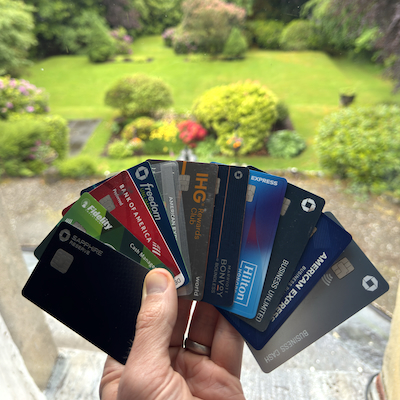
Today, I want to share what’s in my wallet (and why).
My wallet hasn’t changed for many years now. That’s partly because I want to “simplify” rather than “optimize” these days. But it’s also because I’m really happy with everything I have, so there’s been no need to look for anything else.
Chase Sapphire Reserve
My favorite card of all time, and the one I use for over 95% of my purchases, is the Chase Sapphire Reserve.
I applied for this when it first came out in 2016, and it’s been my go-to card ever since.
Here are the main details:
- 4 points per dollar on flights/hotels booked direct
- 3 points per dollar on dining
- Airport lounge access for you and up to two guests
- No foreign transaction fees
- Primary auto rental coverage
The Points Guy values these points at 2.05 cents per point, so that makes the 4x on flights/hotels and 3x on dining like getting over 8% and 6% back on my two biggest expense categories!
The lounge access saves us ~$100 every time we’re in an airport (based on how much we spent when we traveled through TPA, which didn’t have a lounge), and makes our travel days more relaxed/enjoyable.
New perks were recently introduced when the annual fee changed last year, and I’ve received over $2,000 in value from them since they were announced (see Addendum at the bottom of this post for all the details).
Fidelity Cash Management Debit Card
The Fidelity Cash Management Debit Card doesn’t earn miles/points, but it’s the second most-essential card in my wallet for two reasons:
- No Foreign Transaction fees
- No ATM fees
So when I go abroad, there’s no need to change money over (or get traveler’s checks, if they’re still a thing?) because I just take local currency out of the ATM as soon as I get there.
The exchange rate this card gives me at the ATM is better than I’d get at an FX place anyway, and it’s far easier to just find an ATM when we land.
The fact that all ATM fees get refunded means this debit card is great to use in the States as well! I don’t need to hunt for my bank’s ATM, because I can just take money out of any ATM and I know Fidelity will reimburse me for any ATM fees incurred (no matter how high).
Checking Account Debit Card
For some reason, I still carry my bank’s debit card too (to get cash out when near one of their banks).
Chase Freedom Unlimited
The Chase Freedom Unlimited is the card I use for non travel/dining purchases when in the States. It gets 1.5 points per dollar back on all purchases, and since these points are worth 2.05 cents per point (according to The Points Guy), that’s like 3% cashback on everything!
The card doesn’t have an annual fee, so it’s one I plan to keep forever.
Amex Everyday
This card gives 2 points per dollar back on supermarket spending, so I use this one in US grocery stores.
IHG Select
This card is no longer available, but so far Chase hasn’t made me upgrade yet. I only use it at IHG hotels, but I keep it because it gives a free night every year for only a $49 annual fee.
Chase Marriott Bonvoy Boundless
I only use the Chase Marriott Bonvoy Boundless card for Marriott purchases, but I keep it because it gives me an annual free Marriott night (up to 50,000 points) for a $95 annual fee.
Amex Hilton Honors Card
I use the Hilton Honors American Express card for Hilton purchases only. It doesn’t have an annual fee though, so that’s why I keep it open.
Chase Ink Business Unlimited
The Chase Ink Business Unlimited is my go-to business card because it offers 1.5 points per dollar on all purchases (and no annual fee).
Amex Business Blue
This business card earns 2 points per dollar on all purchase (up to $50k) and it doesn’t have an annual fee. I use this one when I want to build up my Amex point balance (which aren’t as useful to me as Chase points, but still valuable).
Chase Ink Business Cash
I don’t really use my Chase Ink Business Cash anymore, now that I got the Chase Ink Business Unlimited mentioned above (I just keep it anyway because it has no annual fee).
Addendum
The perks for the Chase Sapphire Reserve changed last year when the annual fee went up, and I’ve been getting a ton of value from them!
They’ve also been encouraging me to spend more (in the same way having a gift card makes me buy things I probably wouldn’t have otherwise). That may seem like a bad thing in the personal-finance world, but it’s great for someone like me who is learning how to spend money.
Here are some of the new perks I’ve taken advantage of:
- $500 credit for stays at The Edit hotels
- $550+ in value when you stay with The Edit (free breakfast for two, $100 hotel credit, etc.)
- Global Entry, TSA PreCheck®, or NEXUS fee credit (one statement credit of up to $120)
- $300 dining credit
- $288 in Apple TV and Apple Music subscriptions
- $300 in StubHub credits
And if you spend over $75,000 on the card in a year, you’ll get the following additional perks:
- World of Hyatt Explorist status
- IHG Diamond Elite status
- Southwest A-List status
- $500 Southwest credit
- $250 Credit at The Shops at Chase
So here’s how I actually utilized the perks, and how much money I saved:
We stayed two nights at a fancy downtown-Denver hotel ($250 statement credit) where we received $60 vouchers for breakfast each morning in the adjoining restaurant (which was delicious). We also received $100 to use anywhere else on the property, so we used that to get even more fancy food/drinks in the restaurant.
While in Denver, we took a friend out to dinner at a Wagyu steakhouse that we wouldn’t have gone to otherwise ($150 statement credit for that).
I used the Stubhub credit to book tickets to see a Pittsburgh Penguins hockey game, a Deftones concert, and a Kraftwerk concert ($300 total in statement credits).
Once we passed $75k in spending last year, we got the $500 Southwest credit, which we used on a flight from Pittsburgh to Denver. And on that flight, our new A-List status saved us $35 in baggage fees!
- $250 – Denver Hotel
- $120 – Denver Hotel Breakfast
- $100 – Denver Hotel Credit
- $150 – Wagyu Steakhouse Dinner
- $300 – Stubhub tickets
- $288 – Apple Music & Apple TV
- $300 – Annual Travel Credit
- $183 – Function Health Limited-Time Promo
- $500 – Southwest Flight
- $35 – Southwest Luggage
So that’s $2,226 we’ve already saved (mostly on things we would have bought anyway, and a few things that we wouldn’t have normally spent money on, but I’m glad that we did).
Some perks I still haven’t used (but plan to) are the $250 credit at The Shops at Chase, the $250 credit for select Chase Travel Hotels, the $250 credit for The Edit hotels (the second half of my $500/year allowance), and another $150 dining credit (second half of my $300/year allowance).
Add all that up, and we’re talking about over $3,000 of value from a single card (not even accounting for the value of the airport lounge access for you and two guests, the TSA PreCheck® credit, etc.).
Now you can see why the Chase Sapphire Reserve is my favorite card of all time!
How About You?
What’s in your wallet? Do you have a different favorite? If so, what (and why)? Is there anything I’m missing? Let me know in the comments below!
You can replace all of these with the catch-all 3% Robinhood Gold card, much more value and way less headache
Then just rotate signup bonuses on the side
How in the world are you spending $75k in a year on a credit card!! I’m genuinely curious. I’m happy for you, and I’ve been following you for a while, but my first reaction was: Where is our mad fientist and what have you done to him? Cheers on everything good coming your way and the baby!
Haha, that’s still my reaction too!
When I said that we put 95% of all our spending on that card, I really meant it. We don’t have a mortgage or rent, so nearly all of our spending is on that card.
Last year, we also bought a bunch of stuff for our house, and we had two big multi-month family trips, so that’s what brought our annual spending up.
I was as surprised as you are!
Wow assuming a 3% SWR since you’re conservative, your NW is at least 2,500,000 !!! that’s amazing!!! my dream of getting there in 20 yrs
Robinhood gold card isnt bad with 3% cash back on everything. If you fund a roth they also give you a 3% addon which more than covers the ~$60 a year fee. The only catch is you have to put the money in your brokerage account to get the 3% but you can withdraw it right away. Seems easier than dealing with a bunch of cards.
My wife and I use southwest cards as well to get companion which saves us a ton. However, chase limits the credit card usage so we unfortunately cant get any other chase cards.
A 3% cash back card is really appealing (especially in this higher-interest-rate environment, where cash in the bank could earn a decent return vs. miles/points losing value), but having to open another brokerage account really puts me off.
I would have definitely jumped on that card 10 years ago (or if I already had a Robinhood account), but don’t think it’ll happen now that I value “simplifying” more than “optimizing”.
I dropped my Chase Reserve because of the fee increase, and because my local airport doesn’t have a Priority or Chase lounge. Capital One Venture X is much better for me as we have a CO lounge, and the card’s annual fee is essentially -$5 per year with annual points gift. All the other benefits I actually use pretty much match the CSR, so it’s worked out well for me.
Gas and groceries go on my Amex Blue due to the 6% and 3% rewards for each.
I had considered dropping it too, but definitely not now after getting so much value out of the new perks.
The Venture X has been on my list of potential new cards for a while now, but it seems like overkill while we have the Sapphire Reserve.
The Amex Blue has never been on my radar though, but it is now (so thanks a lot for sharing)!
We invest in short-term rentals so have a lot of mortgage spend
1) Bilt palladium. Were able to generate about 60-70k a month in Bilt points that gets doubled when using their monthly transfer partner as a platinum. To simplify it I (er, Claude) built this calculator to let other people with heavy mortgages, especially investors, run their points potential https://realestatevibecoder.github.io/Bilt/
2) Alaska Summit since our nearest airport is a hub
3) Hyatt Biz
How does it work with mortgages? If we have several mortgages (we also do [long-term] rentals), do you only earn points on the largest mortgage or how does that work?
A Hyatt card is the only other hotel card still on my list of “potential future cards”.
Cool stuff with the mortgages, so thanks for sharing!
Capitol One Venture X has worked out pretty well for us as a travel and rewards card 10/5/2% hotels/flights/misc. No foreign transaction fees, and lower annual fee than the Chase Sapphire Reserve, which includes benefits that I don’t need (uber, door dash, peleton, etc). I got it back when they were doing a 100k points intro offer.
I’ve considered doing the Sapphire Reserve but just hasn’t seemed attractive enough to make it worthwhile.
Does your wife use Sapphire Resrve as well? I have the card and thinking about getting one for my wife as well, but not sure about paying the fee.
Both me and my wife put nearly all our spending on my Sapphire Reserve (she doesn’t have her own).
Bilt is newer and has become one of our primary spend cards
I’ll retire in less than a year with 30 million points and miles. Have cashed in tens of millions more as a side hustle. Only writing this because your interview with Mr. Money Mustache many years ago was the catalyst for my FIRE journey and I appreciated the episode. But I’ve been a hard core points and miles person for a decade+
That’s insane! I’ve definitely earned and used over a million miles/points over the years, but nowhere near 2 million (let alone 30 million ).
Huge congrats on your upcoming retirement, and enjoy all your free travel!
I also use and love the Fidelity Cash Management Debit ATM card for the same reasons. However, like you, we still needed a physical bank ATM to do cash deposits at an ATM. Has anyone had success using the Fidelity Cash Management Debit Card to do cash deposits? I’ve tried at a couple of ATMs and it wasn’t an available option.
I’ve never tried it (I just use my bank’s card for that, like you do)
It would be far too much effort for me for a gain of $5,000. But for someone who enjoys the process I’m sure it’s worthwhile. I could save more than that by switching to DIY investing, but that’s too much effort as well.
Amex blue cash preferred is one easy upgrade. 6% cash back in groceries and streaming. 3% cash back on gas and transit. $95 annual fee that pays for itself very quickly.
Following on Aaron’s comment above, I use my AMEX blue cash strictly for gas and groceries because it pays 3% in those categories, and there is no annual fee. I have considered upgrading to preferred, but I just don’t spend enough on groceries to justify the $95 (I spend almost nothing on gas living in NYC…). That’s the one recommendation I’d make – swapping your existing AMEX everyday for Blue cash, but I think you live in Scotland and I don’t know if this only applies to US supermarkets, in which case it may not be worth your time.
Hi! Since it seems the last update on your “what’s in my FI portfolio (and how I manage it)” post was in 2022 and a lot has happened/changed since then in the world, do you think you’ll be doing any updates to your portfolio and/or that post any time soon? Or maybe you have and I missed it – if so, can you please direct me to it?