
The ultimate retirement account isn’t technically a retirement account…
It’s a Health Savings Account (HSA).
An HSA is a tax-advantaged savings account available for people who are enrolled in a high-deductible health insurance plan (HDHP).
Since people with HDHPs could face more out-of-pocket costs (due to the higher deductibles), the government provides tax incentives to motivate people to save for those expenses.
HSA account holders can contribute pre-tax dollars to the account and can then withdraw money from the account, tax free, when paying for qualified medical expenses.
And if used wisely (as described below), it could be one of the best places to put your money when saving for early retirement!
Warning: Do not confuse HSAs with other health-related accounts like FSAs and HRAs because they are very different and definitely aren’t as good. This article is about HSAs only.
HSAs are Super IRAs
The HSA is billed as a savings account for health expenses but it’s really the Clark Kent of retirement accounts because it’s actually a super IRA in disguise.
Why is it a super IRA?
Before answering that, let’s first briefly touch on some of the benefits of the various types of retirement accounts.
Tax-Free-Contribution Accounts
These are the most common retirement accounts (e.g. 401k, 403b, Traditional IRA) and are great for two reasons:
- Your contributions to these accounts are pre-tax contributions. This means that you don’t pay any income tax on the money you contribute. For example, if you make $100,000 a year but contribute $15,000 to your 401(k), the IRS treats you as if you only made $85,000.
- The money in these accounts is able to grow tax free.
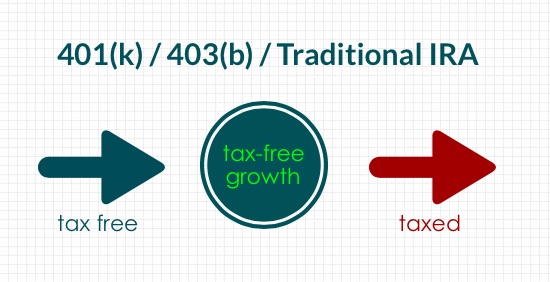
Taxation on Traditional Retirement Accounts
You eventually have to pay tax when you withdraw money but since you receive a tax break when you put money in and the money is able to grow tax free, it is usually worth maxing out these accounts to take advantage of these benefits (see why I think these accounts are best for early retirees).
Tax-Free-Withdrawal Accounts
Tax-free-withdrawal accounts (e.g. Roth 401k, Roth IRA) are different because they require you to pay tax on your income up front but the money grows tax free and you do not have to pay any tax when you withdraw the money after you reach the age of 59.5.
So using the salary in the above example, if you contribute $5,000 to a Roth IRA, you will still initially pay tax on your full $100,000 salary but you won’t have to pay any tax when you withdraw the money from the Roth.
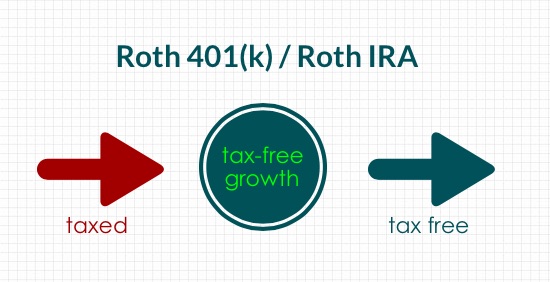
Taxation on Roth Retirement Accounts
HSA Accounts
For most of the population, an HSA is simply a savings account for medical expenses that provides some tax benefits.
Since you’re a smart Mad Fientist reader though, I suggest you disregard the medical aspect of the account and simply think of it as a special retirement account that you are able to contribute to when you are enrolled in a high-deductible health plan.
When used intelligently, the HSA can potentially provide the best benefits of both a Traditional IRA and a Roth IRA because you are not only able to contribute pre-tax dollars, like you can with a 401(k)/403(b)/Traditional IRA, but you can still enjoy the tax-free growth and tax-free distributions that a Roth provides!
That means you could potentially have tax-free contributions in, tax-free growth, and tax-free distributions out. Or in other words, completely tax-free money!
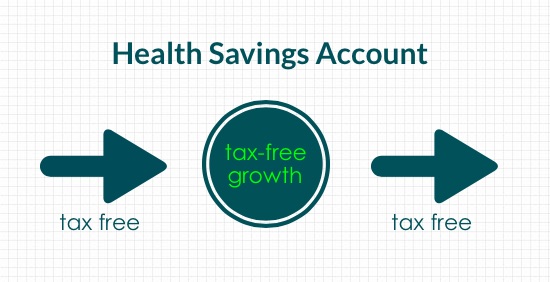
Taxation on Health Savings Accounts (HSAs)
The best part is, you can take the distributions whenever you want (assuming you’ve had a qualifying medical expense after setting up the account) so this can be used to fund your early retirement!
Automatically calculate your net worth, asset allocation, and investment fees with this free portfolio manager!
Get StartedDelaying HSA Distributions
Since there is no rule stating that you must use your HSA to directly pay for medical expenses or that you must withdraw money from your HSA within a certain amount of time after paying for a medical expense, you can just take out the money whenever you want.
As long as the qualified medical expense occurred after the HSA was opened, you can withdraw money from the HSA at any time after incurring the expense to reimburse yourself.
Example
Let’s assume that I only spend $200 a year on medical expenses. It doesn’t make sense to pay a lot of money for an expensive full-service health insurance plan, since I rarely go to the doctor, so I instead decide to get a cheaper high-deductible health plan with a lower monthly premium.
Since I have an HDHP, I am able to open a health savings account so I elect to max it out with $3,650 every year and I invest the account’s money in a total stock market index fund.
Because contributions to the HSA are pre-tax, depositing $3,650 into my HSA decreases my taxable income by $3,650 and therefore reduces my taxes.
When I go to the doctor, I can pay for my $200 yearly visit with my tax-free HSA funds directly but if I instead pay with cash or my normal credit card, I am able to withdraw that $200 from my HSA at a later time (to pay myself back for the qualified medical expense).
The great benefit of having an HSA is that I can decide when to pay myself back. Since I am already maxing out my other tax-advantaged accounts and have ample savings, a $200 payment isn’t going to break the bank so there’s no rush to get paid back from my HSA. Instead, I am able to leave that $200 in my HSA to grow tax-free until I decide to withdraw it!
As long as I keep my receipts (and make digital copies, in case the physical copies wear out), I can withdraw the money for qualified medical expenses from my HSA at any time, in a similar way a retired person over age 59.5 can withdraw money from a Roth IRA – tax free!
So to summarize, I have saved myself from paying income tax on the $3,650 of income I used to fund the HSA, I now have $3,450 that is growing in the account tax free, and I have another $200 that is in the HSA growing tax free that I can withdraw whenever I want to!
Worst Case (or Best Case?) Scenario
I can hear you saying, “What if I put all this money into my HSA but I don’t have any health issues…how will I ever get my money out?”
In this case, the account will simply act like a Traditional IRA but with an increased distribution age (65 instead of 59.5 for a Traditional IRA).
Like a Traditional IRA, your contributions to the HSA are pre-tax contributions and your contributions are allowed to grow tax free. If you don’t use your HSA funds for medical expenses, you can begin withdrawing money from your HSA account for any expenses after you turn 65, without penalty. You’ll have to pay income tax on any distributions that aren’t for qualified medical expenses, just like you would with a Traditional IRA, but you won’t incur any additional penalties or fees.
Therefore, after the age of 65, an HSA is nearly identical to a Traditional IRA but it’s still better because your withdrawals for medical expenses are still completely tax free!

How to Maximize Your HSA
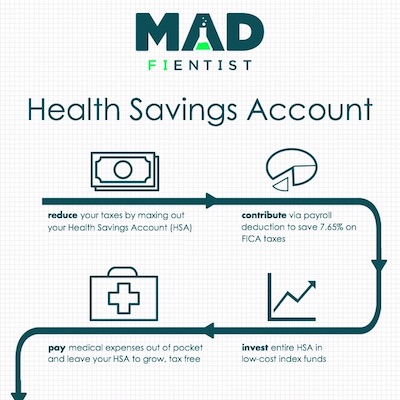
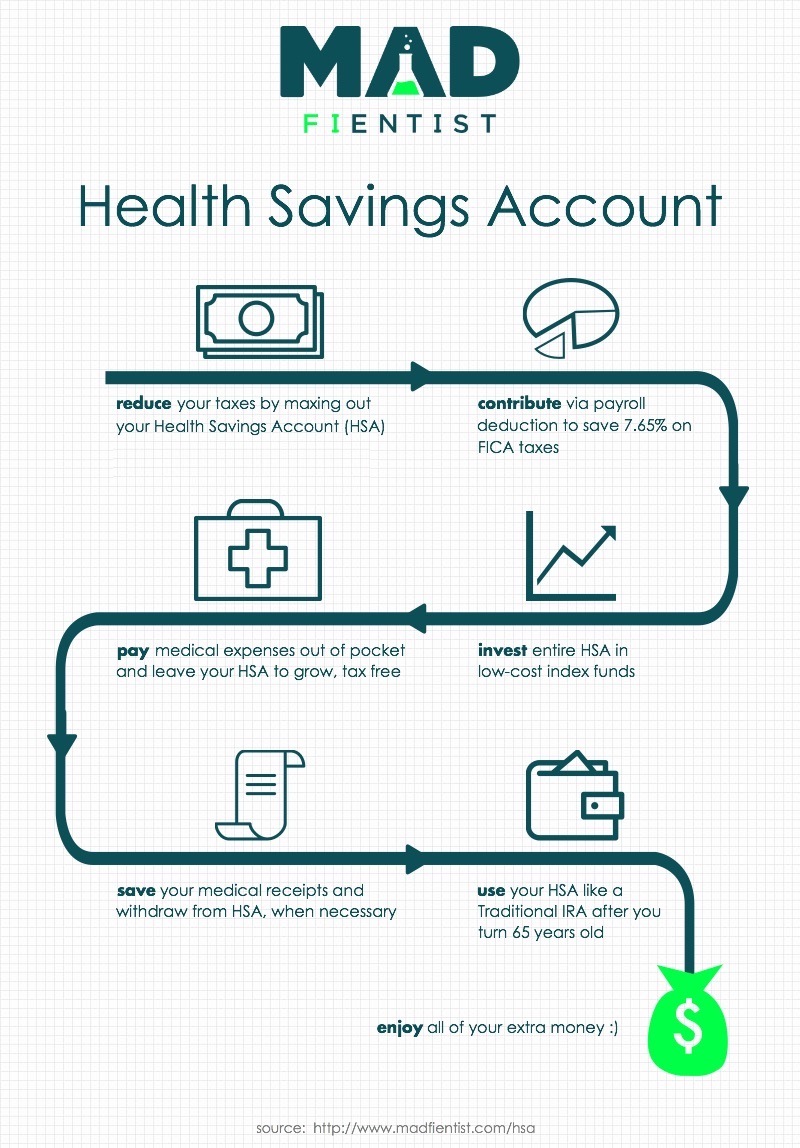
Here’s a graphic explaining how future early retirees can take full advantage of an HSA (descriptions about each step are below):
Max Out Your Contributions
Decrease your tax burden by contributing the maximum amount to your HSA each year and increase your savings rate by investing the tax savings.
The contribution limit for 2022 is $3,650 for individuals and $7,300 for families.
Assuming your family is in the 24% marginal tax bracket, maxing out your HSA could save you $1,752 in taxes each year!
Contribute via Payroll Deduction
When you contribute to your HSA via an automatic payroll deduction, you are able to avoid paying FICA taxes (i.e. Social Security and Medicare) on your contributions.
Assuming your family maxes out an HSA, this could result in an additional $558.45 of tax savings per year!
I am not aware of any other retirement account contributions that are exempt from the 7.65% FICA taxes so this is yet another reason the HSA is the ultimate retirement account!
Invest the HSA Funds
Rather than treat your HSA as a savings account, instead treat it as a retirement account and invest the entire HSA balance in low-cost index funds (note: not all HSA custodians offer low-cost index funds so make sure yours does before opening an account).
Don’t Use your HSA to Pay for Medical Costs
Rather than use your HSA to pay for medical expenses, instead use your after-tax money so that you can leave your HSA money to grow tax free.
Keep Track of Your Medical Receipts
Keep track of all your medical receipts so you know how much you are able to withdraw from your HSA.
As you incur qualified medical expenses, you increase the amount that you can withdraw during early retirement (you effectively convert your HSA into an early-retirement Roth IRA over time).
Treat Your HSA as a Traditional IRA After Age 65
Assuming you reach the age of 65 and have not accumulated enough medical receipts to fully liquidate your account, the HSA can be used for ordinary expenses in the same way that a Traditional IRA can be used for any expenses after standard retirement age (note: withdrawals for qualified medical expenses will continue to be tax free but withdrawals for all other expenses will be taxed as income).
Things to Consider
Obviously you shouldn’t switch to a high-deductible health plan just to take advantage of an HSA so do the math to see if an HDHP makes sense for your family before making the switch.
Employers are actually starting to make HSA contributions for their employees (which is great!) so factor those contributions into your calculation when deciding whether an HDHP is worth it.
Also, fees can sometimes be an issue with HSAs so make sure either your employer is covering the HSA fees or they are low enough to still make it worthwhile before setting up an account.
Conclusion
A health savings account is an incredibly valuable tool in an early retiree’s arsenal, especially if you are already maxing out all of your other tax-advantaged accounts.
By treating your HSA as an additional retirement account, you can use it to further reduce your tax burden during your working years, shelter more of your investment earnings from tax, and potentially provide a source of tax-free income during your early retirement years!
What do you think? Do you agree that an HSA is the ultimate retirement account? If not, what type of account gets your vote?
thanks for the article! I have one of these but never bothered to look at the details >_<
Glad it was helpful, Greg!
That’s great you already have an HSA set up so that you can start taking advantage of it immediately.
Let me know if any questions arise as you dive into the details.
Thank you for your post. I have an HSA that is just set up as a savings account through my bank, where I do not pay any service/maintenance fees.
I’m interested in moving the $ to an investment account, but I don’t know which administrator is best. The main administrators seem to have fees of around $60/year plus a percentage of the total assests…. what is the break even point where the fees are worth it, and do you know of an administrator that doesn’t charge fees this high?
Yes, this is my absolute favorite investment vehicle. One thing I hadn’t realized until recently was that you don’t have to withdraw money to pay for medical expenses in the current year. Like you point out, the best strategy is to let that money grow tax free, and save those receipts! It looks like the HSA contribution limits may be significantly increasing under the new administration too–we’ll see if that pans out.
I’m having trouble getting detailed information from my HSA admin on what exactly qualifies as a “receipt” for future claims.
Examples:
If I purchase medication through my online pharmacy, is a digital snapshot of the purchase with the drug name / my name / price paid enough of a “receipt”?
If I pay a doctor with a check and don’t receive any receipt, can I use their paper bill (before it was paid) as my claim reference?
My HSA has said “it can’t be an Explanation of Benefits from your insurance company”, but that helps me exactly zero. I don’t want to end up 20 years later with a pile of “receipts” that don’t cut the mustard.
Thanks :)
~Meech
Here is one company’s take on it…
https://support.tangohealth.com/hc/en-us/articles/204316210-Health-Savings-Account-Record-Keeping-Receipts-and-HSAs
I Scan all my receipts, medical docs, any correspondence and load it to google drive. Then toss the receipts, etc. ( should probably keep them but receipts sucks and seem to erase after a few months anyway). I think the only time I would actually need them is if one were audited by the IRS. My HSA distributes money “on my honor” for reimbursement. Once they even allowed a Amazon Prime subscription to renew from my HSA Debit card. I got that change reversed via Amazon however.
Mad Fientist. I sold a $87K equity position in my HSA in Oct 2021 with proceeds put in my HSA bank. The platform used was Optum Financial.
I had auto invest for my payroll deduction enabled and 30 days after I sold the position the auto feature automatically bought it back. I lost 10K on that transaction and Optum Financial says it has no liability because I had checked the auto investment through my payroll check. Any advice on this matter. It seems to me that this is very poor consumer protection.
I agree, great article! I didn’t know there was a way around FICA and Social Security taxes either. I am going to max this account out every year until retirement.
Woa woa I don’t think this is a good idea! I just stumbled on this article so I’m three years late to the discussion. I appreciate that this is a clever idea and loophole, but I don’t believe it actually leads to any benefit. Please allow me to explain:
The amount of tax-free money you can withdraw from this is equal to the sum of your health expenses. Lets take the author’s example of $200 medical expense that occurs in the year 1980. You pay that with in 1980 with your own post-tax money, external to your HSA in 1980. Then in 2015 you can withdraw $200 tax free. But according to inflation that $200 is worth a lot less! In fact it’s 2015 equivalent is $579.26! Again you are limited to your healthcare costs, the entire remainder works like a traditional IRA.
The next problem is paying your initial medical expense in 1980. You have to pay that bill regardless. But lets say instead you paid it from your HSA with pre-tax money and then use the $200 of post-tax money (that you would have used in the author’s example) to invest in a Roth IRA. Come 2015, assuming the $200 investment only kept up with inflation, you’d have $579.26 tax free. That’s a lot better use of money!
Eric, you are correct in your reasoning. However I think the this particular idea is for people who have maxed out their other retirement vehicles, contributed max to 401K, and IRA’s and are looking for more ways to etch out a couple of extra pennies. For those who have not maxed out their other retirement vehicles this tactic is not useful.
Thanks for the reply Hin. I considered what you wrote and I agree that this is ONLY useful if you’ve maxed out all other retirement vehicles. However the article says:
“The ultimate retirement account is better known as a Health Savings Account, or HSA.”
Ultimate by definition is:
noun
1. the best achievable or imaginable of its kind.
Is this THE best retirement account? No way! You would actually be losing out on a lot of money to use this over a more traditional Roth. In fact I’d argue that given inflation you are better off paying your medical expenses out of the HSA as intended. At best the article is disingenuous and at worst its steering people to make costly financial decisions (which I assume is the opposite goal of this site?). In fact I was linked to this article from reddit where someone claims this is better than both a traditional and Roth 401k! For further evidence that this is misleading look at some of the other comments here.
Please re-name this article “An interesting loophole in HSAs that allow you to pay more money now to get less money in the future”
For reference here is the reddit discussion that shows how this misinformation has spread to other people that mistakenly think this article is true and a good idea. https://www.reddit.com/r/personalfinance/comments/2tkk65/are_roth_401k_contributions_worth_it/
I had a discussion with the site owner about this. Apparently this site is for those individuals that have exhausted all traditional means of savings for retirement and are looking for as you may put it “interesting loopholes” to increase their retirement savings. If you have not maxed out all your traditional savings vehicles then go to Suze Orman and the kindergarten class before coming here. While I wouldn’t consider the article misinformation per se, it is ,as you note, a bit exaggerated.
My main objection to this HSA savings strategy is that 20 years from now they may change the HSA rules, such as only allowing the deduction on medical expenses incurred in the same year. Then poof that 20 years of saving receipts was for nothing. Also what happens if you lose the receipts? Lost again. Too much work and risk for me.
My biggest concern with this strategy is also with potential law changes as Hin mentions. Most would argue there would be a grandfather clause, yet that’s not always the case. An example of this in recent history is that you were allowed to use 529 plans to pay for a student’s computer (i.e. law at the time of contribution). The law then changed at time of distribution that you can only use the plan to pay for a student’s computer that is explicitly a requirement to attend the university. While it seems as if this is a given, the taxpayer in this case did not have written proof to show the IRS that it was indeed a requirement and had to pay tax on that money. Since this was a small purchase further pursuing this with the IRS was not feasible, yet one would think if this was challenged in the court the taxpayer would win. To me this HSA strategy makes for an interesting court case in the future!
To keep it simple I won’t use numbers at all. Here is why the HSA is better than the other two:
Traditional IRA: Money going in (pay FICA tax), growth (no tax), money coming out (pay income tax)
Roth IRA: Money going in (pay income and FICA tax), growth (no tax), money coming out (no tax)
HSA: Money going in (no tax), growth (no tax), money coming out (no tax for medical expenses or income tax for non-medical expenses).
Even if you expect you’ll never have a medical bill to pay in your entire life (not likely), it’s still better than the other two since the HSA is better than a traditional IRA and I’ve already argued that a Traditional IRA is better than a Roth for early retirees.
As Hin mentioned, if you’re not maxing out your other retirement accounts, then it makes more sense to pay for medical expenses with the HSA and contribute more to your other tax-advantaged accounts.
Regardless of whether you use your HSA to pay for medical bills immediately or not, it’s still the best option because of the triple tax advantage.
Assuming that you have maxed out other retirement accounts, if you never have a medical bill to pay in your life then the HSA is almost exactly the same as an IRA, taxed advantaged going in, pay tax when withdrawn. I count the FICA as only a slight advantage to the HSA since paying less FICA could potentially reduce your SS benefits in the future. It is an interesting additional savings vehicle for those who have maxed out other accounts since at very worst it would be an extra $5k and change more you can save in a tax advantaged traditional ROTH like plan than otherwise, even if you never have a medical bill to pay.
Personally, I while I contribute quite a bit to my 401k I have not maxed it out while I have maxed out both my ROTH IRA and HSA contributions every year. Since you can only contribute a relatively small amount to a ROTH it is easy to max out and ROTH IRA accounts have several advantages such as the ability to take out the initial contributions tax/penalty free before retirement in case of emergencies. I use my HSA for current medical expenses to get the savings immediately and not worry about saving receipts or future tax law changes. Should I not have current medical expenses I would save enough in the HSA to cover a couple years worth of deductibles then switch to increasing my 401k savings.
A bit late to this discussion, but I have to generally disagree with Eric’s comment. At worst, like others have said on this article, the HSA is slightly better than (but about the same as) a Traditional IRA. I would argue even further that it is, in fact, better for most people to contribute to an HSA OVER maxing out one’s 401(k). This is because, while it may be true that your medical expenses now could loose out to inflation, most medical expenses don’t happen when people are young in life. In fact, most expenses will be, in all likelihood, incurred in retirement. Unless you are requiring this money for non-medical expenses, all of the money left in your HSA for these later medical expenses can be withdrawn tax free to pay for them as you need them. Thus, if your HSA allows you to invest your money, and you expect to incur medical fees over the amount you have in your HSA (estimates at over $200k throughout retirement), then it makes sense to let your money grow tax free and use the contributions plus interest to pay for medical expenses tax free. If for some reason you have way too much money in your HSA (which would be impressive, considering how low the max you can contribute in one year is), you can just stop contributing to it.
Finally, as some people have mentioned, there is a worry that the law will change and there will be a requirement to withdraw the money the year you have the medical expense. While this may or may not happen, I would still easily take such a risk because, at worst, the HSA becomes a Traditional IRA without minimum distributions, at best nothing happens, and more realistically, if such a bill to close the loophole was put before Congress, I would simply withdraw all the money I was eligible to before they passed the law (assuming it made financial sense). The interest on that money would still be in my account accruing tax free, and that money I withdrew (tax free) would go to whatever else I would want it to go to. Again, I could use the interest to pay off future medical expenses, and all of it would be tax free. Pretty much a no brainer.
I see a different condition that maximizes the effectiveness of this strategy. My family is currently spending more than what the HSA can cover in a year. (me, my wife, and a newborn baby boy!) But, we can’t deduct those expenses until they reach 10% of AGI. The first year I had my HSA, I used it for immediate reimbursement, but then found myself with several thousand dollars of medical expenses that I could not deduct. I am only starting my HSA in my 40’s, so I do expect that my medical expenses late in life will soak it up, anyway. But in the case as discussed here, where medical expenses in retirement do not take up the full HSA, then I am running a “medical expense surplus” each year, that will also eat into the investment growth of the money I leave in the account each year. (I am now leaving it untouched) I do take advantage of deductions in years when I top 10%, so I have to track that. But I am very comfortable that I will rack up lifetime total medical bill for my family that will allow me to apply this trick to its fullest potential. My HSA provider also has online storage for documentation, so I keep up with that for reference in the future.
The issue of inflation with regard to HSA accounts is the exact same as inflation in general: future dollars are worth less than today’s. The reason that HSA accounts are being used as retirement accounts are because you can invest the HSA money into index funds that generate above inflation returns (stock market returns are around 7% after inflation). You do not lose out to inflation in these accounts if you have the accounts invested in stock funds. In this scenario you would not put any money into the cash portion of the HSA. I found an HSA account with Health Savings Administrators that offers Vanguard funds, and is linked to from Vanguard’s website.
The second reason to put money in these beside inflation protection is that you get a tax deduction in the year contributed (if not pre-tax through employer – many employers don’t offer them). This is now well over $3,000 per year, that amounts to $750+ in tax savings. I see the $750 as additional money to invest each year, by front-loading my tax return into yet another tax-shelterded account the following year, compounding the tax savings. You could also look at the tax savings as an inflation hedge, down payment on your annual premiums, etc. Whatever way you look at it, you are $750 ahead every year than otherwise, and you have more money earning dividends tax-free.
I’m quite grateful for this article. This was the first article I read which opened my eyes to being able to use HSAs as extra retirement accounts. Very cool.
But, I’d like to add something to think about. I think it works out better to claim your HSA expenses as soon as they’re incurred, rather than saving them to withdraw sometime in the future. Now, I may have totally made a mistake in my calculations here and reached a wrong conclusion, definitely you should do your own calculations and not listen to some random guy who could very easily be dead wrong. However, so far things seem to be checking out; consider this food for thought. :-)
Let’s say you have the choice of either claiming $5000 of medical expenses from an HSA today and invest into a taxable account, versus leaving the $5000 in an HSA to grow for 30 years and (hopefully!) withdraw the $5000 tax free then.
The tax-free growth of the HSA seems like it would make the HSA the no-brainer investment. However, pulling the money out results in $5k of no-tax principal you can invest in a taxable account. Basically, this is $5k of no-tax principal in one account vs $5k of pre-tax principal in the other – with an eventual $5k tax-free withdrawal, yes.
What I see in my personal calculations is: while the HSA money does grow better due to not having to pay dividend taxes every year, the benefit of having that $5000 tax-free sooner outweighs leaving it in the HSA to grow completely tax deferred and then pull out the same $5000. The money in the taxable account grows slower, yes, but only the interest and dividends are subject to further tax, and at lower rates than taxable withdrawals from the HSA. The HSA money is all subject to likely higher income tax rates, and leaving the money in the HSA results in more taxes that eventually have to be paid, as well – except for what you can claim as medical expenses, of course. From that single $5000 amount, maybe your HSA would grow $7,500 more in 30 years than the same amount in a taxable account. But, even after accounting for the $5000 tax-free future withdrawal from the HSA, the post-tax value of the taxable account ends up, in my calculations, to still be higher than the post-tax value of the HSA.
That doesn’t mean it’s always better to withdraw early – and I could be wrong, and I’m no expert here – you may very well want to not withdraw if you need that money to cover medical expenses in the future. But if you’re investing in an HSA expecting to use a large portion of it as retirement income rather than covering medical expenses, do some calculations – you may find it’s better to *not* stockpile your receipts and instead claim things sooner. …That’s what I’m planning to do.
@Paul you make an interesting point. I didn’t consider the difference between earnings being taxed more efficiently as investment gains as opposed to income tax rates in the case of distributions for non-medical expenses after age 65. I suppose this difference can vary wildly depending on if your retirement income is lower or higher than your average tax rate over the years you slowly siphon money from the HSA. Personally I am still leaning on the side of keeping all the money invested in the HSA for the long run. Mainly because I think over my life I will rack up more random medical expenses than I think, and I have a very long time period to keep racking them up if I ever want to make progress on making tax free distributions. The more medical expenses I can reimburse myself for, the more I can distribute tax free, and the closer the gap becomes when compared to the advantage in tax rates for investments vs income taxes. Not only that, but as time goes on, the tax free growth begins to compound more than the other strategy allows. In your example it grew 7500 more. Well that 7500 more is now earning more money as well, further closing the gap even if the tax treatment is not ideal. I think if you play the waiting game and let your medical expenses stack up over time to maximize tax free distributions, and only make those taxable distributions when you are satisfied with your investment gains in lieu of harsher tax treatment, you may very well come out quite a bit ahead in the long run.
You’re missing an important detail. just like your IRA the HSA dollars can be invested and they grow tax free – so that negates any positive positioning to IRAs that you mentioned. Investing the HSA funds to grow while you wait to need them is possibly the greatest advantage. In your example you also didn’t account for the taxes paid upfront on the IRA contribution in the difference.
What everyone seems to be missing (and I admit I haven’t scrolled down more than a few dozen posts, but don’t have the time to check the entire comment section) is that many employers will contribute to your HSA, just as they do to your 401k. So… free money! In my case, my employer will contribute $500 per year, in 2 payments of $250 each, one early in the year and the other late in the year. The total allowed for 2018 is $3,450, which makes my max contribution for the year $2,950 (adding employer’s $500 brings us to the max). Maybe back in 2016 this was not true, and that’s why no one mentioned it.
You may need to check this–the total allowance for 2018 of $3,450 includes employer contributions unlike a 401k. If you go over you are in trouble. So since my employer contributed $300 I can only contribute $3,150.
Ooops sorry for some reason I read your total contribution would be $3950 instead of $2950 you are correct!
Deductions, personal exemptions put us in the 15% marginal bracket
The HSA alone saves us around 2% / year in effective taxes (including fica )
Brillant post here, Mr. MF.
In fact, I liked it so much I added an addendum to my own Stocks Part VII post discussing IRA, 401K and the like with a link to it.
As I said there, RE HSAs, I couldn’t have said it better myself and so I didn’t!
You’re too kind, Jim!
As I said in our Mad Fientist FI Podcast interview, I honestly think your stock series is the only thing a person needs to read to become a successful investor so I am truly honored that you included a link to my article in that series!
Kudos to this article making it to the stock series. I love that you great FI guys read and contribute to each others content. I never had any knowledge on this subject and got an excellent crash course. It made me look into what we had w/ my company which unfortunately is an HRA use it or lose it. It did get me to contact HR about what could be done about it or if our insurance policy would allow an outside HSA account such as the vanguard links you have posted. Would you recomment only doing this if 401k and IRA contributions were maxed out?
That’s a shame you have an HRA instead of an HSA. Hopefully you can convince your company to offer a High Deductible Health Plan so that you can open up an HSA somewhere.
I personally would invest in an HSA over the IRA, due to the benefits described in the article, so if I couldn’t max out everything, here’s where my money would go:
1) 401(k), up to the employer match %
2) HSA
3) IRA
4) Rest of 401(k)
How would you revise this for those of us with a TSP?
1. TSP up to employer match
2. HSA
3. TSP
4. IRA
or would you switch 3 and 4?
I’m not too familiar with TSPs but from what I know, they have very low costs so if you’re happy with the investment options, 3) TSP and 4) IRA makes sense but I’m not sure it makes too much difference so you could switch them and be fine as well.
Would 5) be taxable investment like VSTAX?
Two years later.. I just received your email referencing this blog post and I’m investing in my HSA for the first time. I was planning to nearly max it out and based on your article I will now DEFINITELY be maxing it out each year. Thank you.
Question: Why would you contribute to your IRA before you maxed out your 401k?
I have the same question as Alison–why would you contribute to an IRA before maxing out your 401(k)?
I’m guessing you’ve addressed this somewhere on your site–if so, could you point us in that direction?
It comes down to choice and control. Since a 401k and traditional IRA are taxed exactly the same, we have to look at the investments that are available in each. Since a 401k is with a broker that is chosen by your employer, and an IRA is with a broker chosen by you, you get more control in an IRA. Most 401k’s only offer 7-15 investments (and half or more are the utterly worthless target date funds), but you can invest in literally anything on the market with your IRA (since you can shop around).
Dang, I just spent 45 minutes compiling all the links to the ‘Stock’ series, to send to my daughter.
Then after the last one, I run across the page that links to a list of all posts in the series.
http://jlcollinsnh.com/2013/10/05/the-stock-series-gets-its-own-page/
It has a link to a Mr. Money Mustache page, with a link to all in the Stock Series.
http://www.mrmoneymustache.com/2013/03/07/how-about-that-stock-market/
Might save someone some time.
Hi Lamont…
I’m honored you are passing my Stock Series along.
With MF’s kind permission, here is the easiest link to use: http://jlcollinsnh.com/stock-series/
Permission always granted, Jim!
You say that you can invest the money in your HSA in index funds that you chose. Is that possible in all HSAs? I may be wrong but in my company provided HSA it only pays a small amount of interest, similar to a savings account.
George,
Just like with a 401(k) plan, it depends on your provider. I have not explored the availability of rollovers to a different provider (like rolling a 401(k) to an IRA) but you could present this issue to your HR department–HSA’s are new to them, too!
Your company deposits your HSA money into a bank or credit union HSA account of your choice so really your company has nothing to do with it. If your institution that holds your HSA account does not allow investment you can change it to someplace else that does. Generally they will not allow you to invest all your HSA funds. My credit union only requires me to keep the first $1,000 in cash and above that can be invested. I would recommend that you always at least keep your deductible (typically $3-6K) in cash and invest amounts more than that.
Hin,
My company has a designated HSA custodian, just like for our 401(k). I did not know that the company could have the option to open deposits at the employees discretion! The benefit of our arrangement is that this custodian is affiliated with the insurance company, so my expenses flow into it, reducing the paperwork (data entry) somewhat.
Since I am spending more than my deductible, (in fact, we have maxed out the last 3 years) I am choosing to invest all I can immediately. I do also have a minimum I have to maintain in cash–$2,000.
Hi Matt,
Every company I have been with just asks me to fill out the form with a voided check to the HSA account at my credit union. I get checks and a debit card from the credit union account so all my expenses flow into that as well so minimal paperwork. I think this is better since I can move banks to one that gives me the lowest fees and/or best investment options should I want to. Since you are locked into your HSA custodian you might be locked into their investment options and fees.
However remember before trying to take advantage of the HSA savings strategy you should be maxing out your 401K and Roth.
Larger employers will typically offer only one custodian. You can roll your money into another at any time, but your payroll deductions (and any employer contributions, if offered) will go into the company’s chosen one.
My employer also uses a terrible HSA provider, but they do provide some free money into the account each year, so here’s what I did:
1 – Open up an HSA account with the provider of your choice, preferably one that lets you invest immediately or with only a small balance that’s reserved for cash. There’s nothing stopping you from having more than 1 HSA account – you just can’t contribute more than your total max amount into the sum of the accounts.
2 – Directly contribute in your preferred HSA account the full max amount at the start of each year, so that it has the longest period of time to grow.
3 – After my employer’s contributions have been completed, I file the form to do a distribution of excess HSA contribution from the HSA provider that my employer chose. This way I don’t exceed the max HSA contribution amount. They will typically charge a fee to process that form, so I enclose a separate check to pay for the fee to ensure that I fully distribute the excess contribution.
Looking at some other comments, I didn’t previously realize that you could save on FICA taxes by having your employer deduct from your paycheck, so if you wanted to maximize that, you could do that as well and then do the distribution of excess HSA contribution after you’ve maxed out the HSA contribution amount. Since that would be at the end of the calendar year, that can easily become your next year’s HSA contribution into the provider that you chose, starting the next year’s cycle of contribution and distribution.
I have a different take on this. I think they’re great for individuals who can take advantage of them, but we don’t meet the “low medical expenses” criteria so for me an HSA is useless. Worse, I suspect that if you analyzed the impact of many healthy people taking HSA’s on the cost of medical goods and services, there may be some nasty side effects from healthy people removing themselves from the insurance pool and instead diving into these HDHP / HSA arrangements. Perhaps choosing an HDHP / HSA should come with a higher bar of entry if your medical situation changes later and you need traditional health insurance. When you get down to it, this article basically describes a way to game the health insurance system to avoid taxes; no criticism of individuals who choose this is intended; I’d do it as well if I could. But using these plans as a back door to higher retirement asset levels seems like a distortion of the health insurance market that only benefits a few. If I could vote to eliminate them, I would.
Hi Mike, thanks for the comment. High Deductible Health Plans (HDHPs) definitely aren’t for everyone so I agree HSAs are useless for people who are better off with another type of insurance plan.
While HDHPs are usually best for people with low medical expenses, sometimes they can actually be a good option for people with very high medical expenses as well. My health care provider, for example, offers a HDHP that has maximum annual out-of-pocket expenses of $2,500 for individuals and $5,000 for families. The other two “full-service” health plan options, which have higher monthly costs and don’t provide access to a Health Savings Account, have much higher out-of-pocket maximums ($4,500/$5,000 for individuals and $13,500/$15,000 for families). So for someone who could potentially need expensive procedures or require extended hospitalization, it may make sense to enroll in a HDHP, in order to minimize annual out-of-pocket costs and be able to utilize the HSA tax benefits described in the article.
As far as gaming the health insurance system, I don’t really see it that way. The government is providing an incentive to save for health expenses and I’m taking advantage of that incentive. Over the long run, I will be less reliant on an already stressed system, because I will be able to pay for more of my own medical expenses, so I can’t imagine the government would be too concerned with me maxing out my HSA and letting it grow for years/decades until I need to use it.
I’m not sure I understand what you mean by “HDHP/HSA should come with a higher bar of entry…”. Would you mind explaining that part a bit more?
Words: eaten.
We now have an HDHP through my wife’s employer. This only made sense once we decided to switch from my health insurance to hers, she had some options I didn’t. This move was primarily for cash flow advantages, after running the numbers we determined that we’d actually spend less out of pocket under her plan than mine, so we made the switch. Time will tell if this turns out to be the case in practice, and no read yet on it’s value as a retirement account.
Mike, good to hear from you again! I really appreciate you coming back after almost a year to post an update.
If you do decide to open an HSA to go along with your HDHP, make sure you contribute to it through payroll deductions so that you lower you FICA taxes (as Nick described in the comments below).
Keep me posted on what you think of the HDHP/HSA. Hopefully it will turn out to be a good switch for you and your wife.
I’d love to know how Mike and his wife faired!
“Gaming the health insurance system”. The incentive is available and honestly encourages saving for Health expenses later which will not be as it seems later (trust me…like when does the US have a solid track record in this department). The health insurance industry is gaming the reputable users/payers.
“describes a way to game the health insurance system to avoid taxes”
This is “gaming” the system about as much as taking your legally entitled deductions to reduce your taxes. I guess if you don’t want to “game” the system, you could just voluntarily not take tax deductions you are legally entitled to and pay more money to the government than you need to. Washington sets the rules to the game (and it is a game), as long as we follow their rules then our conscience should be clear. If you think the rules are wrong then contact your congressperson.
Hi Mad Fientist — I’m following you over from 20somethingfinance where I saw your comment there about HSA distributions using old medical receipts (the same as your article here discusses). I’m duplicating my comment on 20somethingfinance here to ensure you see it, plus it pertains to this article as well:
“No, you can’t do that.
Only “Qualified Medical Expenses” (QME) can be withdrawn from your HSA, and a QME is only valid in the YEAR the expense is PAID.
For example, if you go to the doctor in December 2012 — but pay the bill in January 2013, then that is a “Qualified Medical Expense” for tax-year 2013. You can’t, as you imply, pay that bill in 2013 out of pocket, and then get a distribution from your HSA in 2016 (or some future year).
This is mentioned in the language in IRS Pub 969 (talking about “Qualified Medical Expenses” for HSAs), and IRS Pub 502 defining when a “Qualified Medical Expenses” is good for:
“You can include only the medical and dental expenses you paid this year, regardless of when the services were provided.”
I erroneously thought the same as you a few years ago and a quick call to the IRS help line set me straight then: 1-800-829-1040”
Hi BG,
Thank you for getting in touch. I try very hard to ensure everything I post here is accurate so I’m really thankful that you took the time to speak up when you thought something I wrote was incorrect.
I had read the IRS Pub 969 when doing research for this article but I didn’t look at the IRS Pub 502 that you mentioned. I just looked through it now though and to me it still seems ambiguous. I can see how Pub 969 defines qualified medical expenses as “expenses that would generally qualify for the medical and dental expenses deduction”, as defined in Publication 502, and Pub 502 does say “You can include only the medical and dental expenses you paid this year” but to me, that doesn’t explicitly mean the HSA can only be used for current year expenses.
Publication 502 describes what medical and dental expenses you can deduct on your tax return so it makes sense that you can only deduct qualified medical expenses that were paid for in the tax year that you are hoping to receive the deduction. For HSA purposes, however, just because it doesn’t fall within the current tax year doesn’t mean it wasn’t a qualified medical expense. To take a deduction, Pub 502 states that the expense has to be a qualified medical expense AND has to have been paid for in the current tax year but an HSA distribution just states that it has to be a qualified medical expense, as defined in Pub 502. To me, the date the expense was paid for is additional information and does not determine if a medical expense is a qualified medical expense.
Saying all that though, if you actually spoke to the IRS about this, I definitely believe what you’re saying. I will give them a call to get clarification on everything and will update this article accordingly.
Thank you very much again for the comment and I will be in touch again soon.
When I called the IRS a few years back, it was for a real example I was facing. I had roughly $8k in QMEs, but only $6k (max contributions) in the HSA. My question to them was whether I could ‘roll’ the extra $2k in QMEs into the next year and take the distribution from the HSA then (when I could add an additional $6k to the HSA again).
The IRS agent pointed me to Pub 502 and said the best I could do in my current situation was try to delay the payments to the medical providers into the next year. Any payments I had already made in the current year would not count as a QME for HSA distributions in a future year.
If you call the IRS and find that they have changed their position on this, that would be very good news.
OK, I stand corrected. I called the IRS again, and spoke with a representative who put me on hold a few times to research the question. She changed her mind from originally “you can’t do that” to ultimately coming to the conclusion that yes, you can ‘roll’ your QMEs into the future and take the HSA distribution at any arbitrary future time (be that years away).
She did say, however, “unless my specific plan precludes that” — though it isn’t clear if that is my employer’s ins. plan, or the bank (HSA) trustee that could preclude us from using HSAs this way.
Regardless, as far as the IRS is concerned, there is nothing in the rules preventing us from saving QME receipts, and deferring HSA distributions indefinitely — as long as you had an HDHP insurance plan when the expense was incurred.
Also, though this is common sense: no ‘double-dipping’ allowed: using the same QME for multiple HSA distributions and/or using a QME that was deducted on Sched A in any tax year.
BG, that’s great news! Thanks a lot for giving the IRS another call.
Tax documents are such a pain to interpret so that’s a great idea calling the hotline to ask questions. I’ve never thought to do that in the past, I’ve always just suffered through hours of frustrating reading instead, but I can definitely see myself using that service in the future.
Thanks again for bringing your concerns to my attention and for following up. It’s nice to know there are people out there keeping me honest!
Your HSA plan has nothing to do with this, since you do not have to substantiate withdrawals — you just have to keep your own records.
The IRS has issued a notice specifically on this topic — IRS notice 2004-50, see Q-39.
You’re absolutely right, Geoff. Jeremy from GoCurryCracker.com actually linked to that IRS notice in his comment on the How to Hack Your HSA article.
Here’s the link, for anyone else interested: http://www.irs.gov/irb/2004-33_IRB/ar08.html
“…as long as you had an HDHP insurance plan when the expense was incurred. ”
To be clear, does this mean an expense incurred previous to acquiring HDHP is not a QME even if it is paid after acquiring HDHP?
For example, one goes to hospital on (non-HD) insurance and incurs an out of pocket expense. One then changes insurance to HDHP and has not yet paid the bill. This bill is not a QME.
Calling the irs for tax advice is widely regarded as pointless. They don’t know what they are talking about. You need to talk to a tax adviser of some sort.
I realize I am late to this party, but I enjoyed the article and it has made me think more about fully funding my HSA account. I currently fund some but I do not max it out.
I wanted to point out another advantage of an HSA account with high deductible health plans. Many companies are encouraging HDHP and HSA’s by giving money HSA accounts. I’m assuming this is because it also saves them money. My company gives me $500 a year into my HSA.
So just another way to get “bonus” money from my company above and beyond my salary.
Welcome, Peter! It’s better to come late to a party than to not come at all so thanks for joining the discussion.
That’s amazing your company contributes $500 per year towards your HSA. I imagine that your free $500 combined with the amount you save on monthly premiums by having a HDHP adds up to almost cover the difference in deductibles between the HDHP and some of the other options. Your HSA is the super ultimate retirement account!
Not to one up Peter, but my company puts $2400 a year into my HSA, $200 a month, which equals my $2400 deductible.
Thanks for the great article. I never realized I could invest the money, its sitting in an account paying .15% interest. I found out I have 22 mutual funds I can choose from, including 2 vanguard index funds.
I also didn’t realize i could add in more than my company already puts in.
I have been looking for ways to sock away more money tax-free. I already have the 401k and IRA’s maxed.
Thanks for saving me money!!!
Wow, $2400 per year is very generous. That’s great you also have two Vanguard index fund options to choose from.
It’s always nice to hear when one of my articles helps someone so thanks a lot for letting me know!
Great article! As a financial planner, just wanted to add one extra feature that gives the HSA an extra vote as the “ultimate” retirement account. If you contribute through payroll deduction, you also save on Social Security and Medicare tax (7.65% this year)! You do not receive this extra tax break if you do not contribute through your paycheck at work.
Thanks, Nick! That is definitely another incredible benefit and one that I actually didn’t even recognize. This is why I love writing about this stuff here…other smart people like you come to my house and tell me more interesting information about topics that interest me. The HSA keeps getting better!
Hi Nick, MF….
Can you site a source for HSAs being free of FICA taxes? Sound intriguing, but I can find anyplace that confirms this feature. Thanks!
I don’t have an official document as a source, but I can say that looking at my W-2 from last year, Box 1 (wages minus 401k withholding and HSA withholding) and Boxes 3 and 5 (SS and medicare wages, respectively) differ only by the amount of my 401k withholding, so it appears the HSA contributions were not added back into the SS/Medicare wages.
Additionally, each paycheck I receive, I can calculate the amount that SS/Medicare withholding is based off of by dividing the withheld amount by .062 or .0145, respectively. Taking the difference between my wages and that amount tells me that my automatic payroll deductions for HSA contributions, as well as my portion of medical and dental insurance premiums that automatically come out of my paycheck, are not subject to FICA taxes.
Hey Jim, check out this IRS bulletin (see the answer to question #19).
Like Matt, I too can confirm that HSA contributions are not added back into SS/Medicare wages on my W2.
Question #19 in that bulletin is specifically referring to the money an employER contributes to an employEES HSA account. Has anyone confirmed “officially” whether the money an employEE contributes to their HSA is exempt from FICA taxes?
I don’t remember the source, but it was either official (us govt) or reputable (Forbes, Intuit, HR Block, etc). I came across this when I was reverse engineering what withholding method my employer used (turns out the withholding method was one of the obscure ones from Pub 15A).
Thanks guys!
That works.
Depending on your taxable income level, the FICA tax rate for the $3300 in potential HSA contribution will be:
– 7.65%: $0 – $117,000
– 1.45%: $117,000 – $200,000
– 2.35%: $200,000
My employer doesn’t allow front-loading of the HSA contributions through paycheck contributions. Therefore, it occurs to me that I’m better of front-loading the HSA directly with FICA-taxed funds, rather than pre-FICA paycheck deductions. Assuming I don’t fall into the 7.65% tax rate, the earnings from front-loading are likely to compensate for the potential FICA savings.
Is my thinking correct or flawed?
Hi Eli,
If you make $300,000 a year, for example, you would have to pay 7.65% on the first $117,000, 1.45% on the next $83,000, and 2.35% on the final $100,000. Were you thinking that you’d have to just pay 2.35% on the entire $300,000?
No, but any reduction in taxable income comes from the top tax bracket.
If you make $300,000 a year and you have $3,300 deducted from your paycheck for the year, the result is:
– 7.65% of $117,000
– 1.45% of $83,000
– 2.35% of 96,700 (instead of $100,000 without the deduction)
The savings in FICA taxes is 2.35% * $3,300.
Ahh, I see what you’re saying now.
I think I would still go the payroll-deduction route, since that’s a guaranteed return and I like to minimize my taxes as much as possible. If you’re making more than $200k though, 1-3% of $3300 is likely only a very small drop in your investment bucket so you might as well just go with whichever option is easiest.
I didn’t choose the HDHP/HSA this year, but for future reference… I’ll probably more than max out social security next year. So for example, if I contribute $5000 to an HSA via payroll deduction, the FICA savings is perhaps $72.50 (5000 x 1.45%). Our current HSA charges $24/yr to use the investment option and does offer a Schwab S&P index with a .09% expense ratio. Other low ER choices include Vanguard Total Int’l Stock at .22% and Fidelity Spartan US Bond (AGG) at .22%. If I’m able to max out my 401k this year, and thus dive into the HSA next year, those fees/expenses seem a reasonable price to pay to keep it simple and not maintain separate HSAs for employer vs. employee contributions. Or will I do significantly better, long term, with cheaper funds available at HSABank or Health Savings Administrators?
Obtw, definitely no reason to do a non-deductible IRA prior to funding an HSA, right? Thanks.
Before using payroll deductions, I suggest everyone read http://www.bogleheads.org/wiki/Payroll_deduction and consider the impact lower OASDI taxes has on your social security benefits. The loss of SS benefits may make using payroll deduction less appealing, particularly at lower income levels. YMMV.
In my own case, I’ve done the math and am comfortable with the tradeoff. The website I cite suggests it would take 18 years of SS benefits to outweigh the savings in OASDI and Medicare taxes paid, before calculating either the Federal and State income taxes on SS benefits or the opportunity of investing the saved taxes.
I’ve done the math, for every 1k of income I will receive .80 cents extra in SS benefits per month. At $76.50 in savings, it would take 8 years just to get my money back in benefits. Now, what’s more valuable, $76.50 invested in stocks today, or 8 years of $.80 cents per month, taxable, at ages 62-70? I think the answer is obvious.
Nick (and MF), Thanks for this great information. I’m about to enroll in an HDHP and I’ll be setting up an account on my own, but my employer is fairly progressive. I’d like to approach him with as much information as possible but am having a hard time finding it on my own. Wondering if you could help me out with…
1. Mainly, who would my employer get in touch with to set up a payroll-deductible HSA?
2. Do you know of any that have Vanguard Funds as an option to invest in?
Many thanks,
L.R.
Hey L.R., I’m not sure about how your employer would need to set up the HSA but Health Savings Administrators is a good choice if you want to invest in Vanguard Funds.
Good luck!
I tried looking through the comments, and didn’t see anything, so I thought I would add that some states (California included) do charge taxes on contributions to HSA, including the employer portions. I believe they tax the gains on investments once realized. Hopefully this will change in the future. CA tax is not as high as federal tax, so that is saying something.
Joe, I’m from CA as well and I verified with my employers HSA provider that all contributions if done as a pre-tax payroll deduction are also exempt from FICA and FUTA taxes. All earnings are also tax exempt as long as invested within the choices provided from the HSA provider. All distributions are tax exempt as long as they are QME’s.
Ok, I’m not sure what that has to do with my comment about state taxes though. I worked with my CPA and the HSA savings account got treated as a normal taxable investment account for California. You pay state taxes on dollars contributed to an HSA and pay state taxes on earnings from the HSA (realized gains, reinvested dividends, interest earned). For instance, I am in Vanguard Total Stock Market Index Fund which is my only low cost option. I had some dividends for that fund received during the year that were taxable in California. These dividends are not taxable on the IRS side.
Straight from the mouth of the beast – “The deduction allowed and interest earned on Health Savings Accounts(HSA). HSA contributions may not be deducted and any interest earned on the account is taxable to California.” “HSA dividends line 9, column C.”
https://www.ftb.ca.gov/individuals/vita/Training_Course/Catalog/540.4.pdf
My mistake, you are absolutely right. I miss understood and CA is 1/3 states along with Alabama and NJ, where HSA contributions are not state tax deductible as of 2014. You are right again about the earnings as well for CA. Price of our sunshine and blue skies I guess…
Man, California must really be amazing if you guys are willing to pay all those crazy taxes over there!
Well when the mid and East coast were in a sub zero polar vortex with record snows California was in the mid 70’s and sunny. How much is that worth?
I luckily avoided the winter this year but last year was brutal as well so I probably would have paid quite a bit!
The Sierras are also at 6% of their annual snowpack at this point in the year. Guess where your drinking water come from!
Maybe one day they will make this less complicated. Until then, cheers!
I know this is an old thread but I’ve been searching if doing the HSA for retirement makes sense in CA due to the State tax issue.
I respect Madfientists detailed analysis and clear guidance on this stuff.
Any thoughts/recommendations?
TIA
Which HSA custodian do you recommend? Mine is currently at a local credit union since it’s free of fees and I have a small balance thus far.
Hi Nephi, I would recommend a custodian that a) doesn’t charge account fees and b) allows you to invest in low-cost index funds. Hopefully your local credit union has some good low-cost investment options so that you don’t have to worry about moving the money you already have invested and can instead just focus on maxing out the account every year!
Any custodians you would recommend I look at that offer both those? The current is no fees, but only basic interest accounts. (at most, .7%)
Ahh, I see. A basic interest-earning account really won’t let you maximize the HSA as I described in this article.
The first thing I would do if I were you is check to see if your employer offers an attractive HSA option. My employer offers a Fidelity HSA and they pay the annual fee so I’m able to invest in low-cost index funds without paying any fees. Going through my employer also means I don’t have to pay Social Security and Medicare tax on that money, as Nick mentioned in his comment above, since my HSA contributions are deducted directly from my paycheck.
If your employer doesn’t offer a good option, your best bet may be to go with Health Savings Administrators. They charge an annually fee but they allow you to invest in Vanguard Admiral shares, which are the best index funds you can invest in, in my opinion.
You could also take a look at HSA Bank. Their investment option is provided through TD Ameritrade, which offers quite a few commission-free ETFs, including several good Vanguard ETFs whose expense ratios are equivalent to Admiral shares.
Awesome post. I am maxed out on Roth and 401(k) and working toward financial security. This is perfect! I really appreciate the post!
Thanks, David! Thanks a lot for stopping by!
I looked in to my employer’s HSA after seeing this post, but I’m concerned about this statement in the plan:
“All pre-tax funds that are not used for eligible expenses incurred during the plan year will be forfeited. This is mandated under the IRS “use it or lose it” rule.”
What does “forfeit” mean? Does it just mean I’ll be returned the unspent money and taxed on whatever isn’t used for QME? Or does all of the deposited money get swallowed up by the government?
I’m a reservist in the military (single, healthy 26 y/o male) and I have access to Tricare ($51/month premium, only $150/yr deductible). Thus, my reason for looking into this is for the tax benefit, since I spend next to nothing on health care costs.
Ideally I’d like to max out contributions and take the money out at 65 like you recommend, but I’m not sure what the “use-it or lose-it”/forfeit clause means.
Thanks!
Hi enceladus, it sounds like you’re looking at a Flexible Spending Account (FSA) and not a Health Savings Account (HSA). An FSA must be used up by the end of the year or you’ll lose that money forever. An HSA, on the other hand, does not require you to spend the money during any particular timeframe so you can let that money grow tax free, as described in the post, for as long as you want.
Great call maxing out your HSA for the tax benefits but definitely make sure it is an HSA and not an FSA before you make any contributions!
Thanks for the quick reply MF!
On closer inspection, you’re correct. My employer refers to it as a Healthcare FSA in my benefit plan, which I incorrectly read as HSA. Glad I didn’t throw a bunch of money it before I realized this!
I’m glad too!
Hello,
I have the same option from work and it is an FSA, you loose the money if you do not use it within the calendar year, do I have another option or am I stuck with that?
Hi Carlos, you’ll need to check with your employer but it’s possible you only have an FSA option. If your employer doesn’t know for sure, contact your health insurance provider to see if your plan is HSA eligible.
MadFientist – just an FYI about FSAs that you might find interesting. FSAs are use it or lose it, however, there is a provision called the “uniform coverage rule” that requires the annual value of the employee’s election be available on the first day of the plan year. For example, if I’m an employee that wants to deduct $200 / mo (i.e., $2400 / year), I can access the $2400 on day 1. Now, if I’m planning on quitting or leaving my job, my employer will be on the hook for the full $2400, even if I haven’t contributed the full amount. Might be a good thing to call out for those people who know when their FI date will be :D – Van
Loved this article. So glad someone confirmed what I was thinking. I changed to our HSA/HDHP two years ago when I started doing all the math. My company also contributes, and what I pay out of pocket is almost exactly the same — but I now have thousands saved in an HSA account that would have just been ‘my share’ to pay to the insurance company under a traditional plan. We will on occasion ‘max’ out the year due to hearing aids needed by myself and my daughter, and soon my son. But, I plan this to happen all in the same year so we max out our out of pocket. That leaves ‘off years’ as savings years for us. 3 out of 4 years of savings helps out!\
Even without investing, having 20 years of $3000 savings in an account is better than just paying it to the insurance company for a traditional plan and letting them profit from it.
Absolutely! In some cases, the out-of-pocket maximums for high-deductible health plans are actually lower than they are for traditional plans so I bet you save even in the years you have to max out.
Glad you enjoyed the article and thanks for the comment!
Hi there,
very nice post. It made me start to think about the following: would it make sense to pay all medical expenses with after-tax money, i.e. not accessing the HSA at all? Because the HSA money can grow tax-free for a long time, and when I use the HSA money, this obviously stops.
There must be a way to figure out under what circumstances paying with after-tax money is the better solution. Do you have an idea how to run the math?
Thanks
Fubek
Absolutely! That’s exactly what I propose in the article (see the last three paragraphs in the Example section).
I just pay for my qualified medical expenses with after-tax money, keep track of the expenses so that I know how much I could withdraw from my HSA if I need to, and then leave the entire HSA to grow tax free.
I’d argue that most of the time it makes sense to pay with after-tax money. That way, more of your money is left to grow tax free.
I have health insurance through Kaiser at my company. I just got married and I’m in the process of filing for my wife’s “green card.” She needs to get some sort of insurance policy in the near future.
We are in great health and are very motivated to retire early and slow travel! Should we get an HSA in addition to my Kaiser? Where is the best place to buy these policies? Does 2 people mean I can max us out our savings as a family? Lastly, do high deductible HSA accounts require monthly fees? Thanks so much.
Hi Steve, I would first speak to your health insurance provider to make sure your plan is HSA eligible. Next, I would speak to your employer to see if you could automatically contribute to an HSA through a payroll deduction (this will allow you to save on FICA taxes). If your health plan is HSA eligible but your employer can’t help you set one up, I’d take a look at Health Savings Administrators. They charge an annual administration fee but they offer some great Vanguard investment options so it could be a good choice.
If both you and your wife have HSA-eligible health plans, you should be able to max out the family contribution limits.
Good luck and let me know if you have any other questions!
Thanks for the tips. This is a great stepping stone for me! Can you please edit out my last name in the previous post. Keep up the great work!
Your previous comment has been edited, as requested. Good luck getting everything set up!
Brandon,
My DH can get an HSA through his employer this year (literature wit details will be distributed beginning of October during open enrollment).
I am reading on this topic and cannot see a clear answer anywhere: what happens if his employment is terminated?
I assume the HSA would stay active till the end of the contract year?
Suppose next year husband has a different employer and decides to get a traditional health insurance plan.
Is this possible, or is once you start the HDHP, you are stuck forever?
Hi Danielle,
The individual owns the HSA, not the employer, so even if your husband leaves his job, the HSA will stay with him.
You are definitely not stuck with a HDHP forever. You are free to change your health plan as often as you’d like but you can only contribute to your HSA when you are enrolled in a HDHP.
Really interesting. A question: if you’re only earning .1% on your HSA funds (no investment options are available), is there any reason not to pull out the money from your HSA now (tax free) to pay for a medical expense vs paying for the medical expense out of pocket and letting the money sit in your HSA account but earning very little? I briefly looked into HSA Bank & HSA Administators (transferring my HSA dollars there) but the fees & hassle etc don’t seem to make sense for a fairly small HSA balance (~$7000 at the moment). Also, do you know what kind of long-term care premiums can be paid for from HSA accounts? Thanks!
Hi Nancy, it sounds like it may make sense to use your HSA to immediately pay for your medical expenses, since you don’t have any good investment options within your HSA. You’d be giving up tax-free growth but the additional returns could make it worth it, assuming you invest the after-tax money that you didn’t spend on medical expenses.
As far as what kind of long-care premiums can be paid with HSA money, your best bet would be to take a look at this IRS document to see if your specific expense is a qualified medical expense.
Great job Brandon. This is my favorite post, I have reread it many times.
I had a question regarding the medical expenses and delaying their payment. I was wondering if it wouldn’t be safer to “pay yourself” for your yearly expenses and stash that tax free money in a Roth IRA? (I know you would love to max out both of them!)
By “safer” I mean you’re sure that you don’t have to interpret the IRS Pub 502 or rely on an employee’s interpretation of it. Or am I missing something here?
Hi Antonio, glad you enjoyed the post!
If you don’t plan on maxing out both your HSA and your IRA and you feel a bit funny about leaving your money growing inside the HSA, then what you proposed makes sense.
I was working under the assumption that all retirement accounts would be maxed out so what you proposed isn’t an option in that scenario.
Thanks for the answer Mad Fientist.
I wasn’t worried about leaving money in the HSA but I am worried about Uncle Sam :)
My proposal comes from a guy longing to be FI but still on the road to freedom, i.e. I still haven’t maxed out all these accounts :P
Please keep up the great job for all the future FI guys and gals out there that still need a north star.
Thanks for this post. I had thought about joining my employer’s HSA last year but decided against it because I was concerned about the high deductible. What a mistake! After reading your article and looking at things more carefully I’ve decided to switch to the HSA in this year’s open enrollment period.
My employer’s EPO plan was costing me $865/year, with no in-network deductible, a $1000 out-of-pocket max and $10 copays for doctors visits. The HSA plan costs $0/year, furthermore they put $1000 in your HSA account if you take an annual physical (which is free), but it has a $1250 deductible, and a $2400 out-of-pocket max on 10% coinsurance for visits.
The amazing thing here is that even if I use my HSA to pay for medical expenses, in the worst case where my expenses hit the out-of-pocket max, I’d only be paying $1400/year on the HSA after the $1000 company contribution, compared to $1865 on the max o-o-p plus fees on the EPO, a saving of $465. In the best case, if I don’t go to the doctor at all, I save $1865! Neat!
That’s great, Dave! It’s always nice to hear when something I’ve written helps someone save a considerable amount of money so I really appreciate the comment.
Also, thanks for sharing the specific numbers of your company’s available plans because I imagine it will inspire others to look more closely at their own options.
I would add that one should also do their homework on the bank distributing your HSA. Chase charges a monthly fee (I think it was $10 or $15) for maintaining the HSA. So you need to at least gain that much in its tax-deferred growth in order to break even on the tax-deferred advantage.
Another cool thing about the HSA is some employers (like my last 2) will contribute $1K each year to your HSA just because you’re participating in the HSA. Other wellness incentives abound: $50 for signing up for a mail-order prescription service, $50 for keeping phonecall appointments with “life coaches,” $25 for signing up for a 5K, etc. All of those small amounts are contributed to your HSA by either your employer or the provider.
I’ve been able to “make money” by not needing to spend that free money from my employers. One troublesome thing about HSAs is also the requirement of having a high deductible plan at the time you decide to pull money from it in order to get all the benefits of the HSA (no penalty, no tax).
So while I agree that HSA is a good tool for saving, it’s more of a tax shelter than a strong way to grow tax-deferred money.
Good point about fees, Denise. When running your calculations though, you need to not only factor in tax-free growth but also the amount you save on taxes up front (thanks to your pre-tax HSA contributions).
You mentioned that you need to be enrolled in an HDHP when withdrawing money from an HSA but that is not actually the case. You only need to be enrolled in an HDHP when you contribute to an HSA. Once your money is in there, you can use it for qualified medical expenses (tax and penalty free) whether you’re enrolled in an HDHP or not.
When you put it that way, HSAs DO sound like the ultimate retirement plans. Especially considering how medical expenses will probably go up as we age.
Thanks for your site; learning a lot of good things on here.
Glad you’re enjoying it, Denise!
First off, great article; it pretty much was the tipping point for enrolling in my employer’s HSA plan. Quick question about that though, and a slightly unrelated topic:
How much should I be contributing the HSA a year? My employer matches up to $1,800 a year but the overall limit is $6,450. Should I be contributing as much as I can towards that limit? I just don’t know where to start when it comes to contributing to the HSA versus my 401k, versus my IRA, versus a regular savings account, etc. Thanks.
Thanks, DB!
As far as how much you should contribute, it definitely depends on your personal situation but I, for example, choose to max out my HSA because I already max out all of my other retirement accounts and I have a good HSA custodian with low-cost investment options and low fees (my employer actually covers the fees while I’m employed).
Without knowing anything about what options you have available, I’d probably say it’d be worth funding your HSA at least up until the employer match. If you can contribute via a payroll deduction, you’ll save an extra 7.65% on FICA taxes so it could be worth maxing out the account for those additional savings.
Traditional IRAs and 401(k)s are great too and are a bit more flexible when it comes to withdrawing money from them for ordinary expenses prior to standard retirement age (see my Traditional vs. Roth IRA article). If your employer offers a 401(k) match, you should definitely take full advantage of that.
The important part is to just save as much as you can so it’s up to you how much future flexibility you want to trade for tax savings now.
I literally smacked myself on the forehead — literally — when I read the line in which you pointed out that you don’t have to reimburse yourself for your qualified medical expense immediately; you have the option to continue letting that money grow tax-free.
Of course! (*Head-smack!*) That makes SO much sense! Why didn’t I think of that?!
I’ve had an HSA for many years. I ALWAYS pay for medical expenses with a rewards credit card, and then I reimburse myself from the HSA. It never occurred to me that I could simply choose NOT to reimburse myself, and instead let the money grow.
Why didn’t I think of that?!?! That makes so much sense!!
Brilliant post, Mad FI. It’s not often that I read one single blog post that will immediately and forever cause me to change my behavior. But this post did it. :-)
Haha, while I’m glad you enjoyed the article, I don’t want to be the cause of damaging that brilliant brain of yours so I hope you smacked lightly :)
I’m really glad you enjoyed the post so thanks a lot for letting me know!
This was an amazing article, but after reading it and all the comments I don’t think I saw anywhere how long you plan or think it would be safe or wise to wait before being reimbursed from your HSA.
You mention, and I agree since I’m young and have similarly few medical bills, that $200 a year doesn’t meet the deductible and it doesn’t break the bank to pay it and not get reimbursed right away.
Assuming there is no financial emergency that you’d need the money for, are you planning on just saving all of your receipts for a 3, 5, 10+ years before submitting them for reimbursement? Do you think the institution would guffaw at you for submitting a several year old receipts? Would they accept them without a fight?
Instead, would you recommend after 5 years (arbitrary suggestion) to start a “reimbursement receipt ladder,” where on the 6th year you’d submit bills from your 1st year, thus allowing your investments to still grow and compound, while not holding onto receipts for decades?
I suppose I’m wondering, how long you can keep this streak going without worrying that they won’t “honor” your receipts. I’m 28 right now; could I max out my HSA every year and invest in a total stock market index until I’m 65, all the while letting my investments grow like crazy, and then start submitting my 30 year old receipts?
Thanks for all your financial wisdom!
Well I went to Health Savings Administrators’ website and found this under their “Commonly Asked Questions:”
http://www.hsaadministrators.info/welcome-kit#WhatIsTheDeadline
…What is the deadline for submitting claims for reimbursement from my HSA?
There is no deadline for submitting claims for reimbursement from an HSA. In the event of an IRS audit, you will be required to produce receipts for any medical expenses for the amounts that have been reimbursed from your HSA…
I suppose that takes care of my question, though it still makes me wary for keeping the receipts for the next 30 years. I guess I’d just start submitting receipts for my HSA reimbursements before any other accounts during my years of early retirement when I need income.
Hi Ryan, it’s safe to keep your money in there as long as you want (see this IRS document).
I understand your concern about keeping receipts for 30 years but I’m sure you could scan them or take a picture of them so that you have a digital copy to keep somewhere.
I likely won’t start taking money out of my HSA until I stop contributing to it. The tax benefits associated with making pre-tax contributions outweigh the admin fees for the HSA but if I stop contributing to the account, I won’t get those tax benefits so it would probably make sense to start drawing down on the account then to minimize the years I have to pay the additional HSA admin fee.
Hope that helps!
Your article served to re-enforce what I already assumed about HSAs. However, I am also making another assumption that wasn’t addressed, so I wonder if you would comment.
I’m retired already. I set up my HSA after retirement and fund it with withdrawals from my Traditional IRA. My assumption is that the deduction for the HSA contribution will offset my withdrawal from my IRA, rendering it tax free. Correct?
Hi JC, your assumption seems to be correct. The distribution from your Traditional IRA would be considered taxable income and your HSA contribution would decrease your taxable income so they should cancel each other out.
One more benefit to an HSA account. Once you reach 65 and sign up for Medicare you can make your Medicare payments out of your HSA account as if they were regular medical expenses. Normally you can not make premium payments out of an HSA account, but they make an exception for some reason for Medicare payments. Also, it should be noted, once you are on Medicare you can no longer make HSA contributions.
Great points, JC. Thanks!
This is a great article and I really appreciated all the comments. From personal experience – I have a HDHP through my Employer with a Family Deductible of $4,000 each year. My employer puts in $2600 each year and I have been adding $1400 so that I always have $4000 saved each year. For 3 or 4 years we didn’t touch the HSA, but last year when I was diagnosed with Cancer and we reached our Deductible in January – we were able to dip into the HSA (which had over $12000) and pay the $4000. After that all my medical expenses were covered by the HDHP. These are great plans, and now I like building up my HSA to save. Plus it is helpful to know that I will never pay more than $4k in a year.
One other piece of advice – when you are 65 you can use your HSA funds to pay for Medicare premiums – so again Tax Free in, Tax Free Gains, and Tax Free Withdrawal on a Medical expense we are going to have to pay someday anyway. Keep up the great Blogs!
Thanks a lot for sharing your experiences. Most people don’t realize that the out-of-pocket maximums for high-deductible health plans aren’t much more than they are for the full-service plans. As long as you can cover the out-of-pocket maximums, the HDHP seems like the way to go.
I actually had an emergency appendectomy last year and I hit my $2,500 max but that was all I had to pay! I’ve pumped way more than that into my HSA over the years so even if I had decided to use my HSA to pay for those bills, it wouldn’t have even made much of a dent.
Thanks for stopping by and I hope you return to full health very soon :)
Glad I stumbled across this article. I heard about the benefits of the HSA so I did luckily sign up for the full contribution amount in 2014. I’m glad I did. It helps that my employer chips in $1000 for the year also.
One other small benefit with this method is that if you pay out of pocket for medical expenses, using a rewards credit card helps as well. So if you have a large medical expense coming up and you would like to use HSA money for it, use a rewards card to rack up cash back or for a bonus, and then withdraw that money to your regular checking account.
It’s a very good account that hopefully doesn’t lose its great tax benefits in the future.
Great point, Syed. I actually had an emergency appendectomy at the end of last year so I put the $2k+ that I owed on my Chase Ink Bold card and I’ll use the points I earned from that transaction for some travel at some point (one of the benefits of getting your appendix out, I guess)!
I’m actually going to just leave that $2k+ in my HSA to grow tax free though so I’ll just keep that receipt and will only withdraw that money when I need it (hopefully many decades from now).
I think there is some confusion on when you can withdraw from the HSA. While you can put up to $6550 in each year, and can use the HSA funds at anytime for Medical expense tax free. Unlike the FSA (Flexible Spending Account, where it is use it or lose it at the end of the year), the HSA continues to roll over and remains your money to grow tax free.
However when you go to take withdrawals from the HSA the year that you take the withdrawal must match Medical expenses for THAT tax year, or you will be taxed on the withdrawal. During an Audit, we received a form from our HSA that showed we had pulled $3600 out of our HSA for the tax year 2010. We had to prove that we had at least $3600 in medical expenses during that tax year.
So while you had $2k in expenses this year, you can use that receipt only for withdrawals this tax year.
The good news is that when you do need to pull out $2k from your HSA, you probably will have expenses in that tax year as well, and once you are 65 you can use them for Medicare premiums, which we will all have someday! I hope this helps someone, as I know the language is awkward on the HSA rules.
Okay, I don’t know if the rules have changed, or it during our Audit we just had to show $3600 in Medical expenses (and we were told it had to be from that tax year – but the IRS Auditors can be wrong too!).
Here is a good answer from the IRS Website, which conflicts with my previous statement:
Q-39. When must a distribution from an HSA be taken to pay or reimburse, on a tax-free basis, qualified medical expenses incurred in the current year?
A-39. An account beneficiary may defer to later taxable years distributions from HSAs to pay or reimburse qualified medical expenses incurred in the current year as long as the expenses were incurred after the HSA was established. Similarly, a distribution from an HSA in the current year can be used to pay or reimburse expenses incurred in any prior year as long as the expenses were incurred after the HSA was established. Thus, there is no time limit on when the distribution must occur. However, to be excludable from the account beneficiary’s gross income, he or she must keep records sufficient to later show that the distributions were exclusively to pay or reimburse qualified medical expenses, that the qualified medical expenses have not been previously paid or reimbursed from another source and that the medical expenses have not been taken as an itemized deduction in any prior taxable year. See Notice 2004-2, Q&A 31 and also Notice 2004-25, for transition relief in calendar year 2004 for reimbursement of medical expenses incurred before opening an HSA.
Yeah, hopefully you just got an auditor that didn’t know any better.
As the IRS bulletin states, “a distribution from an HSA in the current year can be used to pay or reimburse expenses incurred in any prior year as long as the expenses were incurred after the HSA was established.”
Enrolled in an HSA for the first time this year and already loving the decision – EVEN MORE NOW!!! I had no idea that I could defer the reimbursals which is awesome. I also will take advantage of the reduced taxes. I have four kids so I probably won’t be able to delay all of my reimbursals, but certainly some. Thanks.
Glad you enjoyed the article, Pat!
I know this is an old post, but it looks like you still respond to comments on it, so here goes!
I have an HSA with work that does not allow investment, so I opened a second HSA at Eli Lilly Federal Credit Union that does allow investing, and plan to roll over my balance from the work HSA to the investing HSA each year.
However, I am just getting this underway, so I just opened the ELFCU HSA last week. I also hit my deductible last month when my first son was born. My question is this: would I be allowed to withdraw the money from the ELFCU HSA? It was opened after the QME, but I did have another HSA open prior to the QME. Any thoughts?
Hi Matt, as long as you contributed the funds that you plan to withdraw to a valid HSA prior to the medical expense, you should be able to withdraw that money to pay for the expense.
The government doesn’t care who houses your HSA so switching banks shouldn’t affect anything.
You can do a rollover once a year. Every December, I withdraw almost the entire balance from my employer-sponsored HSA and then send it to a low-cost one.
In theory you can do a trustee-to-trustee transfer (no limit how often), but the trustee losing money is going to make it painful and I always got the vibe that something would go wrong, maybe even accidentally-on-purpose. They seem to be under no obligation to cooperate on transfers. Lucky for me, I can just use the ATM to withdraw a few hundred $ a day and then make a single deposit to the good HSA.
Trying to get this straight.
In your example you pay $200 with post-tax dollars out of pocket. Do you then sign into your HSA management system and tell “it” that you spent $200 so that it tracks the money separately, or do you wait until you are 65 to reconcile?
Hi Jeff,
I would just file away the receipt and update my custom spreadsheet, moving the $200 from my ‘HSA’ column to my ‘HSA Withdraw Anytime’ column.
The HSA custodian doesn’t care what you do with the money but just make sure you keep the receipts in case you get audited.
I think I get it. So hypothetical situation:
You pay out of pocket for all medical expenses until you are age 65 and you don’t withdraw any money to cover your receipts.
When you withdraw money after age 65, will only the amount equal to your out-of-pocket expense be tax free, or will it be the capital gains on those amounts too, starting from the time of original expense?
Only the amount you spent when paying for the original medical expense would be tax free.
Interesting. Example. An individual expense is $200 and you are 40 years old.
If you pay out-of-pocket, you are paying $200 post-tax dollars, say $334 pre-tax dollars. The “benefit” is that you get to withdraw $200 tax-free in 25 years, but I don’t understand how that is a benefit.
You just paid $334 pre-tax dollars right now and in exchange, you’ll get $200 pre-tax dollars in the future……. Doesn’t seem like a good deal. I feel like I’m probably missing something :)
Just think about the two choices you have when paying for a medical expense (and forget about the contribution stage since that’s already happened and doesn’t affect the current spending decision): you can either a) pay out-of-pocket or b) you can use HSA funds. Since HSA funds can grow tax free, it makes more sense to pay out-of-pocket so that you have more money growing tax free (assuming your HSA fees are low and/or you’re still contributing to the HSA).
I know it’s been a while, but I thought I’d add a bit to help clarify Jeff’s example. HSA or not, you’re paying $334 pre-tax dollars, or $200 post-tax dollars for the medical expense. Except with the HSA, you are reimbursed $200 post-tax dollars, without actually having lost the additional $134, saving you $80 post-tax. If you choose to get reimbursed later, the growth is also tax advantaged.
Apologies if the formatting gets messed up, but here’s a breakdown of with and without an HSA:
no HSA w/HSA
$334 pre-tax ($200 post) spent $200 pre-tax ($120 post) spent
$134 pre-tax ($80 post) saved
+ $X gained tax-free from growth
The reimbursement could be instant if you pay directly from the HSA, or deferred over many years. But either way you’re at least making $80 on the deal.
(This is all assuming Jeff’s example tax rate of 40%.)
FWIW I’d like to share my brief HSA story, full of mistakes and definitely not an optimized HSA strategy, but still some lessons learned. My wife was at her last job for about two years. They offered a HDHP with a $500 employer contribution. The first year we contributed none on our own. The next year we realized there were some tax benefits to contributing and we could spend the money on both of our health expenses with no time limits so we set up to contribute $1000 a year (I believe through payroll deduction so we probably got more benefit than we realized). I’m sure the money is in some basic checking account of some sort.
This year she took a new job which offered no HDHP and we had about $500 left in the HSA (we paid all sorts of medical expenses out of the account including the entire deductible of my LDHP twice). Having left her previous employer she now gets a grace period before the HSA starts charging a $3.50 monthly fee. Obviously that will eat through our money rather fast so aside from looking for “medical expenses”, the next best option seems to be to just pay taxes and penalty on a withdrawal (since most of the money was free to begin with it’s still a net positive).
To transfer the funds into a separate account (if we could find something like the no fee savings account mentioned above) would cost a hefty $25, and HSAs offering investment options all seem to have annual fees comparable to the $3.50/month in our current plan (the administrator Vanguard links you to is $45 a year + 0.008%).
Obviously we didn’t max out our contributions or hold our money in the account, but if you are young and don’t expect to be at your current employer for a particularly long time, there is no guarantee your next employer will offer an HSA compatible plan and you could be stuck paying some $45+ a year until 65. It would take many years before that ate through your savings from the 7.5% FICA and income tax deferment, and the more you contributed the less it would matter. Anyhow, that just my two cents regarding what not to do with an HSA.
Thanks for sharing your story, LMaS.
Yeah, you definitely want to watch out for fees and if the fees outweigh the tax-free growth you get in the account, it’d make sense to use your HSA funds to directly pay for medical expenses.
Should you use the HSA for more tax inefficient investments like TIPS OR REITS
Inside of the total stock index fund that is already tax efficient.
Yes, it makes sense to put your tax-inefficient investments into your tax-advantaged accounts. My buddy Jim over at jlcollinsnh.com wrote a great article about where you should put various investments so you should take a look when you get the chance.
I feel the HSA bank my employer uses has structured their program so that it’s not worth using as a retirement account. Can you help me look at the figures to see if I’m correct?
-You must maintain a balance of at least $2,000 in a 0.05% apr savings account before you can invest funds. If you drop below that $2,000, you can’t invest.
-There are no low cost index fund investment options. They’re actively managed funds with expense ratios right between .80% and 1.9%.
-The moment you leave your employer, they charge a maintenance fee of $4 a month if your balance is less than $2500.
Thoughts?
That looks pretty rough to me so you should maybe look into opening an HSA somewhere else instead. You may have to pay a fee to do so but if you plan on maxing it out every year for the foreseeable future, it may be worth it. You could also try talking to your HR department to find out why they picked such a terrible custodian and see if you can convince them to switch one with better options!
I was in the same boat before retiring — maybe even the same bank! What you want to do is find a good HSA account, and once a year you can withdraw the contributions from your employer-sponsored HSA and roll them over into the good one.
Don’t bother trying a trustee-to-trustee rollover, because they have no incentive to cooperate. I found the only fee-free way was to use the ATM card and withdraw $800 every day starting Dec 1 (arbitrary day — you can only do this once a year per IRS) and then send a big check to the new trustee when I had drawn it down to under $20.
Hey MF, I’m in a similar HSA situation. The bank my employer chose (UBM) only offers high expense ratio, actively traded funds. Vanguard recommends a company called Health Savings Administrators because they exclusively offer Vanguard index funds. Have you had any experience with this company? Is it easy to roll over funds from an employer sponsored HSA to an individual HSA?
Hi Ross, I don’t have any experience with that company but it seems many readers have recommended them so they may be a good option. I don’t have any experience with roll overs either but based on some of the other comments, it doesn’t seem like they are a big deal.
Great post. I think HSA is a good deal for people (US citizens as well as non-citizens) who wish to retire abroad.
I called Benefit Wallet (my HSA administrator) and I was told that HSA funds can be used for qualified medical expenses incurred outside of US. Few things to consider if you wish to retire abroad and have funds in HSA –
a. Once you move out of US (quit your job or transfer), employer may no longer pay account maintenance fees. In my case I will be paying around $3.25/month
b. HSA administrator might charge international transaction fee when using HSA debit card for medical expenses abroad
c. After 65, there might not be any US taxes on withdrawal of HSA funds for non-medical expenses, but the country where you live might tax you on the amount withdrawn from HSA
Let me know if you have any additional information on using HSA outside of US.
I meant to say “….good deal even* for people who wish to retire abroad”
Hi Shashi, glad you enjoyed the post.
a. Yes, you may need to start paying account maintenance fees after leaving your job so you’ll need to run the numbers to see if the tax-free growth outweighs the additional fees.
b. I imagine most HSA debit cards would charge foreign transaction fees so I’d recommend using a fee-free rewards credit card instead and then reimburse yourself from your HSA later.
c. Would you declare that as earned income on your foreign tax return?
Sorry, just saw your reply today. I am getting ready to make changes to my HSA contribution and revisited this great post. Regarding item (c), as you mentioned I might have to declare the withdrawal as earned income, but the tax rules might vary by country. So, it really depends on where I end up during retirement.
Thanks to your blog, my wife and I have made two major changes in our investment approach –
– front load and max-out 401(k)
– max-out HSA
Glad to hear you’ve made some positive changes as a result of reading this blog!
Regarding foreign taxation, it’s actually worse than just getting taxed on withdrawals.
Typical retirement plans like 401(k) and IRAs are covered by most dual taxation treaties (treaties between the US government and foreign governments, giving reciprocal benefits). But HSAs are not a retirement plan in any typical sense, so they are most likely not covered at all. This means that any gain from the sale of assets, or dividends received, inside the HSA is likely taxable in the foreign country, whether or not funds are withdrawn from the wrapper. Withdrawals are unlikely to be taxed by themselves, instead the point at which capital gains and dividends are received is (but this may vary by country).
Best to stick to traditional retirement plans if you’re likely to face this issue. If you have an HSA already, you could sell any assets in the HSA before becoming tax resident abroad. If you keep funds in cash from then on, it seems likely that the HSA would be treated like a bank account, i.e. only gains are taxed, not withdrawals.
Thank you for your informative article and the clarifying replies to other readers. We have had employer insurance so far with no access to HDHP, we’re now retiring (early) and will take an HSA eligible HI policy. My question is about the maximum that can be tax deferred in HSA accounts for a couple, both aged over 55, with one child still at home. If we are all on the same family policy for 2015 I calculate the limit is $7650 (6650 plus 1000 for over 55). If we were to enroll in a family policy for dad and child and then a separate policy for mom could each parent have their own HSA? That would allow contributions of $7650 plus $4350. The drawback would be that there would be two separate out-of-pocket maximums, but we don’t use much healthcare anyway and could take this extra risk. We file taxes MFJ if that matters. Possible?
Yes, the family limit is $6650 for 2015 with an extra $1000 for over 55 catch-up.
Since you file Married Filing Jointly, you may have trouble combining the family and individual HSA contributions. Even it it were possible, I’m not sure it’d be worth the extra hassle and expense. Surely the higher premiums and higher out-of-pocket expenses would outweigh the benefits of the additional HSA contributions?
Aren’t you essentially making the billed medical expenses similar to a ROTH IRA when you defer your withdrawal-except with a higher no penalty withdrawal date and none of the additional ROTH benefits? After all, you are paying the bill with after tax dollars to keep an untaxed dollar in the account-meaning that you are actually spending more money in the present to invest less money than you would if you were putting that $200 pre-tax into a traditional 401k or IRA.
Considering your support for what you refer to as front loading this seems a bit counter to your usual tactics. I can understand the logic since you’ve already maxed the 401k and IRA options though I’m not sure if that was specifically pointed out that it is an important consideration that these be maxed out to use the tactic you’re talking about as opposed to withdrawing and use a traditional IRA/ROTH IRA conversion strategy with the $200 you could have invested.
Overall an interesting article, unfortunately my insurance disqualifies me from this plan.
When you pay for a medical expense out-of-pocket rather than with HSA funds, you are effectively converting those HSA funds that you didn’t use from a Traditional IRA to a Roth IRA contribution (which can be withdrawn immediately, tax and penalty free).
As you mentioned, this is more useful for people who already max out all of their other retirement accounts but is also useful for people who already have money in an HSA and don’t tend to invest every last cent they have every month. When you have money in an HSA and have a medical expense, you can either pay with normal money or HSA money. If you pay with HSA money, you lower the amount you have growing tax free so it makes more sense to pay with normal money and leave that HSA money alone in most cases.
I agree with Green Knight. Take 2 examples to demonstrate:
(1) Put $1000 into an HSA. Immediately you have a $1000 bill which you pay out of pocket. Now, you have $1000 in your HSA which is tax-free.
(2) Put $1000 into an HSA. This time you use the HSA to pay the $1000 bill, then take the $1000 which you would have spent on the bill and open a Roth IRA.
In either case you have your bill paid and you have $1000 growing tax-free forever, so there’s no special advantage to spending your bill out of pocket.
Hey Dan, I definitely see what you’re saying but I’m not sure how many people would be disciplined enough to invest the money they would have spent on the medical expense into a Roth IRA after the fact. If you are disciplined though and you aren’t already utilizing all of your Roth IRA contribution space, I agree that option #2 is better because I’d choose $1000 in a Roth over a $1000 in an HSA, for the reasons Green Knight mentioned.
Continuing down this train of thought, say you are currently maxing all tax advantaged space including HSA and Roths. On top of that, every dollar left over at the end of the month is invested in your taxable brokerage account, so it’s not like spending it out of your monthly cash flow instead of your HSA is forcing any additional overall savings, it’s just a tax decision. This is me. How does this affect your view of spend vs save HSA qualified expenses? I’m having a hard time wrapping my head around the optimal strategy in this case.
In your case (which is also similar to my situation), I’d pay for medical expenses out-of-pocket so that I leave more of my money growing tax free (I’d rather have $1000 in an HSA instead of $1000 in my taxable account, if given the choice).
But from a medical expense perspective, would it not be better to keep the money in the HSA that way the investment earnings can also be used for medical expenses? If converted to a Roth the earnings are not accessible without penalty until 59.5. What am I missing?
Isn’t there a problem with the math here? If you pay for a $200 medical expense out of pocket now so you can leave the $200 in the HSA to grow tax-free and pay yourself back later, you used after-tax dollars initially. If we say your income tax rate is 25%, you would have needed to make about $267 to pay that out of pocket. The HSA money would have to be growing in the account for quite some time to make the tradeoff worth it, right?
OK Mad Fientist, a strange question.
Checking for if my Health Insurance Plan qualifies for an HSA: http://www.irs.gov/publications/p969/ar02.html#en_US_2013_publink1000204025
I see that to be eligible, the minimum deductible for a family is $2,500
My plan is a hybrid, where the company partially self insures it. The deductible is $10,000, which obviously meets the minimum. However the employee is responsible for the first $1,000, and the company picks up the remaining $9,000. So $1,000 does not meet the minimum.
Is my plan HSA eligible or not? (I did ask and they told me ‘no’, but they are a smaller company and the tone was more like “we don’t understand, and are not sure, and we don’t know what to say ….. so ‘no’ “)
Thanks for the help!
If you don’t trust the person you spoke to, you may want to call the health insurance provider to get a definitive answer or just keep calling people in your HR department until you find someone that seems to know what they’re talking about. Definitely be sure you have an HDHP before you open an HSA!
Commenting on the addendum. My company only offers an FSA (not doing that). I want to open up an HSA with Vanguard. I dont think they can automatically deduct the HSA funds from my paycheck, so I believe I would be contributed after-tax money into it.
If I am correct so far in my HSA assumptions, do you get the money taxed on the $3K contribution to your HSA back in your tax refund/taxes you file for that calendar year? (I would call Vanguard but its Sunday and they arent accepting calls and figured you might know)
Also, the same question comes to mine about getting the taxed money back on your yearly tax refund with contributing to the traditional IRA outside of the company offered 401K. Do you get the amount taxed on the $5.5K back in the refund?
Hi George,
Yes, any after-tax contributions to an HSA or Tradition IRA will be reported on your tax forms and will reduce your taxable income.
Thank you
MF – question for you (couldn’t find this in any other comments, but may have missed and if so, apologies)…
What if my company’s payroll structure does not support pre-tax contributions to the HSA so I need to make them post tax? Is it still worth it to open one up and contribute? Too broad a question without knowing specifics?
Thank you
Hi Andy, you can make post-tax contributions to your HSA and then get those taxes back when you file your tax return so I’d say it’s still worthwhile.
What if the deductible is much higher than the standard plan? I currently use geha standard with a deductible of 750. The hdhp is 3k. Worse yet, the out to pocket max is 12k for the hdhp while 5k for the standard. Premiums are about even between the plans. The govt would put 1500 in the hsa, but I still don’t think it makes sense to go the hsa route. Thoughts?
It all depends on how much you spend on healthcare each year and whether you could cover the additional costs associated with the HDHP in particularly bad years.
Decide which option will make you most comfortable and if that option comes with an HSA, great! If not, I wouldn’t make a change that could stress you out just to have an HSA.
I apologize if you addressed this in another comment but…Have you considered the impact of this account upon the death of the account holder and spouse? If at death the account holder is anybody but the spouse the designated beneficiary or estate must include in gross income the fair market value of HSA assets at death. However, Internal Revenue Code 223(f)(8)(B)(ii)(I) states that the amount included be reduced by the amount of qualified medical expenses which were incurred by the decedent before the date of the decedent’s death and paid by such person within 1 year after such date.
For example, if I contributed $6,500 to the account for 20 years I would have approximately $200,000 (front loaded contributions). My intention is to take advantage of the triple tax benefit and use the money tax free for medical expenses, but I live a healthy, wealthy life so I never dip into it. At my death my child or other beneficiary might be left with a $200,000 nightmare of taxable income! No option for RMDs to spread out the taxation, so since they’re stuck with a big fat tax liability maybe some of the benefit of this strategy is lost?
OK, maybe this is a little too much and a big hypothetical but the point is that it’s not a great gift to leave your children.
I hadn’t considered it but I don’t think it’s something I’d worry about at this stage. Maybe later I’d make moves to try to prevent something like that happening but I wouldn’t change my strategy now because of that risk.
p.s. I used a 4% rate of return in that scenario and did not account for account fees.
My company just made a HSA an option for us this year. I am signing up because I read this article a while back and was wishing my employer had the option. Now they do! And, they are kicking in $500 a year. Thanks for this article. Even though the info did not resonate with me in the beginning, it quickly came back to memory after I saw that the HSA was now an option for us. Had to come back for a re-read. Kudos!
That’s great news, Alan! My company just decided to start chipping in $500 every year as well so I’m excited the HSA will be even better for me in 2015!
Glad this article stuck in your memory and was eventually useful to you :)
Holy crap MF, this is an awesome post! I never thought about an HSA this way, so I’m really glad I found your article! My employer is basically forcing everyone into a HDHP next year, and of course, it includes an HSA. There is one other plan available, but it’s a lot more expensive and doesn’t make sense for us. Anyway… My employer will contribute $1000 to my HSA, and then I was going to contribute a small amount each month in addition. After reading this post, however, I’m going to look into maxing my contribution out completely. I already max out my 401K, and contribute the max each year to my Roth IRA (and my wife’s). Now I need to go look into the investment choices I will have with my new HSA in 2015 and find out how much I can contribute to max it out. :)
Glad you enjoyed it, Dave!
That’s great your employer contributes $1000 to your HSA. I’m excited because I just found out that next year my employer will start contributing $500 every year to mine!
My insurance company pays towards my HSA and I just realized it. So, I overpaid my HSA by about 1800 in 2019 and am on track to over pay again this year. It seems that the only penalty is a 6% excise tax on the overage every year. Given all the taxes I avoid on by putting the funds in the HSA, is it advantageous to overpay?
Really interesting info. We are strongly considering a HDHP with HSA for next year’s enrollment with my job. My employer offers to contribute $1k into the HSA if we choose HDHP in addition to whatever we contribute to the HSA, which is a nice little sweetener.
I think my biggest concern would be with keeping track of my medical expenses if I want to withdraw the money well after the expense occurred but before age 65 when I could withdraw for any expense. If I spend $1000 on medical expenses over 5 years and decide I want to withdraw the $1000 at the end of the 5 year period, I would need to have records of those expenses. I would definitely have to put a system in place to make that easier, since I am not particularly organized in this type of stuff. Not meant as an excuse, not too hard to overcome, just something I would have to act on if I were to use the HSA in this way.
I love the idea of paying for expenses out of pocket and letting the HSA money continue to grow though. We are perfectly positioned for this because we have a nice size emergency fund (not to mention spending less than we earn each month) to cover such things.
Yeah, keeping track of the receipts could be a pain but I’d suggest storing them all in one location and then making a digital backup of each receipt and store the digital copies in Evernote or something.
I created a paper file to keep all the paper receipts in chronological order, but I fully expect them to be faded and unreadable in a few years. So, before putting them in the file, I scan them to PDF and save each receipt with a format like “YYYY-MM-DD HSA Receipt for Blah Blah Blah.pdf”. These all get put in a folder on my computer and backed up to multiple locations. The files sort perfectly in the order in which you will likely reimburse yourself from your HSA account in the future. As you withdraw the funds from your HSA, move the corresponding receipts into a separate subfolder to indicate they have been reimbursed.
I was even thinking of adding the amount of the receipt to the PDF filename so I can quickly add them up. I guess a better option would be to put a master spreadsheet in the same folder and just add each receipt amount to the spreadsheet as I scan them.
Would be interested in hearing how others are handling the receipt challenge.
That’s a great way to do it, Dave. I actually think I’ll adopt your method because I like the idea of having separate folders when I eventually start pulling money from my HSA. Thanks for sharing!
When you are tracking/saving your “receipts” for documentation, what exactly are you keeping? Do you keep the actual bill from the provider or your EOB (explanation of benefits) from insurance company? I’ve paid most of my past medical bills with a credit card, so I was never given a paper receipt as proof of payment. Maybe I should have been asking for paper receipts over the years, but so far I’ve only kept the bills and EOB’s. I’m sure the more paperwork the “safer”, but I also don’t want to over document if it isn’t necessary since I could potentially have to hang onto this stuff for a long time. Great post by the way…new to your blog but have really enjoyed everything I have read so far. Keep it up!!!!
MF,
Between you, jcollins, and MMM, I have a full notebook of “Worthwhile Financial Shit” that has me on the path of FI. I am 30, started saving last year, and 2014 will be the first time that I max out my HSA, t401K, and tIRA. I was also able to put ~8k into taxable accounts (index funds!). Man does it feel good.
I am trying to sell my long term girlfriend on the idea of FI. We have always lived below our means, saved way more than we spend, and this year I finally took the time to put together spreadsheets to show her how what we do now will change our lives both now and the indefinite future. She is finally on board, and last month opened her first Vanguard account.
One question she perpetually has, that I haven’t been able to answer, is what about medical insurance? Let’s pretend Obamacare doesn’t exist (for the simple fact that it 1) is relatively new and 2) we have no idea what power shifts in Congress will mean for the law). What is your plan for health insurance coverage/what would be the best way to approach this? Health care premiums are so expensive (irrespective of the actual care itself), and I haven’t seen this brought up yet on any of the blogs I mentioned. This is her number one concern, and I would love to appease her worries with any insight you might be able to provide. I know I’ll have a bunch of money in the HSA, but I’d like to consider that another FI vehicle instead of a use for health care (since it can’t be used for premiums anyway…?).
Keep it up man! Safe travels to Scotland when you head that way.
Congratulations on such a good savings year! You’ll be FI in no time!
As far as health insurance is concerned, I think the Affordable Care Act is great for future early retirees. If for some reason that gets repealed, you could always just work part-time for health insurance or you could move to somewhere that offers free or cheaper healthcare. I’m in the UK now and the NHS provides free healthcare to everyone but if you didn’t want to move abroad, I’m sure you could move to a cheaper state or something.
It is an expense that you’re going to have to factor into your calculations but since you’re a fientist, I’m sure you’ll figure out a way to minimize that expense as much as possible :)
Hi Mad Fientist,
I just changed to the high deductible plan at work and the HSA that goes along with it.I will not be able to max out my 401k and IRA contributions next year, as this is only my second year of work and I don’t make/save enough to do that. This raises the question of how much to contribute to the HSA, assuming any amounts I put in it I could have just put in my 401k or IRA. I have somehow landed on a somewhat arbitrary number of $1400 for the upcoming year to go into my HSA, based on room I had within my budget and my expectations for the year etc. My question is, does it make any sense to contribute to an HSA with the strategy above in mind if I am not already maxing out my 401k and IRA?
Thanks! Your site is awesome and my roommates and I talk about it all the time!
Do you have any sort of employer 401(k) match? If so, I’d definitely take advantage of that first and then move on to the HSA. When contributing to an HSA, make sure your contributions are made via a payroll deduction so you can save on FICA taxes!
MadFientist, thanks for getting back to me. Yes , I am contributing to the 401k up to and a little over the match.
I know this is an older post but just wanted to say thanks for pointing this out! We took advantage of this in the fall and are now starting our first year with a high-deductible plan. Since I’m maxing out my 401k and we can’t do a Roth or traditional IRA, this has become an important part of our overall investment strategy for retirement.
Nice job on the blog btw. I was at the jlcollinsnh meetup this weekend in LA and Jim had lots of great things to say about the Mad Fientist. Now I need to go back and read up on the whole Roth seasoning process…hoping we’re only a few years out from FIREing ourselves…
Thanks a lot for the comment, Mr. FC, and glad to hear you are able to take advantage of an HSA.
Jim’s blog is one of my favorites so whatever nice things he said about my site, I’m sure I would say the same things about his.
Thanks again for getting in touch and congrats on being so close to FI!
Please sub-title this article “And potentially worst retirement account”. HSAs have zero asset protection in many states in the event of bankruptcy or judgment. All true retirement accounts fall under federal law and are fully exempt.
I’m really interested in this point you’re making Scott. I reached out to an Asset Protection related resource on-line (seems to be some lawyers that do this type of work) to see if I can find out more about my state’s laws. I haven’t heard back yet. Do you have any type of information you could point the readers of this site to, to learn more about our state-specific laws regarding HSA protection.
http://www.legalconsumer.com
http://www.nolo.com/legal-encyclopedia/bankruptcy-exemptions-state
I was mistaken regarding federal asset protection of retirement accounts. I believe it’s by state with a few exceptions. For retirement account exemptions, the lowest I found was a limit of $500,000. Many states, including the one I live in, do not exempt any amount for HSAs. I’ve read of several court cases where the plaintiff argued that HSAs are retirement accounts, but none were successful.
Bankruptcy is so far off my radar that it’s not something I personally worry about.
Few people do until they’re forced to. For example, a really bad car accident involving a lot of people. The HSA benefits will probably outweigh the risks 99% of the time (at least for people who read financial independence blogs). Just thought you might want to add a caveat that it’s potentially the worst retirement account in terms of asset protection and not to put all your eggs in one.
Still loved the meat of the article and have been saving receipts!
Because the contribution limits are so small, the risk of having a large percentage of your portfolio in an HSA is also small so it’s probably not that big of an issue. I didn’t realize that was the case though so thanks for the comment!
Great job on the article, MF.
For someone who is an independent contractor, would it make better financial sense to enroll in a HSA eligible HDHP plan? The other option would be to continue to be covered under my mom’s traditional workplace plan until 26 (a little over a year left) and then enroll. The catch is I’ve over-contributed from my last employer (had no idea until I called just now) so would need to withdraw that to avoid taxes/penalty which I really don’t want to do! I want that balance to be growing, not shrinking!
On the open market monthly premiums for a bronze HDHP HSA eligible plan are coming in around $220/mo. I visit the doctor very little and can easily cover the yearly deductible if I ever needed to. $220 is not insignificant, but won’t break the bank.
Thoughts? I’m a complete health care noob so any advice appreciated.
Tiffany,
My daughter will be in the same situation as you in 4 months. Since we have other children and our plan is a family plan, it won’t cost us any extra to leave her on our insurance. Would it cost your mom any more to keep you on her plan?
Tiffany, you should just run the numbers and see which option you prefer. I personally wouldn’t spend more money just to have access to an HSA but if they are similar in cost, I’d likely go with the HDHP.
I understand that W2 employees that contribute to their HSA through a payroll deduction to avoid FICA tax. Is there something similar for self-employed/1099? I’d love to avoid the self-employment tax on these contributions, but haven’t found anything anywhere that covers self-employed contributions to HSA and FICA.
Thanks!
Hi Dave, I haven’t figured out a way for self-employed people to get around FICA but maybe someone else out there has?
One way would be to incorporate as an S-corp, and start paying yourself wages. Your S-corp can then make pre-tax HSA contributions for you.
Hello Mad Fientist,
Thank you for all your insight. I am considering signing up for an HDHP to access the HSA and having a hard time confirming the answers to a couple of questions. I was hoping you’d be willing to help me with a couple of specific questions. As background, I work for a university and fully fund my pre-tax retirement accounts. My annual income is around $300K currently. Our coverage year is July 1 – June 30 so I can make changes in a few months. Our high deductible plan has a max family deductible (my husband and kids are all covered on my plan) of $3000 for in network and we have had no reason to go out of network. My monthly cost (pre tax) for the plan I’ve been using is $195 and the HDHP is $19. The current deductible is $750. I have two young children and hope to have one more in the upcoming (2015-16) coverage year. None of us have chronic health problems but of course the delivery of a baby will use our entire deductible.
So – based on these numbers, even though we’d be paying the whole deductible, it seems to me that it would make sense to open the HSA given the tax benefits. Am I missing something??
Next question – can I use both an FSA and an HSA? Ideally I would like to contribute to an FSA the full amount I expect to spend on the deductible, and still max out my HSA and keep that as an old age account or for medical expenses after my retirement (<10 years I hope!).
Thanks in advance for your time. I have been really inspired by your blog. Found you through MMM.
If you max out your deductible every year, you’d be paying nearly $900 more to go with the HDHP so I doubt that’d be worth it, just to get access to an HSA. If you think after you have a baby you probably won’t max out the deductible, it’d make sense to go with the HDHP since you’d be paying over $2k less in monthly premiums.
As far as the FSA is concerned, you can’t do both in the same year so you’re probably better off just going with the FSA, since you know you’ll have a bunch of expenses in the upcoming year.
Glad you’ve been enjoying the blog!
I am not sure if you mentioned this anywhere, but after a certain age you can roll an HSA balance into an IRA instead, and all the “qualified medical expense” limitations no longer apply and you simply pay regular income tax on withdrawals. This might be beneficial to those who have been maxing this account out, in a family plan, for many years. My wife used to have one but she has since quit her job but for many years we maxed this out.
I view this as a FICA free IRA more than I do a tax deferred medical spending account. It’s important to note that you only skip the FICA taxes IF you get your contributions payroll deducted. I would advise only contributing outside of payroll deductions IF you made an error somehow and weren’t able to max it out via payroll deductions.
Hi Dan, I mentioned both the IRA aspect and the FICA avoidance aspect in the post. Both are key points that led to my conclusion that the HSA is the Ultimate Retirement Account!
No, you CANNOT roll an HSA into an IRA. But you can, once in your lifetime roll a trad. IRA into an HSA. Look up the rules.
I currently don’t max out my 401K yet and don’t particularly relish the idea of trying to save and track medical receipts for 20 years especially since the IRS could easily change its mind and “clarify” the rule to limit the tax free payout to the year it was incurred. Am I wrong to think that in this case the HSA only has a marginal benefit over an IRA, namely the social security exclusion while being somewhat more limited in with the higher age for withdrawal.
Saving 7.65% on FICA taxes is a pretty big deal and being able to withdraw from the account, completely tax-free, for medical expenses is also a big deal so I’d say the benefit is more than just marginal.
Hi FL,
Oh I agree that the benefits of an HSA are great and I fully fund my HSA (as opposed to my 401K), my point was with your idea of not using the HSA for medical expenses and as a retirement fund. The main benefit of saving on FICA and tax free withdrawal is already realized if I use my HSA funds for current medical expenses now. The benefits of saving the HSA funds instead of using them for current medical expenses is what seems marginal if one is unable to fully fund other retirement sources such as 401k and IRA but perhaps you can enlighten me further in my situation.
If paying for the medical expenses with your taxable account money would prevent you from maxing out some of your other tax-advantaged accounts, then yes, it makes more sense to use the HSA funds to pay for your medical expenses.
I can’t believe after reading through all the comments that no one discussed the math!
If your average lab rats medical expenses are $200/year and he is contributing $3000/year, then the amount you can’t touch until 65 is going to be growing quite rapidly, while the amount that “becomes roth ira” is much much smaller. If we take our stereotypical retiring lab rat at 30, by the time he is 40 he has $2000 in “receipts” that he can convert to tax free disbursements and $28,000 still stuck in a fund he cant touch until 65!
If we are talking about early retirement here, i think it is important to note this strategy works much better if one has higher medical expenditures. Either that or this really needs to be labeled as a strategy for growing the “old-man” fund. I agree it is great at reducing FICA taxes, but this strategy seems to be less effective than some of your others that actually help us achieve FI earlier.
I don’t know about you but I hope to live past 65 so early retirement to me includes standard retirement. You can’t plan for early retirement without also planning for standard retirement.
Valid point MF, I wasn’t disagreeing with you there, merely pointing out that depending on medical expenditure, it may not work for tapping into during early retirement. A lot of your posts are filled with great strategies for early FI via ladders or maxing out tax deferred account. I just thought it might be worth clarifying that when you look at which accounts are available for access during early FI….this one will depend greatly on what kind of qualifying medical expenses you have made over the years.
In the end, its a great strategy for further retirement savings, as long as you SAVE THOSE RECEIPTS!
Very true. I’d say this strategy is more useful for the “standard retirement” side of the equation rather than the “early retirement” side. Hopefully none of us have any medical expenses and the HSA will simply be another Traditional IRA for us all :)
Hi Mad Fientist,
Are you saying that if we have medical expenses now that we should pay the expence from our bank account or credit card and let the money grow tax free in the HSA account. My question is if we pay for the expenses now then its paid..Why do we have to keep the medical bills for later date?
Is this to get money out from HSA account or for tax purposes?
Thank you.
Hi George,
If you go to the doctor and pay him $200, you can take $200 out of your HSA at any time, tax and penalty free, to pay for that expense. So I suggest you leave that $200 in the HSA to grow tax free for as long as you can and only withdraw that money when you need it (just make sure you keep the receipt so if the IRS asks why you took out $200 from your HSA in the year 2036, you have the receipt to show that it’s for a valid medical expense).
Hi MF,
Just wanted to say thank you.. we’re new to HSA and been paying kid’s doc bills with HSA acct…
The idea of “borrowing from yourself” to pay for doc bills, while allowing the money to grow tax-free in an HSA is awesome. Thanks so much!
You’re very welcome! Glad you enjoyed the article :)
Hey MF,
I was wondering if you could help me understand if an HSA would be beneficial for me. I have an abnormal medical condition that requires me at minimum to see a specialist once a year and a surgeon once a year, as well as at least one CT scan and a few other tests.
My HSA option has a deductible of $2,250 while the non-HSA option is $1,625, also the out of pocket maximums are $3750 and $4500 respectively.
I can almost guarantee that I will hit my maximum or at least come close every year, would an HSA still be beneficial?
It looks like the HSA option has a lower out-of-pocket maximum so assuming you hit the max every year, it seems like the HSA option would be the best choice.
I appear to have mis-typed..
The HSA out of pocket max is $4500, while the other plan is $3750 ($2500 of which comes from a tax free FSA.)
Doesn’t sound like the HSA would be worth it if you have to pay an extra $750 every year for medical expenses.
You got to watch out for the FSA since it is a use it or lose it account.
Would also need to know what the premiums are before making a call on this. If the premiums are the same, then I would suggest not using the HSA plan. I am thinking that the HSA plan premiums are probably cheaper though.
MF,
My HSA with my employer is through Chase and it’s telling me my investment threshold is $99,999. That can’t be right, can it? Everywhere else says that a Chase HSA just needs a minimum of $2000 to open an investment account. Any thoughts? Has anyone else run into this?
Thanks for all the work you do!
That would be pretty ridiculous if that was true. You should call them and see what they say but hopefully that’s not the case. Let me know what they say!
would it make sense to go with a low deductible plan and use and FSA card if you know you’re going to have high medical expenses then when your known medical expenses are done switch to a high deductible HSA account.
It is my understanding that once your deductible is reached, you can start to use FSA funds to pay for medical expenses. I used to do this at my former employer to pay for glasses and such after I reached my deductible on the medical plan. So you could sign up for the HDHP and still use both accounts to fund expenses if you wanted to, but you would have to know beforehand that you are going to definitely reach the deductible.
Ok, Let me summarize the HSA tax free withdrawal and see if I understand .
I’m maxing out my HSA account and I’m not using any of the money for yearly healthcare expenses..
I have saved all my healthcare receipts, and now 8 years have passed.
I tally up say, $12,000 of receipts and withdraw $12,000 from my HSA and it is a tax free withdrawal.
Does that sum it up correctly?
Lamont, that’s it exactly. Save tax-free money in an hsa now. Pay medical expenses out of pocket now. Let the money grow tax-free. Come back later and withdraw the value of those expenses tax-free.
Mad Fientist had a good idea to scan all the receipts so you don’t lose them (saves space, too).
No one replied to my question, but I did find an answer in a later blogpost.
https://www.madfientist.com/hsa/
It was in this response in the comments.
“Mark, you can defer withdrawals.
See here: http://www.irs.gov/irb/2004-33_IRB/ar08.html
An account beneficiary may defer to later taxable years distributions from HSAs to pay or reimburse qualified medical expenses incurred in the current year as long as the expenses were incurred after the HSA was established.”
AND, the Mad Fientist also adds,
Great find, Jeremy! I had read through all of the official documentation but I never came across the Q&A Bulletin you linked to. It is great to see the IRS explicitly state that reimbursements can be deferred to future tax years.
For those interested in the full question and answer in the document…
Question: When must a distribution from an HSA be taken to pay or reimburse, on a tax-free basis, qualified medical expenses incurred in the current year?
Answer: An account beneficiary may defer to later taxable years distributions from HSAs to pay or reimburse qualified medical expenses incurred in the current year as long as the expenses were incurred after the HSA was established. Similarly, a distribution from an HSA in the current year can be used to pay or reimburse expenses incurred in any prior year as long as the expenses were incurred after the HSA was established. Thus, there is no time limit on when the distribution must occur. However, to be excludable from the account beneficiary’s gross income, he or she must keep records sufficient to later show that the distributions were exclusively to pay or reimburse qualified medical expenses, that the qualified medical expenses have not been previously paid or reimbursed from another source and that the medical expenses have not been taken as an itemized deduction in any prior taxable year.
My current health insurance for my entire career has been Aetna CDHP: cost for me is $1,850 per year, it includes a $1,000 yearly fund that pays all costs until it’s empty, 2 free dental checkups and Xrays
alternative option, Aetna HDHP: cost for me is $1,500 per year, they pay $750 per year to a HSA, I can add $3,300 to the HSA pre-tax.
I usually use spend about $1,000 on doctors and medicines a year and use the free dental checkups and xrays
I’m guessing the math says the HDHP + HSA option would be better for me?
Mike, I would say yes, IF you can put in extra HSA money. I say this because it may cost you a little bit more yearly to pay for your own teeth check ups and x-rays but if you can put in more to the HSA and later on your medical expense goes over $1,000 a year you will be able to pay for it in pre-tax money instead of post tax money. Meanwhile you will have an additional tax advantaged savings vehicle.
Yes I can afford to put $3,300 into the HSA every year
Then Mike, if I were you I would go with the HSA, put as much into it as I could. Each year you would save $350 in premiums which would more than make up for the difference between the $1,000 and $750 they would give you. You would need to pay for your own dental and x-ray check ups so your total expenses in a regular year might be a little bit higher. However, should your expenses exceed your $1,000 a year average then you would potentially save you a lot of money by being able to pay with pre-tax money instead of after tax money. In addition you have the potential to invest the HSA funds in the stock market (aware of the risk) to increase gain.
One thing you will want to consider is the maximum out of pocket costs on the HSA vs the HDHP but the main thing for me is the difference between the use it or lose it nature of the HDHP and the keep it forever for the HSA.
HSA’s are awesome. The contribution limits may make them seem like small potatoes, but if you have dependents, the limits increase. Many of my married coworkers have managed to build up 6 figure principles in well under 10 years – not bad for never paying any taxes… ever.
Sadly, working for my state’s government, we have a Flexible Spending Account, which sounds similar, but is a use it or lose it account. So I can pay for expenses with pre-tax money, but any extra money at the end of the year is lost. WAH Wah wah
You can roll over $500, at least. Challenge yourself to put $1 in your after account for ever $1 you spend from your fsa.
Also, if you leave your company before year-end, you could spend your whole annual FSA and only contribute through the months you worked. Free money!
Hi Edifi,
Can you clarify what you meant by “.. if you leave your company before year-end, you could spend your whole annual FSA and only contribute through the months you worked. Free money!…”
So say if I elect to contribute $3000 to FSA and by mid-year I left the company so I only have contributed $1500. You’re saying I can still use all of $3000 even though I only paid $1500 into it? How can it work that way??
Hi Jeff,
Exactly. With an fsa, you can spend your entire annually elected amount on day 1 of the year. Payments are pro-rated through the year. If you depart the company before year-end, you don’t owe any make-up payments to cover excess expenditures. Free money!
Wow, seriously, but who are the suckers who’re left to hold the bag if everybody starts doing this? For sure someone’s footing the bill right?
Software won’t let me reply to your latest comment (too deep of a nest, probably). The insurance provider pays the benefits and loses slightly if you haven’t paid in fully. They still come out ahead because of all the people who lose unused portions of FSA at year end.
It’s not the insurance company left footing the bill, it’s the company you’re employed by. FSA’s are front-loaded, meaning if you elect to contribute $1000 to an FSA, your company pays that $1000 up front to the FSA benefit’s administrator. Through payroll deductions, you reimburse your company in the following year. That’s why some companies don’t allow you to contribute the FSA max allowed by the IRS rules. I don’t know, but I’d be interested to know, who gets the excess if an employee doesn’t use the full amount and “loses it” if the balance at year-end is over $500? The FSA benefit administrator, or your employer?
This is a really useful article. When I were first offered HSA from my recruiter, I have no idea what it is and think this is a scam! I think I’d go with HSA from now on since I am paying about $230/mo for Obama care, which only has minimum coverage and high deductible. On the other hand, I am thinking not going into HSA because I am thinking to have a baby in a year or two. Do you think I still should go after HSA? What’s your opinion. Thank you.
Having a baby in a year or two is more reason to use the HSA this year, because all of it will roll over. When you have your bundle of joy, you can use this year’s contributions to help pay for it.
If you are wanting to use the HSA for long-term investment ad described by MF, you should first confirm that your administrator allows you to invest the HSA and that it won’t just be stuck in a cash savings account.
Wow, great post! Very insightful. You even addressed my immediate next question – what if I don’t have any health issues (I keep telling myself I’m impervious). Anyhow, I will plan to use my HSA as a traditional IRA as you mentioned, which completely makes sense. Let’s just hope they don’t change the tax laws over the next 30 or 40 years on this.
Just remember that you use the HSA as an IRA only AFTER you have maxed out your 401K and IRA’s.
I’m way late to the party here but just want to thank you for this post. I’ve been maxing out HSA contributions for several years now, but I’ve been stupidly paying medical bills from the account even though I didn’t really need to and really knew better. So I’ve got about $11k in the account when I would probably have $40k or more if I had just left it alone. Also I should have been doing backdoor Roth’s the last several years but never bothered. This year though, my boss got fired and replaced by a new one that I can see I won’t be able to tolerate for long! Can’t wait to FIre him – I guess that’s what it took to shake me from my financial slumber!
Surprised no one mentioned, but a couple of things to add:
1. Most retirees spend upwards of $200K on medical expenses during retirement, so I think most people will eventually use the money in these accounts.
2. Money in an HSA can be used to pay for COBRA as well. Although with Obamacare, that is no longer a nasty reality for most people.
Hi there! We are getting ready to make the leap from working to being FI at 48….my recently found your podcast and the discovery could not have come at a better time…wish we found info re FI earlier but better late than never!!
My are your thoughts on health insurance .gov now that we have Obamacare?
Hi George, I’m hoping to be FI sometime in the next few years, but I’ve yet to research the best way to cover health care. What did you end up choosing? And, would you mind sharing the cost? I’d love to know. thanks.
Please help me understand this…if I pay with after tax dollars, say $100 medical bill, isn’t that actually $120 pretax if I had a blended 20% rate. Then I submit reimbursement and I get $100 of pretax money back, am I losing $20 or is it a wash cause I used pretax and post tax dollars.
Great article! I tried to leave this comment in the Hack Your HSA article, but was unsuccessful.
I’m looking to utilize the HSA for early retirement, but unsure of the tax advantages and how to set one up through an S-Corp. The business is my families only source of income. I am 99% shareholder while my wife holds 1%. We run myself through W-2 and have zero employees.
From my understanding, we can set up our healthcare under our personal names (Need over 2 EE in CA to run through business). The HSA can be set up through the S-Corp. We make payments toward the HSA from the business. This allows us to avoid employee/employer FICA taxes (15.3%) and employer FUTA tax. I believe we are still taxed on ordinary income portion for the employee W-2.
Now comes the fun stuff…
Which option is more advantageous for early retirement and taxes?
1. Contribute $3,500 per year to the HSA and pay $400 per month out of pocket. Annual cost of family plan is $4,800 with $3,500 deductible.
2. Have a no deductible family plan and no HSA. Cost is $9,600 annually. Pay for this using company and take shareholder deduction of 100%. (Pass through for taxes)
3. Have a $1,000 deductible and no HSA. Cost is $7,000 annually. Pay for this using company and take shareholder deduction of 100%. (Pass through for taxes). Contribute left over $2,600 to owner only 401k.
I appreciate any feedback. Hopefully, this is not too confusing. May be appropriate to have an ice cold beer while you read this :)
Thanks,
Chris
Wow, chris. Sounds like you need to setup a cash flow model and make some assumptions about your medical costs. Your considerations are not only tax and retirement growth, but business tax and actuarial. A good tax attorney might be able to help you identify some “blood in the water”, as MMM says.
Really good article, thanks TMF. Wondering: is there any way for those of us living outside the US (UK here) to take advantage of this? If I were to return to the US, I would very much like to have cash in an HSA to use to offset the (much higher) cost of medical care. Does an HDHP need to be a _US_ HDHP to allow you to add money to the HSA?
I’ve read this article in the past and wondered when I would be able to take advantage of this awesome savings option. I’m currently following in your footsteps and I’m getting paid to get a Master’s degree. I automatically get my health insurance covered, and (unfortunately :) it’s not a HDHP, so I’m ineligible for an HSA and my school is paying a lot of money for insurance I don’t anticipate needing. However, this fall, my wife and I (she’s also in grad school in the same boat) will be spending 3 months abroad on a fellowship. We are supposed to get travel insurance for that time. Is it likely that somehow this window will be sufficient justification to allow us to get an HSA?
Scenario:
Married couple, 1 child. Both working. Both have access to a HSA.
could you have a individual plan for Spouse A and contribute $3,350. A family plan for Spouse B that covers the child and they contribute $6,750.
So would it be possible for them to put away 10,100 into HSA’s for the year??
NM!, found the answer, you cant combine limits. could only do the 6750 limit
Age 55+ can put away an extra $1000 each to make a potential maximum of $8750 for 2016. The $1000 catch-up amounts have to be put into the individual’s own HSA which means a couple has to have two separate HSAs set up to be able to do this.
Thank you MadFientist for another great article. Yes the HSA is a smart way to save for retirement, and is one more tool of financial flexibility.
Great article! My husband and I started contributing to an HSA this past year and it has been a great benefit. We had our first baby over that time, and he spent time in the NICU, so the HSA helped us with that greatly :)
But, I am a little concerned we may be doing something wrong? Both my husband’s employer and mine do not offer an HSA. We were able to sign up and contribute to one through Select Account online though. So, we are contributing to it with our after tax dollars. Does all this information still apply? Thanks!
You lose most of the benefit by contributing with after tax dollars. You would get tax deferred growth but you would miss out on the huge benefit of not taxed going in, tax deferred growth and no tax going out.
I like the concept but not sure the tax benefits outweigh the benefit/cost of health insurance for a healthy low risk young person with no kids, no prescriptions who does not use health insurance and hasn’t for the past 10 years.
Premiums here are $2400/year with a $6000 deductible.
To fix a broken leg it’s about $2500.
Looks like the long term benefits are close to outweighing the cost, still undecided.
$2400 out of pocket expense to save roughly $900 in taxes. Seems like a net loss of $1500 with the gain of a crappy health insurance plan.
But the difference gets to grow tax free.
Would the tax free growth out weigh the extra cost of having health insurance?
Unless I missed something.
Agree, This only works if you don’t get sick. You get no health insurance benefit till you use up your deductible up front, on an approved plan.
Depends on the premium of the other health plan. In my case the premiums of the HMO plan were so much higher than the HSA plan that there was almost no circumstance where I would have been better off on the HMO. Also consider that you can take the HSA with you. So if later on you change jobs and get a job that only offers HMO plan you can still use the HSA money to pay deductibles and co-pays.
Great stuff! I have an HSA but only contribute about half the max and haven’t invested it yet. Going to do that asap.
My HSA provider advertises low cost index funds at an average of 0.14% fund expense + 0.1%/quarter investment fee. Would you consider ~0.5% fee investment “low cost”? I’m guessing that, despite being on the higher end of the low cost spectrum, it’s still worth doing since my tax savings more than offset this?
Thanks!
My company does not offer an HSA and I thought I’d share what the Director of Benefits told me when I asked him why. He said that since our company has a self-funded insurance program (employee and company contributions are used to pay for the claims employees file), adding an HSA would lead to what’s known in the industry as a “death spiral” for the existing traditional plan (which would remain in place in order to offer employees a choice).
Basically, what happens is that all the healthy employees see the advantages of an HSA, so they all opt for the HSA plan and shift money away from the traditional plan. Meanwhile the unhealthy employees (or the ones who file the most claims) stick with the traditional plan because of its lower co-pays and other benefits over an HSA.
So now the traditional plan has even less money than it did before (because all the healthy employees opted out of it), but it has higher claims as a proportion of the deductions it is getting from employee paychecks. So the company has to increase the rates to offset the losses. Employees begin to receive fewer benefits in relation to their costs from the traditional plan, and more switch to the HSA or else onto their spouse’s plan. Eventually the traditional plan can no longer sustain itself, and the employees who are most in need of coverage can no longer afford the rates or the lowered benefits.
At least that’s what I was told.
As I have linked to this article in the past, I 100% agree with the premise, calculations, fancy pictures, etc. The only item that I do not use in practice is “Don’t Use your HSA to Pay for Medical Costs”. We do use the HSA to pay for medical items, the long term affects of this are probably something similar to a larger fee associated with the account. Like my 401K, I hope to keep this as hands off as possible until 59.5 or greater.
You have stated the most efficient way to use your HSA, practically for myself I’m on board 90% of the way. Hope the trip is treating you well!
Is anybody concerned that trying to pull money out lets say 20 years from now with 20 year old receipts could be risky? Like what it to stop the government to challenge your receipts and your medical provider at that point has no record and you are left unable to pull the money out tax free.
Inversely, what is to stop somebody (other than the risk of jail time) from magically pulling a 10K medical receipt from 20 years ago from a hospital that was since shutdown?
Or you simply lose that box of receipts. Or the government changes the rules. Personally I say spend it now and get the tax break sooner is better than later.
The obvious answer to your first point is not to keep it in a shoebox. My company’s provider allows storage and association of receipt images. (which does, admittedly, also give them a good assurance of sticking with them) This is also a standard feature in Quicken, although you could keep them in a “digital shoebox” as loose files, too.
Tony,
You point out a real risk, but then again that’s true of any tax management strategy. What if the US went to a consumption tax? Who knows what will happen? For this reason, I think the best overall strategy is tax diversification.
I don’t think receipt production is a controversial issue–any IRS audit requires production of receipts; the HSA receipts are just a subset of that.
Happy to have found this article at a time we’re thinking a lot about our HSA.
It took a year with our HSA before we fully realized it’s potential, started to max it out, invest it and not use it for medical expenses. It’s growing nicely now and gathering some dust!
Our questions are starting to turn to what happens to the HSA after Early Retirement? I assume we can roll it over to somewhere else (which will save some annoying monthly fees we pay now to my employer provided account). I also wonder what the rules are if you no longer have a High deductible plan. I guess you can’t contribute, but you can withdraw? Any thoughts on the ‘post employment’ HSA?
Mrs, Pie,
You are correct: an HSA requires a high-deductible plan to further contribute, but does not have a required plan to withdraw–only that tax-free withdrawals have to be used to pay for health care. It can, for instance, even be used for Medicare expenses, when the time comes.
The really intriguing thing for me in regards to early retirement is that you don’t even need to withdraw for costs in the same year. If you have been paying for medical expenses out-of-pocket for years, then you have a tax free source of income for any current purpose–you just need to make sure you can prove your prior costs. (to Tony’s point, at least for now) To me, this is as effective a MAGI-management technique as the Roth ladder trick.
As for rollovers, I am interested in the possibility of an “in service” rollover (immediate rollover) because, as with other posters, the management fees added by my employer’s HSA custodian jacks up their index fees to .5% per year. Still better than the active funds, but money left on the table for any long-term strategy.
Thanks for taking the time to respond Matt.
I need to read around roll overs while in service also. However, I think that this may be complicated by the fact that My HSA contribution is from payroll, and that my company also contributes to it. Being able to avoid FICA taxes may outweigh any benefit from lower fees
you should still be able to do transfers even with your employers money.
there’s no vesting for HSA Funds like 401k or pension plans.
as soon as it hits your account it’s yours.
You can either do a transfer ( administrator to administrator )
I have a crappy administrator through work ( wells fargo ) their funds are overpriced.
I have it scheduled for them to automatically initiate a “transfer” every paycheck to move funds from the crappy servicer to the good one.
You could also do a rollover where the funds come to you first, but your limited to one of those a year.
there’s no limit on transfers.
https://www.irs.gov/publications/p969/ar02.html
Mrs. Pie,
That’s why I’m looking for (the HSA equivalent of) an in-service rollover: I want to take my now-three-years of contributions and invest them at lowest cost, while letting my contributions (and my employer’s) continue to come in pre-tax. For 401(k)s, this is at the discretion of the plan: my company’s plan allows you to do this once, for a maximum of 1/2 of the value. While a lot of the structure for HSA parallels the IRA, I don’t take for granted that the rollover follows that, vs. a 401(k). It’s a hybrid of both: sometimes company-sponsored, sometimes not. There is no easy name / clue to guide on the behavior analog to retirement accounts.
There are other requirements other then a “high-deductible” plan. The plan also cannot pay you anything until the deductible is reached.. The payment is discounted amount the insurance co has contracted to pay your doctor, until your deductible is met. If you use an out-of-network physician, you are responsible for the total amount charged. There are HDHPs where they start to pay upfront before exhausting the deductible, but these are not the HSA eligible plans.
Don,
What you say is true; I meant high-deductible as a shortcut, but all of those qualifications apply. What to look for is a statement that they are HSA-compatible.
My employer does not offer a HSA, but do offer a FSA. What is the difference?
FSA is a use it or lose it. You must use all the money in a FSA by the end of the year or the government happily confiscates it and uses it to fund a shiny new $30,000 toilet they got their eye on. An HSA you can keep forever. Make sure you only put as much money into an FSA that you can certainly use that year.
Hin – the unused portion of an FSA does not go to the government – it goes to the employer’s plan. I actually got a credit one year from my plan (thank you to those participants that didn’t exhaust their accounts). That said, having an unused balance is a waste (you could still come out ahead due to the tax benefit depending on your tax rate).
Also, FSA balance is accrued on day 1. You can spend the entire yearly amount on Jan 1. If you leave the company you get a windfall – you don’t pay it back. I’ve gone on a spending spree after giving notice so I could take advantage of this provision.
Anybody know the answer for the following scenario?
Assume that my HSA currently has 2000 available to reimburse, there is an out of pocket expense of 3000.
Can I wait until the HSA has enough fund to reimburse the 3000 or am I limited to reimburse only 2000 for that expense?
You ask the hospital to put you on a payment plan. Usually they will do this interest free to be paid over the course of a year. Then you pay the payment plan from the HSA. Otherwise you can pay $2,000 out of the HSA now, pay the extra $1,000 out of pocket, keep the receipt and reimburse yourself out of the HSA later when you got the money. But cleaner to go with the payment plan.
I understand you can wait as long as you want to reimburse yourself for back bills that qualify, even if your not now in an HSA.
Brandon, Have you ever estimated the actual overall tax savings from using a HSA? I am trying to compare plans with and without HSAs (like HMOs) for next year. The plans without HSA’s have copays instead of just paying towards deductibles and other differences in benefits. At some point I would expect with a high enough medical utilization, the non-HSA plan may be a better deal. Curious about your thoughts. Thanks Tony
Does anyone have a recommendation on a HSA bank to use?
Optum’s good, online bill pay, investment fund choices are limited, investment account fees are Low and fixed at $30/year.
We use Saturna Capital. If you do one transaction a year through their brokerage ($14.95 commission fee) then there are no HSA fees. We deposit the full HSA contribution and make one buy purchase per year… easy and cheap :-)
Are Vanguard funds available through the brokerage option? If not what are the fees of the index type options offered?
I think you have to have a certain income to make this work. I have seen this offered at the last two workplaces I was at and human resources basically told me that I did not make enough money to make this feasible. I prefer the HSA over the FSA but you have to have a certain amount of discretionary income to make it work
I don’t understand.
It’ll help you even if your marginal tax rate is 10% and your effective rate is 0% because you get to avoid fica.
I knew a couple at church that owned their own business that had an hsa, they only took home around 15k / year from their business. They had an hsa it saved them from 15.3% in self employment taxes.
If your self employed you can combine an hsa and an hra. You can pay for wellness and dental from hra before the IRS minimum and use the hsa for medical up to the minimum deductible Defined by IRS and everything after with the hra
I’ve had an hsa since I made 24k /year.
It wasn’t maxed out and I contributed like $10/ paycheck. But the employer contribution was 1k/year. And it more than covered all of my health care costs.
Also note that if you ever go without employer coverage you can use your hsa for paying premiums or cobra.
I wish I had known this years ago! I’ve been contributing to my HSA since 2006. I didn’t max right away, but at least got my employer match (used to be $1000/yr). I was going through statements and my current $10,000 balance was earning me about $1.50/month in interest! Due to balance, I’ve been getting the “better” 0.2% rate. I had read something on MMM first, and then researched more here and elsewhere. When I realised this could be an option, I poked around my insurance website and found a “resources” link. Several pages later (not easy to find at all without knowing what to look for), I found the UMB investment info. I have to keep $1000 in the cash account, but I immediately invested the rest in VTSAX. I lost a lot of potential growth, but better late than never. It even has better investment fund choices than my 401k. I do think these accounts are helpful if you have low medical expenses. I feel much better about having several years worth of deductibles set aside. I don’t have to worry about paying cash/after-tax emergency savings if I fall ill or leave my job. One note, the contributions are exempt from federal income tax, but some states may still count them as taxable. My state didn’t make them tax free until a few years ago.
Hi Brandon,
Nice meeting you at the SF meetup last month! My question on HSA contribution is if it helps reduce taxes at all for someone whose only income comes from capital gains/dividends/interests?
I’ve done quite a bit of searching online, even read the IRS doc on HSA (!!), but still can’t find anything on this. What I’ve found so far only says yes, one doesn’t HAVE to have earned income to contribute to HSA (unlike IRA/Roth IRA); but what tax benefit is there, unless HSA contribution can lower incomes from capital gains/dividends/interests? Would appreciate any insights on this, as I may have missed something out there.
Found your podcast by “mistake” glad I did. Already do some of the things you do. Started with those I wasn’t. Wish I had found you sooner. Enjoy FIRE. Hope to join you soon. Even have my kids lookin inti it.
Hi ,
I have an active HSA account since 2015. I incurred some qualified medical expenses around 4000$ in July 2016 and I paid it using my credit card as I did not have sufficient funds in my HSA. Later in 2016 I made $2000 payroll contributions to my HSA . I am planning to contribute 2000 more in 2017 so that my HSA balance is 4000 . Can I then reimuburse the $4000 expenses (that i paid using credit card in 2016), from my HSA account tax free in 2017 once i have the sufficient balance?
Many thanks in Advance,
Sam
Having read this article several times in the year. Your graphic revisions have gotten clearer and clearer. Adding a lot to the text. Thanks
Hi MF,
I’m deciding on open enrollment health plan options, and I find myself trying to decide on different plans based on their HSA options (unlike most people in my company). One health plan uses HealthEquity.com which would allow me to invest in Vanguard index funds. Another medical insurance option uses TD Ameritrade’s self-directed HSA with their regular fees. I’ve never used a self-directed HSA before and I’m wondering what other’s experience have been?
I do a fair amount of active trading besides indexing. But with high transaction cost brokerage accounts like TD ($10 per trade), I try to just buy Vanguard ETF’s since they are free to trade in TD. And since the HSA balance is not high, I don’t think I can make a good return doing active trading with a high fee and low balance. Am I missing anything in the comparison? Any suggestions? Thank you again for bringing HSA investment to my attention a few years ago!
HSA is great, but there’s potential risk not covered in this article.
If you make a large withdrawal, and claim it for medical expenses, you are essentially inviting an IRS audit.
If you have receipts and IRS like them – great.
But, If you’ve been contributing to HSA over long time, that’s a hell of a lot or receipts to keep, even digitally.
How many receipts will you have accumulated over your lifetime? Are you that organized?
How will you even copy them and send to IRS if need be?
E.g.:
A limit for family is 6000/year.
Over 40 years, that would be 240K, + whatever gains you make.
How will it all work in practice?
I don’t think there are any real-life examples of this.
And once IRS starts auditing you, for this many years, who knows what else they may find and how much this will cost you.
My only problem with HSA is that I have never seen anyone talk about this aspect of it.
Just filed my taxes and ran into an issue with my HSA. My company does not offer payroll deduction contributions to an HSA administrator. So we decided to make a single after-tax contribution in 2016 and max it out ($3350) into a separate company (Health Savings Administrator). However, I did not enroll in a HDHP until Feb 1st 2016 (b/c I started my job mid Jan 2016). When I filed my taxes it asked me how many months I was enrolled in my HDHP coverage on the 1st of each month. I was only enrolled in it for 11 months. Because of this I was only able to deduct $3071 which is ($3350/12)*11. The big picture is that for after-tax contributions you can only deduct $279/month for the months that you are enrolled in an HDHP. This becomes a bigger issue if you say, get a new job in Nov and enroll in an HDHP that starts in Dec. You could theoretically make a single $3350 contribution in the month of Dec into an HSA. BUT, you’d only end up getting a $279 deduction b/c you were only enrolled in an HDHP in Dec.
Now for next year (assuming I’m enrolled in my HDHP for all 12 months), I’d get the full $3350 deduction assuming I make the full contribution.
After figuring this out via doing my taxes, my wife found the IRS publication that did spell this out. I’ll try to update this post with that info soon.
One caveat to all this, I was using CreditKarma/tax to file my taxes and this is their first year offering a tax prep service (and it has a really wide availability of Forms/Schedules that it supports) and maybe their software was screwing this up. But I don’t think this is the case after what my wife found out from the IRS.
Ben,
I would caution not using your HSA for medical expenses right away for it can be a slippery slope. With the ever changing landscapes of healthcare and national debt, nothing is stopping the government from altering when you can pull out HSA funds for medical expenses in the future. Besides, using your HSA for medical expenses right away isn’t a bad thing. I have an effective tax rate of 25%. Using my HSA funds guarantees me a ROI that is 2.5 times greater than what I would average in the Stock Market.
I meant Brandon or MF not ben.
I’m running some numbers and I must be missing something, because my calculations show that it’s better to pay for medical expenses with the HSA immediately (as opposed to waiting)…
Let’s say I am able to contribute $1000 annually to my HSA (that is, $1000 pre-tax). Starting balance (year 0) = $1000. In year 1, I incur a qualified medical expense of $500. So I have two options, (A) withdrawal the money from my HSA and pay the bill, or, (B) pay out-of-pocket and withdrawal the money from the HSA later.
Scenario A: My starting balance (year 0) is $1000. In year 1, I contribute $1000 and also withdrawal $500 to pay the medical bill. At the end of year 1, the balance of my HSA is $1580 ($1000 x 8% annual return on investment + $1000 contribution – $500 withdrawal). Years 2, 3, 4, and 5, I contribute $1000 each year and I have no further medical expenses. At the end of year 5, the balance of my HSA is $6656.
Scenario B: My starting balance (year 0) is $1000. In year 1, I contribute $333 and do NOT withdrawal any money from my HSA. The reason I am only able to contribute $333 is because it requires $667 pre-tax dollars to pay a $500 medical bill out-of-pocket (i.e. I have to earn $667 and pay tax on it to get $500 take home pay; assume 25% marginal tax rate). Therefore, the balance of my HSA after year 1 is $1413 ($1000 x 8% annual return on investment + $333 contribution). Years 2, 3, and 4, I contribute $1000 each year and I have no further medical expenses. In year 5, I withdrawal the $500 from my HSA for the qualified medical expense I incurred back in year 1. The balance of my HSA is $5928, plus I have $500 in my hand, so total = $6428.
Is this an accurate calculation?
I think the calculation is accurate if you have no more money that you can invest. In that case, you’re better off as you found.
But, what if you have enough to contribute to max out the HSA, plus another $1000 which you would invest in some other (presumably taxable) account somewhere? Now, if you have $500 of medical expenses, you can either spend from the HSA or from your other investment. In this case, I believe you’re better off spending from the other (taxable) investment, and preserve the HSA so it can grow tax free for use later.
I did not re-run your numbers, but the math in the article assumes that you always make the full HSA contribution each year, and pay for medical expenses out of money that you would have put into a taxable account or used to buy beer.
In your scenario, you are giving up some of Year 1’s tax savings by making a partial HSA contribution. In this scenario where there is no additional money available, the best option is to make an HSA withdrawal (as you computed). Assuming that other money is available, the pay now and reimburse later math works out.
Hello Brandon,
Great article, very interesting. Never knew this was possible because I thought the HSA had to be used before the following year’s tax period, which is April, else you will lose it. Are there different kinds of HSA accounts which have time limits?
An HCSA has to be used before the following year’s tax period. An HSA allows the money to be carried over forever.
Thanks for the article. Just to be clear, if I have a $3700 deductible, I could meet that deductible out of pocket, STILL contribute to my HSA the full amount, and not have to reimburse myself for potentially 30 years?
Am I understanding this correctly?
This is my first year to have an HSA account, and I am also expecting some large medical expenses this year, so I want to make sure I have it right.
There’s an important note for the inheritance rules for HSAs. Notably, that most of the tax advantages go away once the account owner dies (with some ambiguity if the beneficiary is the spouse).
“unlike an inherited IRA, an inherited HSA (to a non-spouse) ceases to become a tax-advantaged account, and it appears that reimbursable medical expenses of the decedent that had not been reimbursed no longer can be reimbursed (although unpaid expenses can still be paid and deducted). Hence, from an estate planning perspective, an HSA has no more value to a non-spouse beneficiary than an equal amount of taxable income, and much less value than an equal amount of cash. Therefore an HSA holder should carefully balance the desire to leave HSA funds un-reimbursed in order to compound tax-free, versus leaving behind substantial HSA balances being inherited with significant undistributed tax-free amounts. Even for a spouse HSA beneficiary, it is unclear whether the surviving spouse (who becomes the HSA holder) may distribute the undistributed expenses of the decedent. ”
Taken from https://www.bogleheads.org/wiki/Health_savings_account#Inherited_HSA
If you’re not maxing out other tax advantaged retirement accounts because of lack of money, the following makes sense if you have an HSA:
1. Contribute max to HSA (tax savings plus if payroll withholding, don’t pay SS/medicare taxes on the amount (about 7% savings)
2. Withdraw (from HSA) money for eligible medical expenses
3. Use that money to contribute to a tax advantaged retirement account & reap the tax savings again.
My husband and I both work and have 1 kid. Both our jobs offer health insurance. However, our child and I, are enrolled in my husband health insurance.
1- How do I know if his insurance is HDHP
2- If his insurance is a HDHP can I go outside my job and open a HSA?
Please advise
Tnx
This is great, but even for the cheapest Bronze plan to qualify for an HSA monthly premiums are over $500 for us. And the plans cover nothing till you hit the $7,500 deductible. So you pay $6,000/year in premiums and then another $7,500 before the insurance pays a dime. Health care in the US is so damn expensive it’s crazy. I’m self-employed so I get screwed left and right by Uncle Sam.
BTW, no option to subscribe to comments? What if someone has a question, how will they ever know if someone replies to them? Surely you cannot expect someone to periodically check back on this post for replies.
I’m wondering what Brandon and everyone thinks about maxing out my HSA instead of maxing out my 401k. I’m already investing enough to get the full match, but it isn’t totally maxed out. Is this a wise choice, or is it better to stick with the 401k?
Great article. I work for a company that offers HSA’s and I just posted the link to our company intranet for the employees to read!
I work for a company that the health insurance plan appears to qualify as a HDHP but we don’t offer an HSA Option.
In‐Network:
Calendar Year Deductible: $2,000 Individual; $6,000 per family.
Calendar Year Annual Medical Out of Pocket Max: $4,600 Individual; $9,200 per family.
Calendar Year Annual Prescription Out of Pocket Max: $2,000 Individual; $4,000 per family
https://www.irs.gov/publications/p969/ar02.html#en_US_2016_publink1000204025
The following table shows the minimum annual deductible and maximum annual deductible and other out-of-pocket expenses for HDHPs for 2017.
Self-only coverage Family coverage
Minimum annual deductible $1,300 $2,600
Maximum annual deductible and other out-of-pocket expenses* $6,550 $13,100
* This limit doesn’t apply to deductibles and expenses for out-of-network services if the plan uses a network of providers. Instead, only deductibles and out-of-pocket expenses for services within the network should be used to figure whether the limit applies.
Self-only HDHP coverage is an HDHP covering only an eligible individual. Family HDHP coverage is an HDHP covering an eligible individual and at least one other individual (whether or not that individual is an eligible individual).
Any thoughts on finding an independent provider of HSA with Vanguard as an investing option?
What makes 65 the ideal age to withdraw HSA funds for previous QMEs? Why not 64 or 66 or another age?
Is the idea to remove all QMEs from the HSA fund so the retiree has a better understanding of how much is left in the HSA to use as a Traditional IRA beginning at age 65?
Awesome article! Discussion in the Comments section is also very helpful.
Very helpful article! I would like to check my understanding of some concepts: So money in the HSA just sits in there like a bank? You have to elect to invest that into an investment account for growth correct? I’ve gone into my HSA and it gave me the options between TD Ameritrade and Devenir. I selected TD Ameritrade. My question: At this point it asks me what kind of account I want to invest in (Roth IRA, Trad. IRA, etc.) If I am already fully maxing out my 401k and the IRA contribution allowances in different Vanguard accounts, am I able to invest my HSA in a tax deferred investment account through TD Ameritrade too??? It seems to me like I wouldn’t be able to invest any more to tax deferred accounts. But I can still contribute to my HSA Bank account up to the $3400 and let it sit there without growth.
Am I understanding everything correctly?? Thanks for the help!
I recently switched jobs. Can I re-contribute to my HSA account at the new job mid-year? Are there any IRS complications?
You can, but you need to make sure that the combined contributions between the two do not exceed the annual limit. They will not be aware of each other, so ensuring compliance is entirely on you. (You are allowed to make withdrawals for excess contributions without penalty up until tax deadline in case you make a mistake, same for prior-year contributions. I actually contributed $0.08 in February this year towards my 2016 limit in order to hit it exactly.) Keep in mind, however, that this will require another form, which will cost you more in tax preparation fees (unless you do everything manually like me, but I’m studying to become a CPA, so I’m a special case).
Interesting find from my previous employer that may be relevant to the article: limited use FSA. I haven’t researched the legalities/limits of this, but my previous employer allowed payroll contributions to both an HSA and an FSA. The only stipulation, other than “use it or lose it,” was that the FSA had limited use: i.e. it could only be used for dental and vision expenses. Could be extremely useful for parents with kids going through orthodontia. (and marginally useful for folks with regular vision and/or dental expenses). I doubt many people will scroll through all the comments at this point, so this may be something to add to the main article once it’s verified
Good article, but it neglects the cost of taking the $200 from the checking account. He makes it seem like there’s no cost to this, but there actually is. If left in the HSA, the $200 will sort of grow tax-free, as long as it’s only spent on medical expenses. If it is not, then the HSA turns into an IRA. That’s the difference. The $200 out of the checking account is coming from the most flexible, least strings account he has. That money could be invested (and for most, capital gains taxes are going to be less than the income taxes you’d pay on the growth of the HSA), put into an appreciating house, utilized for an emergency expense, or any number of things the HSA funds cannot. In either scenario, you’ve already realized the full tax deduction of putting the money in the HSA.
Check out Lively – their HSA is 100% Free for Individuals and Families. Plus they offer investing (through TD Ameritrade) for $2.50/month (no minimum required). They are also ranked as the top HSA on HSA Search. https://livelyme.com
Please note – I work for Lively
I have a question about saving receipts and timing of withdrawals.
Let’s say I have a HDHP/HSA combo for 2017 and 2018. I establish the HSA account on 1-1-17 and contribute $500 each of those two years to the HSA for a total of $1000 in contributions. Each year (2017 and 2018) I incur $100 in medical expenses but I only save the receipts and don’t reimburse myself.
In 2019 and all later years, I have a different job that does not offer the HDHP/HSA option.
Am I able/allowed to save medical receipts (co pays, Rxs etc) from later years (2019+) when I did NOT have a HDHP and no longer contributed to the HSA? The HSA that I established in 2017 is still there and open, but I only contributed to it the very first two years.
I saw the IRS wording that said the medical expense must have been incurred after the HSA was established. But what about medical expenses that were incurred after you stoped contributing to the HSA? IRS wording seems to be vague and does not address this.
Thanks everyone. Great article.
Yes, you can reimburse yourself for a medical expense that occurred anytime after the HSA was established, even if you are no longer eligible for or have a HDHP.
The only thing you can’t do is contribute to an HSA if you don’t have the high-deductible health plan.
Thank you!!! That would also be my interpretation but it’s good to hear it from someone else.
I’m maxing out my HSA this year and next simply because my wife is due with our first child in April. I think that’s $6500 this year plus $6900 next year added to the account. I would’ve maxed it out last year too, but this is the first year I’ve had an HSA. I had an FSA last year.
I scan and keep all receipts in a special folder in my Google Drive, plus keep a record of health expenses and reimbursements in an Excel Spreadsheet. This way I can with a glance see what I’ve reimbursed myself for and what I haven’t.
I already max out my 401k and IRA accounts and I want to switch to an HDHP plan to get the benefits of an HSA. However, I’m not sure if it is worth it because I currently expect to max out the HDHP plan deductible of $1400/year for every year due to ongoing medical costs. Here is my analysis:
– My current health plan and the HDHP plan that I want to switch to have about the same bi-weekly premium.
– The HDHP would contribute $450 to my account as a pass-through contribution, and I would add another $3000 out-of-pocket to reach the 2018 maximum of $3450.
– I would save ~7% FICA tax, 25% federal tax, and 8% state tax on that $3000, for a total savings of $1200.
– I expect to reach my deductible of $1400 due to prescription costs, which would otherwise cost me $120 under my current health plan.
So I would be losing $1400 on prescription costs, but saving $1200 in taxes, $120 on prescription, and $450 on pass-through contributions for a total of $1770. Then I also get the benefit of the HSA growing over the years.
So even in the case where the HDHP deductible is reached every year, is still seems like a good idea to go this route. Am I missing something?
Was just informed my company is offering a HDHP next year and immediately fired up this page! To say that I am stoked would be an understatement :)
One more question. Looks like I am littering your blog –
My employer gives me free health insurance. The best course of action for us right now is to have my son and husband on my husband’s HDHP plan. And he has been contributing to the HSA, and we have not withdrawn anything so far.
Eventually, when I have a medical expense, can I use the money in the HSA? Even though I am not on the HDHP plan? In five years, we are going to leave both our jobs, and will have the same insurance.
After reading your article, I feel like such a moron. I did not contribute to HSA in the last 1 year. Now I have to wait another 6 months to get onboard the HSA train.
The FICA tax savings is an added bonus.
I agree HSAs are awesome though I’m not so sure about saving receipts and keeping the money in your HSA as long as possible. While it ensures tax free growth, you might want to actually use it to pay for any medical expenses. In my case, I need to work on getting my taxable/roth account balances up to hold me over for the first five years after FI, which is easily my biggest roadblock to early retirement. So now when I do have a medical expense, I use it as a reason to effectively transfer money from an HSA to a roth or brokerage.
I’m turning 65 and have a nice HSA. I understand that I can now use Part B premiums as a deduction from HSA. Can I use the supplement premium also? Or pharmacies part? Also my wife is 64 and paying insurance premium — can I use any of the HSA for that since I am 65.
Can I max out my HSA contributions ($3450 in 2018) if my deductible is $1350?
Phenomenal article.
If I were concerned about keeping receipts over many years, it seems I could withdraw money from the HSA to cover medical expenses, but then put that money in a Roth. I preserve the original tax exemption, but put it in a future tax exemption investment account without having to use it later for a medical expense.
Can you elaborate on why you use taxed dollars to pay the $200 medical bill instead of $200 of HSA fund? Assuming that you also would invest the $200 of the taxed dollars, why is that a better decision? I guess I’m missing the math here.
I think it’s because if you take directly from your HSA fund now, you might deplete it to a point that you no longer have a large enough fund for the tax advantage when you’re older and have potentially much higher medical costs. I think it’s mathematically best to build up a large balance in case you eventually have high medical costs, then you really get the full benefit of the tax savings after it has compounded and grown.
Over the six or so years this thread has been running I haven’t seen any mention of the following tactic:
You can even make a one-time HSA trustee-to-trustee transfer from your Traditional IRA into your HSA without paying taxes on it. The IRS calls this a “funding distribution”. This might be considered equivalent to a ‘free’ conversion from a Traditional IRA to a Roth IRA without the 5-year holding period the Roth conversion requires. It’s a great way to get some funds into your HSA right away. This is a one-time benefit so you should probably wait until you can do the full amount (your annual contribution limit PLUS catch-up amount), You’ll of course want to do this from your TRADITIONAL IRA…not your ROTH IRA which already has the tax benefits built in.
Don’t forget to use your ability to make that one-time funding distribution from your IRA as soon as you can. Whether making an IRA “rollover” or a before-tax outside contribution, as you approach Medicare eligibility (or becoming ineligible for an HSA for other reasons…like dropping your HDHP in the future) the timing of the actual date you make your contribution becomes important. To avoid penalties, you must remain eligible to contribute to an HSA for a full 12 months AFTER the actual contribution date (not year). Check out the Rule about the Testing Period for your Funding Distribution in IRS Publication 969 for a detailed explanation.
I was fortunate enough to have a company that offered this in 2008. For the first three years I maxed it out and then the next three years only put about 50% of the max for the family amount. 2015 I was outsourced and switched over to a non-qualified plan. I have invested my HSA since that time and my total contributions have been $29,500. I used about $19k over the last 10 years when major bills arouse. It has grown to over $55k today in my investments. It has been an awesome strategy for my family.
This is awesome. My small business had a health plan that wasn’t eligible but we just switched to one that is.
Does anyone know a good bank to place the HSA with no maintenance or service fees that also has Vanguard investment options?
My girlfriend is an educator and is currently enrolled in her employer’s health insurance plan that costs nothing aside from small copays- no deductible and no monthly premium. Her employer also offers an HSA. Considering there’s no cost to her current plan, does it still make sense for her to use an HSA?
My employer offers the option to do a low deductible plan with an FSA or a high deductible plan with an HSA. However, the premiums are the exact same for the two health insurance plans, so I am hesitant to choose the high deductible plan. What are you all’s thoughts?
Thanks!
Steve,
What is the advantage of this conversion? Is this to to save off taxes when the money is withdrawn from HSA (for QMEs or not)?
Is it possible to have a high-deducible health insurance plan for HSA purposes only and be covered under another health insurance plan that does not have a high deductible?
My husband covers himself and me through his employer’s health insurance. It is not a high-deductible plan. I do have access to high-deductible health plans at my employer. Can I sign up for the cheapest of these just to be eligible for an HSA, while still keeping my insurance coverage through my husband? I would in essence be paying a monthly fee for a health plan I do not use to get the HSA.
We quit our jobs this year and got a healthcare.gov high deductible plan and opened an HSA. I had NO IDEA beforehand, but apparently you can max the thing out using an IRA rollover during that first year. This is super useful, as it can rescue $6,900 from needing to be Roth laddered later on!
I can’t think of a single situation when someone who has $6,900+ in their t-IRA wouldn’t choose a rollover instead of regular contributions.
Thanks for the interesting post – I love my HSA. I have been struggling to find an HSA administrator that has reasonable fees for an investment account. MadFientist (or all you other smart readers/savers) – do you have one you like (ideally that allows Vanguard investments)?
Thanks!
https://healthsavings.com/ will let you invest your HSA dollars into Vanguard Index Funds. I’ve been using them for years and highly recommend!
Jeffery,
Check out https://payflex.com/, they offer Vanguard Index Funds. I use them through my employer and I’m pretty happy with their service.
I have an HSA due to my HDHP with my employer. When I reach FI and/or leave my employer, (if anyone has faced this), is it hard to find a health plan “out there” that is a HDHP that allows for an HSA. For US, is this a healthcare.gov search? Just wanted to get an idea that with an employer how does one continue to make qualified contributions to an HSA?
Apologies if this question has already been discussed/answered. Waaayyyy too many comments to read them all…
My understanding is that you can use funds from your HSA to pay for qualified medical expenses incurred during a time when you took part in a HDHP. This article seems to refer to using the HSA to pay for medical expenses not only from the past that you have not yet withdrawn, but also from medical expenses you incur after retirement.
Is the assumption then that retirees are somehow taking part in an HDHP? If you incur a medical expense after retirement when you are currently not part of an HDHP I believe that expense would not qualify to be reimbursed from the funds in your HSA.
I’ve had an HSA for a number of years, and have done what’s described herein. As a self-employed individual, we are required to obtain insurance in the government marketplace. During ‘Open Enrollment’ every year the HSA option insurance plan has ALWAYS increased in cost (I believe all of these crap plans have).
Roughly, we’ve seen it as low as about $95, up to $220 (going into 2019).
This means we currently pay $980 / mo for a healthy family of three. In 2019, that will now be $1,200 / mo.
Looking at options – as I loathe a $1,200 payment, and the insurance plan itself is quite lousy – I am considering a $600 / mo Health Share Plan.
As I see it, going this route would save an immediate $7,200 (thus, funding one’s Emergency Fund, 529, Joint Taxable Account, et al). While these types of health share accounts are not ‘tax deductible’ (maybe they will be in the future?) I think I would still be ahead, and would avoid trying to chase a tax-deduction that really won’t benefit me (ie; writing-off the expense through my business).
What thinks you, B?
Husband is covered thru family plan at my employer with HDHP and contribute to family HSA. He is older and planning to enroll in Social Security Income at FRA which auto enroll in Medicare Plan A. How this will affect our contribution to HSA?
MF, do you have a post dedicated to someone who is an independent contractor- think consultant- and how to best save for retirement?
Thank you!
Question about the HSA.
Our HD plan is $5,000 deductible, $10,000 out of pocket max. Company will put in $3,200 HSA, so we can contribute another $3,800 to meet the $7,000 max per year. I have had an HMO for the last 6 years with company, but for financial reasons, the HMO is no longer offered and we have either the HD plan or traditional PPO. In all cases including premiums its still cheaper for me to do the HD plan. Now with a family of 4 (2 little ones) I have tracked my medical expenses over the last few years and compared it to what we would have potentially paid if we had the PPO or HD plan, instead of the HMO.
Give a little sense as to how good the HMO was (we paid $10 to have a kid, that included everything from first OB visit, thru birth and hospital stay, and we did that twice). All other benefits are similar, $10 for a surgery, etc. So needless to say, I am losing on benefits and will be paying more than I have been, even though the HMO premiums were more $, it was still the way better option. Also, 2019 will only be the 2nd year now that the HD plan is offered, company just started it in 2018.
So in 2016 and 2017, I would have reached the $10,000 out of pocket max (that’s on top of premiums), and this year, I would have spent around $8500, so again, near the out of pocket max. My HMO has saved me $4,000 – $4,500 over if I had either of the other plans the last 3 years. With the medications we need (epi pens, asthma inhalers, allergy meds, etc) the cost of prescriptions are going to be nuts, since we pay full price till deductible hits. Even before 2016, I don’t have the #’s, but we would have came close similar to this year, or even hit the Out of pocket max each year. So I am assuming I will be paying close to if not all of the $10,000 each year. Now $3,200 of that is free money from the company put into the HSA. Already max out 401’ks, roth’s, and do other investments.
My question is with regards to paying for the medical bills that will come, how to pay for them. Yea I can put $3800 into the HSA to get to the $7,000, but then I am going to be paying nearly $10,000 out of pocket on top of that if I do no reimburse myself for the medical bills. Whats the better play here? use the $7,000 to reimburse myself, or pay the $10,000, and keep the $7,000 in the HSA each year. Yes if we have a good year one year, we can actually make money, but I don’t see that happening with little ones (ER visits) and all our medical stuff. My son has probably seen more specialists in his few years, than I have in my 38 years.
I am an engineer, so I do excel sheets for nearly everything, just wondering whats the best way to look at it money wise, what would be better in the long run.
Thanks,
Steve
Have pretty much identical concerns and questions myself. Would love to hear an experienced and educated response from someone on this. Thanks for posting!
It sounds like you are in a pretty solid financial situation. Getting the $3,200 of free HSA money is a big deal. I would recommend paying your $10,000 out of pocket for medical expenses, and letting the HSA grow tax-free with interest. Keep in mind that you are reimbursing yourself only if you pay the bill today out of pocket, and keep the money in your HSA. If you use the HSA money today, it is gone and you have lost the power true power of the HSA. By reimbursing yourself in the future, you will have allowed your account to accumulate much more money; by taking advantage of compound interest, and tax-free investment growth. The more money that is in the HSA account today the better off you will be in the long run. If you can afford to reimburse yourself in the future instead of today, I think you would be glad you did.
In your spreadsheet, you could use hypothetical growth and contributions to see where you might sit at age 65. 4-5%? is probably pretty reasonable growth from age 38 to 80.
Age 38 to Age 55: $7,000/year x 17= $119,000
Age 55 to Age 65 (catch-up contribution) $8,000/year x 10= $80,000
Total HSA Contributions: $200,000
A 5% average growth on your contributions over the course of 30 years would make that $200K number much larger.
You could compare those numbers with the amount you will hypothetically pay in working years on medical bills (that you will reimburse yourself for in the future tax-free). I think you will see that the amount in your HSA will be much larger than the amount of out of pocket expenses incurred.
Does this help at all?
My employer offers an HRA ( Health Reimbursement Account). It doesn’t seem to have all the bells and whistles like the HSA. Is the HRA worth exploring?
Hi, when I first learned about HSA 3 years ago I knew they were a great opportunity and participated for 2 years and maxed out contributions. We went without one this year and with the rising cost of insurance plans I’m not sure it make sense for me to get one next year.
Healthy family of 4, no prescription cost and only go to doctor once a year for a free checkup. So essentially my only healthcare cost is paying for insurance! We have insurance through ACA, went really cheap this year paying only $45/month with a high deductible (but it wasn’t HSA qualified). We could have gone lower deductible, that we never meet, and paid $365/month. So we saved ~$4000 this year in premiums.
My question is if I go HSA this year it will cost $930/month (~$11,000/year) just so that I can put $7000 into HSA saving, or we could go without HSA and pay ~$8/month with ACA and a high deductible, again non-HSA provider.
I use it entirely as a retirement account, never reimburse. Self employed with an S-corp so I pay for everything myself.
I have an HSA. However little did I know about the ability to withdraw later on. I pay for my medical bills with my HSA debit card provided right after I get it. I didn’t realize that if you saved your receipts, you could withdraw money at any time.
I agree that’s a double gain in HSA
Hey! Great information here. I recently quit my job where I did have an HSA account. Now I am covered under a parent’s insurance. I’m not sure if you’re familiar, but could I still contribute to my personal HSA account, while being covered by someone else’s insurance plan? Would that cause any sort of tax implications at all?
I guess I just prefer to use my HSA card to pay for medical expenses as they occur. I don’t like to have anything weighing on my mind, like medical expenses from years ago that I’ll need to withdraw from my HSA at a later date for. I’m probably losing out on a few hundred dollars here and there, assuming the market goes up. But to me the benefit of an HSA and the HSA debit card is two-fold: I keep the money if I don’t use it, and my employer also contributes money to it every year. I guess the tradeoff of not having to think about it outweighs the benefit I’d get from holding onto receipts for decades with the promise of maybe connecting a little bit of money. Especially since I do have medical expenses, not $200.
My lazy question would international medical payments be considered a QME?
This is a great helpful post however for someone like me that will retire abroad it’s quite dangerous. It’s like a Roth IRA. My home country – Brazil-doesn’t have a a tax treaty with the USA therefore they will tax that there and obviously it’s double taxation which is quite bad. Good for lucky Americans. Thks anyway
Question about how the start date works when you roll over an account. I carry a balance on my HSA and I’m saving receipts so I can reimburse myself in a few year. However, my HSA is a company sponsored HSA that seems to change trustees every 2-3 years. My question is if I roll over the account, does that reset the start date and nullify my old receipts?
I’m not sure if what I’m doing is smart or dumb. Could very well be either!
Since I learned about HSA’s I wanted one. I have always had individual health plans (not through work), because my companies never offered PPOs at close to rates I can get on my own, which I prefer over HMOs. My company also does not offer HSA qualified plans. So I got an individual HDHP PPO last year and set my self up an HSA and maxed it out.
My premiums are around $350 currently with a max out of pocket $6700. I’m healthy and rarely go to doctor except routine visits.
My company offers an HMO for $178 (pre-tax). Is it very stupid to not just go that route, for maybe a year to try it out, to save all of the out of pocket cost of premiums, even though I will no longer be able to max out an HSA?
I already max out my 401K and ROTH and am looking for other places to stash/invest money preferably in a tax advantaged way as opposed to just a brokerage account. Thats why I want to keep the HSA as a place to put more money, even though I’m spending more through premiums to get it.
Does that make good sense? Or is that really dumb?
Thanks!
Love the article, I’ve been maxing out my HSA for years but just now started deferring reimbursements. Looking for opinions regarding the clause that the medical expense has to occur “after the HSA was established”. Does this “establishment” survive across a rollover? For example, if I change employers (or retire) in 2022 and it makes sense to change my HSA custodian, can I rollover my existing HSA and sometime later claim reimbursement for a 2020 medical expense? Or do I need to maintain the original account “forever” until I’m done reimbursing expenses that were incurred during the time period I happened to be contributing to that specific account?
I have HSA for a long time, and people, including HR, always tell me that I should max the contribution, because it is a great benefit. But I have never thought, or been told by anyone how I could benefit from it, until I read this article.
It’s important to make sure the HDHP will work for your health needs. For someone taking regular prescriptions that would basically be covered under a regular health plan, but not come near the deductible on a HDHP (so 100% out of pocket) it may not be worth it to pay more in health care just to save in HSA.
Does your plan have to have a high deductible? Mine is low, but am thinking it may be a good idea anyway. Can you do it on your own or does it have to be through your employer, deducted from your paycheck?
Thanks
Hi Mad Fientist,
I have an employer sponsored Hsa through work. I’m contemplating whether or not I should move to a different HSA provider because I get charged with monthly fees and I can’t invest my balance until I have over $2000 in it.
If I were to transfer from my employer sponsored HSA over to Lively, would I still be able to fund the account with pre-tax pay and would I continue to pay less in FICA taxes?
Thanks,
Andy
Hi Andy.
I do exactly what you are asking about. My company will only deposit my HSA contributions into 1 local bank that doesn’t invest. Every few months, I transfer my funds out of this HSA account to my Lively account. It’s very simple to do this on Lively. A few clicks and Lively sends you a email form to digitally sign and then they send the form to your current HSA bank via snail mail for you. Just remember to always do a trustee to trustee account & don’t close your original account. You could also see if your employer will deposit the funds directly into Lively, mine wouldn’t.
Thanks for the info graphic!
It really made it easy to understand how to take advantage of the HSA.
Curious if anyone has thoughts on or knows the implications of deducting your OOP medical expenses on your itemized tax return the year that you incurred the expense, and then reimbursing yourself for that expense from the HSA in a future year.
Traditionally, paying for a medical expense with HSA funds isn’t going to be deductible. Any medical expense that is deductible (i.e. exceeding 7.5% of AGI and you’re itemizing your return anyway) is typically deductible in the year it occurred, but if that expense if reimbursed in a later year the reimbursement itself is treated as “taxable income” for that year. Obviously we wouldn’t want HSA withdrawals for qualifying medical expenses to be treated as taxable income, so I think the clear choice is that we PROBABLY do not want to deduct medical expenses that we’re expecting to reimburse from the HSA later.
Has anyone given this any thought or have any thoughts on the implications?
So you are saying I can save my medical receipts for ten plus years and then use them at retirement to then reimburse myself? So it does not matter how old the receipts are?!!?!!!? Woah!
The most important component of HSA is High Deductible Plan. If you’re young, risk avoidance, eat healthy foods and regular exercise then this plan and account are perfect match.
Awesome article summarizing the HSA. One consideration that isn’t mentioned here is for independent adults i.e people ages 18-26 who are still on their parents HDHP can contribute up to the family maximum to their own individual HSA. You still pay FICA tax because the contribution isn’t through your employer, but you do get a nice tax return! I was able to take advantage of this and it has worked out great.
I really wonder whether it truly helps to pay for medical expenses out of pocket and then only later be allowed to take out the same amount out of your HSA with the old receipts. To me it feels like if you have money in the HSA but you elect to instead pay your health bill with money from your checking account, so: aftertax money, it is similar to exchanging the pretax money in your HSA with aftertax money.
I agree that an HSA has tax benefits, but if you pay for medical expenses out of pocket during the years that you have an HSA so that you can take money out of the HSA at some later date, I wonder whether it has “triple” tax benefits or actually just double tax benefits.
I just learned that since 2020 you can start using HSA for much wider range of expenses including most over-the-counter medicines.
Mad Fientist / All,
Which HSA provider have you purposely chosen and why do you like them?
I’m currently looking at both Lively and Fidelity, and am concentrated on accessibility and investment options. I can’t easily see what the investment options are with either, so am curious if anyone is using these providers and what their experience has been.
Thanks in advance!
I don’t know. If I’m using after tax money that I’ll invest otherwise to pay for all my medicals, thousands a year, to keep this money in a HSA, trapped but growing tax free, it’s seems to me that it’s not a huge advantage.
If you don’t have the receipts in 20 yrs or if the laws change as they always do, you’d screwed
Heads up, everyone: I recently tried to get an HSA reimbursement for a medical expense from 10 years ago, and my claim was denied. The issue? Missing or insufficient information on the original receipt.
The medical practice I used a decade ago was acquired by another company years later. When I approached the new entity to get an updated or more detailed receipt, they flat-out refused, citing the age of the record. They informed me their policy prevents them from altering or reissuing documentation for services rendered that far in the past.
This experience highlights a critical vulnerability in relying on historical records for long-term HSA reimbursements. While HSAs are great for tax-advantaged savings, the administrative side can be tricky. Even with diligent record-keeping, factors like provider acquisitions, changes in billing systems, or evolving documentation requirements can unexpectedly invalidate your claims years down the line.
The takeaway here is stark: Don’t assume that simply holding onto a receipt guarantees reimbursement, especially over extended periods. Verify documentation requirements for your HSA provider and consider submitting claims more promptly for significant expenses. It’s a tough lesson to learn when you’ve been responsibly saving receipts for a decade, only to find the “system” isn’t as foolproof as you hoped.