

I apologize for being out of touch since my last post…I have been in Scotland, marrying my girlfriend of nearly 10 years!
We’ve been there for the last few weeks spending time with her family (she’s Scottish), visiting our friends, and doing a lot of last-minute wedding planning.
Once my family and friends touched down in the UK for the wedding, things got even crazier so I have pretty much been offline since posting my interview with Mr. Money Mustache.
Because this is my first post after getting married, I figured I should make it about my wife (isn’t everything about her now?).
In my Mr. Money Mustache interview, we learned that he and Mrs. MM both set out together to achieve financial independence and retire early.
Hearing him describe their shared path to financial independence, it seemed like a great situation, since both husband and wife were working to achieve the same goals and were willing to make the same sacrifices.
Our situation is different.
She Loves Her Job?
My wife isn’t a fientist.
She actually loves her job and wouldn’t want to stop working even if she had millions of dollars in the bank.
Since she has many decades of wage-earning in front of her, it’s hard to convince her to make some of the same sacrifices I’m making in my effort to achieve financial independence as quickly as possible.
Doomed marriage? No!
Lucky for us, we have had separate finances from the very beginning.
We met when I was studying abroad in Scotland in 2002. Being a typical American, I insisted on paying for everything on our first few dates. She let me pay a few times but then told me that usually people in Scotland split everything 50/50. Since I’ve never liked spending money and had no intention of trying to impress her by throwing cash around, I was happy to comply!
Things soon became serious between us, I ended up moving back to Scotland after graduating, we bought a house together, and all the while we continued to maintain our own separate finances.
Joint Account
Being homeowners and living together, we had many joint expenses that we needed to take care of so we decided to open a joint checking account.
Every month, we would each transfer an equal amount into the joint account to cover our bills and then we were free to use whatever was left over in our personal accounts to do whatever we wanted.
This worked out great for us and continues to work well to this day.
Happy Coexistence
Since we are both contributing equally to the essentials, it doesn’t matter what we each like to do with what’s left over. She can buy or save as much as she wants and I can save as much towards early retirement as I want and it doesn’t cause any fights or disagreements.
Love and Marriage (and FI)
While it is probably better to have both people in a marriage on the same path to FI, if one partner is not up for it, it’s not the end of the world.
If you’re willing to keep some of your finances separate, one person can work to achieve financial independence while the other can pursue his or her own goals.
What Works For You?
How about you and your loved one? Are you both on the same path to FI or are you in a one-fientist family like I am? Do you keep your finances separate or have you found an alternative way to make it work?
Addendum – My wife is now a fientist!

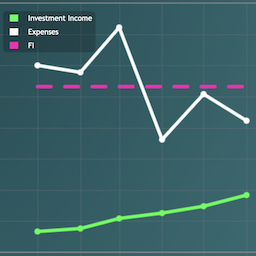
My wife and I are pretty much in total agreement about FI and jointly review the steps we’re taking to get there. It’s interesting to see how you guys are working things out in an alternate scenario.
I suppose you’ll stop working when you reach FI, and she’ll continue to work, then? If so, how do you think this will affect the dynamic of the relationship (if at all)?
That’s awesome both you and your wife are in total agreement about FI! I am a bit jealous because I’m sure it makes making some of the more extreme frugal decisions a bit easier (sometimes it’s a hard-sell for me since she’s not trying to pinch every penny).
To answer your question, my wife will definitely still want to keep working after I leave my 9-to-5 but I really don’t think it will change our relationship. The main reason is because I envision being even busier after I leave my full-time job. This isn’t something I’ve written much about yet but I plan to in the future. I see my post-FI days as being even more active and productive than they are now (I’ll just be doing work that I want to do, instead of what my boss wants me to do). So to her, it will still seem like I have a job because I’ll be busy and will still be contributing equally to our expenses…I’ll just be in a much better mood!
That makes good sense; thanks for the answer. It’ll be interesting to hear your post-FI plans in later posts.
We also do the “yours, mine and ours” accounts. It works out for us. My wife is slowly coming aboard on wanting to retire early, but like your wife she LOVES her job.
The only comment I disagree with is the “hassle to setting up separate accounts.” It is really no more hassle on ING than adding a column to a spreadsheet. But, I also understand, different systems work for different people and yours works for you.
Also, just found your website. So far I am really liking it. I’ll have to add it to my read rotation at work.
Cheers!
Brian, I’m glad to hear you and your wife do the same thing! I read this article over at Budgets Are Sexy today and I started to think I was a jerk husband for having separate accounts!
I also appreciate you letting me know how easy it is to set up ING sub-accounts. I actually hadn’t tried it before (because I was using the spreadsheet method before I became an ING customer) so I didn’t realize how easy it actually is. I’ll probably still keep using my spreadsheet, since that’s what I’m used to, but I’ve updated the article so that people don’t rule out the ING method.
Thanks again for the input and thanks for reading!
Hah! For some reason I just got a notice you linked to a post on my site last year :) A guest post at that – I had my finances separate from my wife for years until we recently merged ’em! So no shame in that if it was/is working… I just started getting all minimalism over here and needed simpler way to manage everything ;)
See you at FINCON this week.
Haha, that’s really weird. This is one of my first posts and it hasn’t been touched in over a year so I have no idea why you’d be getting notified about it now.
Simple is definitely good and since it is a bit of a pain keeping track of who spent/owes what every month, I could definitely see us merging at some point down the line as well.
I hope the road trip to FinCon is going well. See you in St. Louis tomorrow!
Hey – I just stumbled across this post as well. I saw the addendum that your wife is now a fientist (exciting!) but hypothetically, if she continued on a separate path, what tax advice would you give? I assume you should file separately, especially after quitting your 9-5 (and you are converting traditional IRAs to Roth IRAs etc). Are there anything else one should consider when in a separate finance situation like the one described above?
I’m not exactly sure, Dave.
It’s been easy so far because we both make roughly the same amount each year so we’ve just been filing jointly.
Married Filing Separately is one of the worst ways to file your taxes so hopefully we can avoid that but there are many things that could complicate filing jointly when we make the big move next year (e.g. she’s not a US citizen, she’ll be working in the UK, I won’t be working at all, etc.)
Since we’re going to be living abroad for most of the year, it is either going to be straightforward or pretty complicated, depending on whether we’re out of the country for long enough to qualify for the Foreign Earned Income Exclusion.
I’m sorry I don’t have the answers now but I will definitely be researching this more as we get closer to moving next year so I’m sure there will be some good articles that come out of that research.
Sounds good – I am a number of years away from FI myself, so I can wait! But tax stuff is definitely the thing that looms over me as I think about my plans for when I do quit my job. If I find any new info, I shoot it your way as well.
I’m in a similar situation- about 10-15 yrs out from FI. My wife wants to continue working when I retire. Trying to decide the best way to go about the Roth ladder with her still working. Perhaps you could look into this do a post on the best course of action- I’m sure many of your readers are in the same situation. I wonder what the implications are if she takes 1-2 years off so I can convert a larger portion of IRA to roth vs us filing separately so I can do the roth ladder on my own.
Good idea, Mike. This is actually something I’ve been thinking about recently because I will be in that exact situation soon; my wife will still be working and I’ll be trying to convert as much to my Roth as possible.
I’ve added it to my list of topics to research so stay tuned!
MF, just saw this post. Wouldn’t there be no effect of a spouse working except if one try to contribute to IRA? I thought conversion ( from 401k and Traditional to Roth IRA) does not look at spousal income?
Mindset of my SO is to first get a high income and become financially independent of off that possibly,which makes her road to becoming FI at least 20 years long,while me being FI in 5 years(won’t retire immediately).Haven’t yet tried to mention lifestyle inflation that comes with choices but I respect her goals as Im glad she respects mine.If she were however to dig herself into debt then we’d have a problem though.
Though we’re both frugal it takes teamwork and understanding in my opinion to be on the same spending level when it comes to basic expenses.
My wife has no concept of the “RE” portion of FIRE. On the ONL site, Mrs. ONL suggested I ask her what she wants/desires for her future. I can’t seem to get past the concept before she jumps to “Oh yah, Right” pops out. Yet, she is concerned whether she can physically keep working until 591/2. I think I am going to ask her about her goals/my goals and start the discussion there. We are 55 and 51 with a nice sum in investment, no mortgage or other debt and 60 – 100% of our son’s college costs saved for.
Any idea’s would be appreciated.